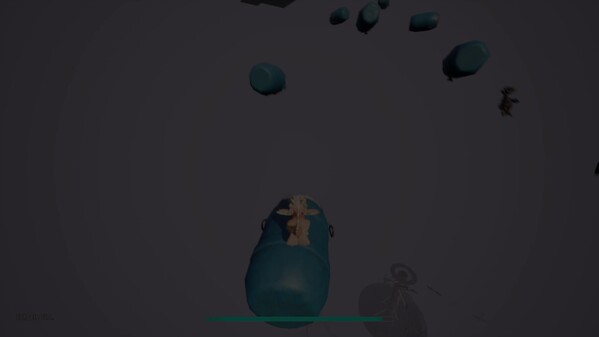
Way of the Dragons, developed and published by Said Yavuz, is an early-stage indie project that builds its identity around chaotic traversal, playful physics, and emergent multiplayer interaction rather than structured progression or narrative depth. It presents a simple concept—control a small dragon and climb your way upward through obstacle-filled environments—but frames that idea as a sandbox for unpredictable, often comedic moments. The result is a game that feels more like a social playground than a traditional platformer, with its appeal depending heavily on how players engage with its systems.
The core gameplay revolves around vertical movement. Players guide their dragon through a series of platforms, hazards, and environmental challenges, using jumping and climbing mechanics that are intentionally loose in their handling. The physics-driven movement is not designed for precision so much as adaptability; slight miscalculations can send players tumbling downward, forcing them to recover and try again. This creates a constant push-and-pull between progress and failure, where each successful ascent feels earned precisely because of how easy it is to lose ground.
Where the game truly distinguishes itself is in its multiplayer interactions. Rather than focusing solely on platforming skill, it introduces the ability for players to physically interact with one another—grabbing, pushing, or throwing others off course. This transforms the experience into a mix of competition and improvisation, where cooperation can quickly turn into sabotage. The unpredictability of human interaction adds a layer of tension and humor that the core mechanics alone would struggle to sustain. In multiplayer sessions, the game often shines, as the chaos generated by multiple players creates memorable and dynamic scenarios.
Level design complements this approach by emphasizing verticality and hazard placement. Obstacles are arranged to encourage both careful navigation and opportunistic interference, allowing players to take advantage of others’ mistakes or create new ones. While the current selection of environments is limited, the structure itself supports a variety of outcomes depending on how players interact with it. Each attempt can feel different, not because the level changes, but because the interactions within it do.
Visually, the game adopts a simple, colorful style that aligns with its lighthearted tone. The environments are easy to read, which is important given the fast and often chaotic nature of gameplay. Character design leans toward charm, with small dragons that add personality without complicating the visual clarity. While the presentation lacks detail and polish, it serves its purpose effectively, keeping the focus on movement and interaction.
However, the game’s Early Access status is evident in several areas. Content is currently limited, with only a small number of maps and mechanics available. This makes the experience feel repetitive over time, particularly for players who engage primarily in solo play. Without the variability introduced by multiplayer, the core loop can quickly become predictable. Additionally, technical roughness and balance inconsistencies occasionally disrupt the flow, reminding players that the game is still in development.
Another noticeable limitation is the absence of deeper progression systems. There are no significant upgrades, unlockable abilities, or long-term goals beyond improving performance within individual runs. While this simplicity keeps the game accessible, it also reduces long-term engagement, as there is little incentive to continue beyond the immediate enjoyment of the mechanics. The experience is best suited for short sessions rather than extended play.
Despite these shortcomings, Way of the Dragons shows clear potential. Its central idea—combining physics-based platforming with direct player interaction—is strong, and when fully realized, it can lead to genuinely entertaining moments. The unpredictability of multiplayer gameplay gives it a unique identity, setting it apart from more traditional platformers that rely solely on level design for challenge.
In the end, Way of the Dragons is a promising but incomplete experience that succeeds most when played as a social, chaotic platformer rather than a structured adventure. Its strengths lie in its emergent gameplay and accessible design, while its weaknesses stem from limited content and a lack of depth. For players interested in experimental indie titles or looking for a light, multiplayer-focused experience, it offers enjoyable moments, even if it has yet to fully reach its potential.
Rating: 7/10