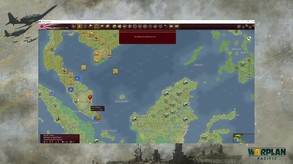
WarPlan Pacific is an operational level wargame which covers all the nations at war in the Pacific theatre from December 1941 to 1945 on a massive game scale.
Modeled estimate, not a reported figure. How we estimate →
Discounts
Every price cut of more than 20% we have observed, in each market that quoted one, with this game's chart position on either side of it. These are episodes, not a model: a sale is one event, and one event cannot tell you what the next one will do.
Reviews, worldwide (the counter carries no country): 0/day in the week to Jul 23 → 0/day in the week after.
For scale, across Steam · Top Sellers · Brazil over the last 30 days: the 25 chart moves that followed a price cut of more than 20% went a median of 10 places towards #1, and the 2,413 moves with no price cut behind them went 2 away. One store, one chart, one country — it is the only place we have enough observations to say even that.
Prices outside the United States have been collected since 6 August 2026 and chart positions since 19 July 2026, so a cut older than that has no market to compare and a market that joined later has no history yet. Nothing here is converted between currencies.
About
Engagement
Reviews
Themes across 41 recent reviews and how positive each mention is. A keyword signal, not full sentiment analysis.
Reviews
Although the game has many outstanding characteristics, it is fatally flawed in two respects - carrier strikes and amphibious operations. This largely makes the game worthless as a realistic wargame. As regards carrier operations a player has no choice of targets; AI makes that decision, and it does it badly. If a player is smart, he will bring a lot of torpedo boats along with his carriers, as AI, it seems especially with the U.S., will attack them in preference to carriers. Works the same with other ship types as well. I can see the pilots saying, "look, there are carriers and torpedo boats in the enemy fleet (it must be they look about the same). Lets forget about the carriers and go for the torpedo boats." Think the Americans would have won the war if they just sank all the Japanese torpedo boats? The game's amphibious operations are a real hot turd. For some odd reason you can only attack an island with a single marine division, although the Japanese can defend it with a full infantry corps. This is despite the fact that the Americans attacked Iwo Jima with a full marine corps. Also, the Japanese, even at Iwo, only defended with a single division. Blockading the island, which is totally unhistorical, does not apparently reduce the Japanese strength, but only prevents them from receiving reinforcements. So the U.S. is forced to attack at low odds, expends all his operations points, and is reduced to total ineffectiveness. The U.S. cannot reinforce the attack (as only 1 ground unit can stack in a hex), nor can they withdraw from the hex. So, they just run out of supply and it there. This protects the Japanese against a future invasion, as while the U.S. beached division remains in the invasion hex, another U.S. unit cannot be brought in to continue the attack. Any credible U.S. WW2 War in the Pacific game revolves around realistic carrier operations and island amphibious invasion operations. The game handles these incredibly badly. As a result, no matter how well developed other aspects of the game are, the failure of these 2 aspects of it makes it a waste of time to play as a realistic historical simulation. This shortcomings could be fixed and I talked with the game's developer about doing so, but he had no real thoughts on the matter, pointing out that ships could bombard the hex to help boost the combat odds. The fact that the Japanese decided by 1943 to not take a defensive position on the beaches but instead go inland and take position inside of caves, underground tunnels, and on the reverse side of mountains, in order to largely negate such bombardment, seems not to have been understood by the developer and his lack of knowledge of carrier and amphibious operations is profound. So if you want to play a fun and well thought out game on the era, this game is worth looking at. But if you want to play a serious historical simulation, it is not. And that is too bad, because it could be fixed. Sadly, with the current mindset of the developer, it is not likely to be, and that is a shame. If I could get my money back for this game, I would.
Media

Related
Related
Price dynamics, follower growth, revenue and sales trajectories with interactive tooltips
This and every other Pro feature is free until October 20, 2026. A free account is all it takes.
Related
| Game | Estimated lifetime revenue | Reviews | Review score | Price |
|---|---|---|---|---|
| $61.4K | 214 | 84% | $9.99 | |
| $61.4K | 136 | 93% | $19.99 | |
| $61.4K | 87 | 85% | $39.99 | |
| $61.4K | 312 | 94% | $7.99 | |
| $61.3K | 136 | 99% | $19.99 | |
| $61.4K | 170 | 82% | $18.99 |
Related
| Game | Estimated lifetime revenue | Reviews | Review score | Price |
|---|---|---|---|---|
| $508.9K | 905 | 95% | $24.99 | |
| $72.1K | 244 | 82% | $11.99 | |
| $2.4K | 109 | 88% | $0.99 | |
| $3.9M | 4.2K | 85% | $39.99 | |
| $3.1M | 5.1K | 78% | $19.99 | |
| $2.1M | 2.7K | 92% | $29.99 |
Genres
Stats
All-time low is the lowest price we've recorded for this game since we started tracking it.
Languages: English**languages with full audio support
Hours played at review time, across 41 reviews with recorded playtime.
positive critical· bar length = how often the theme comes up
Not sure what to say. I am very impressed with this game. It is a little different than the normal turn based war games. I have all the Grisby monster games, but this one is just simplified enough to keep making you want to do one more turn. I am not or ever been a number cruncher and never been consider a 'grognard' and probably never will be. I am retired, but a part time job, 2.5 acres and just life keeps me pretty busy. My first board game was 1914 and I was 14 y/o when I bought it with my own money, mail order. There were no gaming stores near me. Then is when I knew I had to get a computer as I did not have opponents to play against. Needless to say, I retired from the IT world three years ago.I keep saying I will start WITP-AE again, or WITW or East, but I get the initial phase done and I am tired, lol. WP I can crank out a couple turns a night. You have to think very carefully. But everything is so streamlined, it makes it easy and fun! Been playing as Japan even though it is recommenced to play as the allies, but Japan is very challenging. The game is a job very well done. Thank-you!
Sorry, I wanted to like this game, but it just doesn't work. The AI is totally stupid, many important pacific islands are missing, the invasion mechanics are bad (there is no reason to ever buy marine divisions, you must use Army Corps to have any chance of success...its a long story), the supply rules are very strange, etc. Now, to top it all off, playing as the Japanese, it is obvious that the AI cheats. I just attacked a task force that has more than the normally allowed 20 ships, including 11 of 6 allowed CVs, with submarines included in a surface task force. The US arrival schedule also brings in CVs long before they were commissioned historically (can't even get the historical arrival dates right). It is a somewhat interesting game, but not a good simulation. Buy it on sale (max $10), play it with a human opponent, and don't expect anything historically accurate, and it may be somewhat interesting, like chess or something. Sorry, I like to stay positive, but I just can't. I guess the music is good, and the graphics are OK.
Many positive comments here but this game just not my cup of tea. I like strategic games but this one is too randomized. 2:1, 4:1 those numbers are too vague, I had many times losing more infantry than opponents in a 4:1 battle, sometimes 2:1 results are even better. Enemy retreat or not is very random. The fleet interception is very random. The results of the sea battles very random. I know every battles behind there are some calculations but these are very vague and random. I can just save/load to get a better results. Also the fog of war is no fog at all, the lands units are revealed throughout the whole map even 10000km away, I can see which island has defence and which island is empty, this makes conquer very easy.
The more I've played WarPlan the more I've enjoyed it. I also own its only real "competitor" which is War in the Pacific AE. WitP is a classic wargame, but as other reviews point out it is micromanagement intensive and takes a very long time to play. What I've noticed playing both games is that the same operational moves tend to play out in both games. WarPlan just plays 100x faster. Overall, WarPlan Pacific is an excellent balance of detail and abstraction. I prefer the way WitP models submarine and air combat. However, the cost of that level of detail is an insanely detailed equipment, logistics, and pilot management system I do not particularly enjoy micromanaging. This is the rare wargame that is deep enough for veteran wargamers and accessible enough for newbies to the genre to enjoy. If you don't know hex and counter wargames and want to give them a try, this is a great place to start. Pros +Easy to learn, hard to master rules and gameplay that give you the "one more turn...." itch. +Operations flow realistically (based on my knowledge of the pacific war, anyway). +Logistics system matters, but mostly runs under the hood. No micro required. +Clean, crisp presentation and lots of tool tips. Easy to spice up the terrain and counters with mods. Cons -Sub and plane units don't work as well at WarPlan's level of abstraction. For subs in particular I'd rather just allocate subs to operational areas like the game allows you to do with convoy escorts and see any combat results in the turn reports. -It would be nice if units had a bit more character. I know the game purposely avoids detailed ToEs but even silhouettes on the unit detail cards would make things feel a little less abstract. -Single use landing ship and supply truck mechanic is a bit goofy.
It's much easier to get into than War in the Pacific AE. Not very historically accurate since the designer wanted ease of play versus accuracy. Strongly recommend playing with the Small Fleet campaign as that at least somewhat recreates how fleets operated in the Pacific Theater.
This game tries hard, but too many 'features' are completely unimportant. In seven hours I mastered the system, and wrecked Japan (playing as the Allies in the 1942 campaign). The AI is weak, remaining on the defensive almost exclusively. The combat system does capture the slow claustrophobic nature of ground combat on the mainland and New Gunia, but the island invasions feel very much like medieval sieges. Logistics is key to everything, which is good, but the player has almost zero control over supply. You cannot build, or even expand, naval bases; airfields can only handle one air unit. When all is said and done, you are stuck in a situation of very limited options and zero replay-ability. Don't waste your money.
(Overall Rating 4/10... maybe 5/10 on a good day) I cannot reccomend this game in good consciousness, while there are some interesting mechanics that this game adds and I would not describe it as a horrible game. Its just Average. It tries to fit in between the Strategic Command games and Gary Grisby War In Pacific and I find it unable to execute this properly. Now lets start with the good stuff, there is a limited system where ports can be expanded(more on this later in the negatives) and the 1942 start date does make you feel as if your on the backfoot as the Allies. Ground Combat in Burma and in China seems fairly accurate and while I do feel like the combat is a bit random (the odds only saying you have a higher chance to deal casualties, smaller odds can still succeed just need luck). Finally I do like the carrier Interdictions and the Surface Interdictions that can occur allowing you to place your fleets in an offensive position and not get alpha striked for daring to be the first to move. Now on to the negatives, the biggest negative is simple... the AI is bad like really bad. I had the AI decide to bring its last six carriers and 4 battleships + escorts into a port surrounded by allied islands filled with planes and super far behind. Supplies are super important in this game (as they should be) but two things 1: you have no real way of influencing how much supplies are delivered (make sure you have merchant ships to transport supplies, air transport for units out of supply) the only real thing you can do it expand ports which is a cool and unique mechanic... if you could pick and choose what islands to expand the port of unfortunately the Dev has chosen a handful of islands and thats the only islands you can expand, Okinawa for a launching base to japan... nope that cant be expanded, taiwan same thing, Iwo jima, Guam ect... all islands that in my campaign I would have loves to expand the ports but couldnt because the game said so, worse part the Dev says its for historical accuracy (the US only build up those ports so the others cant be done) which is... inaccurate in my oppinion, your telling me Truk cant be expanded, or taiwan. Anyways 2: Fleets can only be out for 2 turns before their effectiveness renders them practically useless in any combat, what does this mean well you go out for one turn fight and then go back to port and sit there for 2-5 turns to get enough effectivness so you dont die, I just feel that its either too punishing and innaccurate that a fleet (which the americans mastered having supply ships for those fleets) would become crippled and incapable of fighting because it was at sea for 2 weeks. Now my biggest two issues with the game, 1: the fleet combat feels so random and inconsistent and 2: the Island hopping campaign is badly respresented 3: minor third point, taking japan was easier than taking islands which is weird. Now to expand on those points, Fleet combat feeling random and inconsistent I cant explain this too much other than providing three examples. First battle Starting USA carriers in 42 (Enterprise, Lexington, Saratoga, Yorktown, Wasp and Hornet) vs Japan main carriers (Akagi, Kaga, Shokaku, Zuikaku, Hiryu, Soryu) similiar BB and escorts numbers, 4 japanese sunk carriers to 1 american carrier. (happen north of Guadacanal). Second Battle Same previous carriers minus sunk ones so 5 American vs 2 japanese, lose 1 american carrier deal 0 damage to japanese. Third (most atrocious in my opinion) I have 4 carrier fleets (6, 5, 5 ,3) against 6 light carriers/escort carriers and I lost 4 american carriers, dealt light damage no sunk (while fighting near my islands so I had planes supporting) and I believe I may have lost a BB or two (maybe some escorts.). Now for the Island Hopping campaign complaint... quite simply you just siege the islands no fighting. Grab a fleet (should be able to defend itself from air or suprise navy attacks) grab a marine division (can be any division really) and have your main carrier combat fleet sit nearby in a port within range to rush over and fight the ♥♥♥ navy. Then the most important part... wait three months japanese are now out of supply from being blockaded and you just attack them on the 3 turn (sometimes you need to attack on turn 4-5) then the japanese unit either dies fully or surrenders. Thats your island hopping campaign rinse and repeat X amount of times (X being island you want to take) This means that an island is taken roughly in 1-2 months and as soon as the battle is done the unit needs 3 months of R&R, which just means you grab another unit that was waiting for fleet escort and do it all over again. Invading bigger islands (taiwan, Philipines, New Guinea, Borneo ect...) is more complicated and does feel accurate. But Iwo Jima, Okinawa and all the other islands are just boring medieval sieges . Now finally, maybe I got lucky, maybe the japanese situation in 44 was just that bad but I took all of Japan in 2 months and one week (the extra week technically being from the turn it took for them to surrender.). Basically I invaded Kyushu (south west Island) and the Shikoku island with around 13 division (I took 3 ports on the initially invasion.) Turn 2 I invaded Hokkaido and north east main island capturing Hokkaido the following turn and all of North east Honshu. Turn 3-5 was closing the trap, grinding units (bringing tons of AIr) parking my fleet next to the tile I was attacking. Finally Turn 6 Tokyo fell, Osaka and Kyoto were the only main cities remaining for them. Honestly this was the most interesting Invasion and was fun... but the game made it out to be a grinding hell to take japan and it didnt really feel like that after turn 4. On top of that I took Okinawa (the island I was most unlucky with) took 3 months to fall, and Iwo Jima took 2 months. Anyways thats the review If you can look past those faults theirs an okay game beneath there but personally not gonna play this again. A shame because I did like the Warplan Europe game.
WarPlan and WarPlan Pacific are both decent games worth trying. The games have limited replayability and as such are not worth the full price. The game design is complex, interesting and differs in some respects from other hexagonal strategies. Especially the land & air war feels nice and innovative. The naval system on the other hand is odd, a bit clunky UI-wise and unrealistic in several respects. For example, fleets can sail right through any number of enemy fleets and/or next to enemy-occupied land full of aircraft completely unmolested as long as they don't stop near the enemy. Also the naval AI is rather bad and underperforms severely. Reading the longish manual is a must as many critical mechanics are not explained in game. Fortunately the manual quality is good. In the game you play an entire alliance, Axis or Allies, rather than individual countries. This means that it's not possible to play e.g. the USA or the western allies without being saddled with the Soviets as well (or China and Soviets in Pacific). This design also significantly reduces replayability as each game can essentially be only played twice before you must start re-playing the same. While alternative historical start dates and some other random scenarios are included, they lack the quality and scope of the full campaign. On the plus side, the full campaign is quite long and provides many hours of play. Overall, the game is a paradox - it would take many runs to master the rules, yet there are just two full-length campaigns per title to practice with. Of the two, Pacific is the slightly less valuable title due to the significance of naval war (which as said is the weaker part of the game). Also the Pacific war is simply significantly shorter, leading to a shorter campaign. While there is a separate China campaign, it ends in 1939 and does not tie in to the war starting at Pearl Harbor.
Viniendo del War in the Pacific AE me resultó al principio bastante desafiante porque sin darme cuenta trataba de llevar la campaña del mismo modo que en ese juego y no tiene nada que ver. Una vez le coges el tranquillo es un juego muy ameno y con bastante más sustancia del que parece a simple vista. Muy recomendable y además barato.
Selling now
See how fast this game is selling right now — estimated copies and revenue per day from recent review growth.
Players by region
Where this game's players are, estimated from review languages.