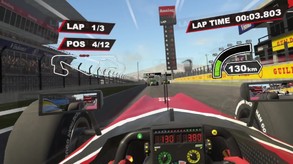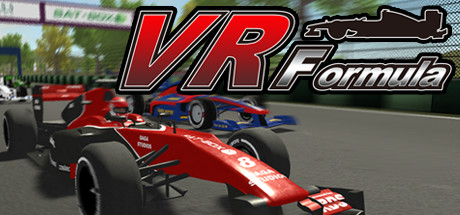
Ultra-fast VRFormula is officially here! Feel the 300km/h sensation in VR! Easy operations and simple rules make anyone a F1 racer!
Modeled estimate, not a reported figure. How we estimate →
Media

About
Stats
All-time low is the lowest price we've recorded for this game since we started tracking it.
Languages: English, Simplified Chinese, Japanese
Engagement
Reviews
VR Formula is a racing game developed and published by SAT-BOX that brings high-speed Formula-style competition into a virtual reality environment built around accessibility and fast-paced excitement. Instead of pursuing full motorsport realism with complicated vehicle systems and simulation-heavy mechanics, the game focuses on delivering the feeling of speed and immersion through straightforward arcade racing design. The result is an experience that emphasizes instant enjoyment and virtual cockpit intensity rather than technical authenticity. The core appeal becomes clear almost immediately. Players take control of lightweight Formula-inspired race cars capable of extreme speeds while navigating tracks designed to reward precision and consistency. The game’s identity revolves around movement and momentum. Every straight section feels like an opportunity to push limits while corners demand timing and control to maintain competitive lap performance. The racing remains approachable enough for beginners while still rewarding players willing to refine driving technique. Virtual reality serves as the central feature rather than a secondary addition. Sitting directly inside the cockpit dramatically changes how speed is perceived. Corners feel tighter, acceleration carries greater impact, and high-speed sections create stronger immersion than traditional racing games can easily provide. The perspective strengthens tension during close racing moments and gives the experience a greater sense of physical presence. SAT-BOX clearly designed VR Formula around accessibility. Instead of overwhelming players with complicated setup options and advanced racing simulation systems, the game keeps mechanics understandable and immediate. New players can quickly begin learning track layouts and vehicle behavior without spending extensive time studying deeper motorsport concepts. The simplicity lowers the barrier to entry while preserving enough challenge to maintain engagement. Vehicle handling supports this philosophy effectively. Cars remain responsive and manageable without becoming completely effortless to control. Success still depends on understanding racing lines, braking points, and momentum management. Faster lap times require stronger consistency and familiarity with individual circuits, creating progression that feels earned through practice rather than artificial unlock systems. Track variety helps strengthen long-term replayability despite the game’s more focused scope. Different circuit layouts encourage adjustments in driving approach, forcing players to adapt depending on track demands. Some races reward aggressive speed while others place greater emphasis on corner precision and maintaining rhythm across technical sections. The changing demands help prevent progression from becoming repetitive too quickly. Leaderboard competition adds another layer of motivation. Even without expansive career progression systems, the pursuit of stronger lap times naturally creates reasons to return. Racing games often thrive when players chase personal improvement, and VR Formula successfully captures that mentality. Improving performance by fractions of a second becomes rewarding because every small gain reflects better understanding of vehicle handling and circuit mastery. Visually, the game prioritizes functionality over spectacle. Environments remain readable during high-speed driving and cockpit visibility stays clear enough to support competitive play. Rather than pushing for maximum visual realism, VR Formula focuses on maintaining performance and usability, which becomes especially important in virtual reality environments where responsiveness strongly influences comfort. The arcade structure becomes one of the game’s biggest strengths. VR Formula never attempts to become an enormous racing simulator filled with advanced mechanical systems and endless management options. It understands that some players simply want the excitement of racing without navigating overwhelming complexity. That clarity of purpose allows the experience to remain focused and enjoyable. One useful addition comes through support outside virtual reality hardware. Although the experience centers heavily around VR technology, players without headsets still have ways to access the racing systems. That flexibility expands accessibility and gives players opportunities to experience the game according to personal preferences and hardware availability. The experience does reveal limitations depending on player expectations. Racing enthusiasts seeking advanced simulation realism, extensive vehicle tuning systems, or large-scale content variety may discover a more streamlined experience than anticipated. The simplified mechanics intentionally prioritize accessibility, but some players may desire greater depth over longer play periods. Presentation also remains relatively modest compared to larger racing franchises. VR Formula focuses resources on maintaining enjoyable gameplay rather than competing visually with major racing productions. Players expecting premium simulation polish may notice those differences quickly. However, the game succeeds because it stays committed to delivering a specific type of racing experience. SAT-BOX builds around speed, immersion, and immediate enjoyment rather than excessive complexity. The virtual reality implementation strengthens arcade racing fundamentals effectively while creating moments of excitement that traditional displays cannot always replicate. VR Formula works best as an accessible racing experience designed to capture the thrill of high-speed motorsport through immersion and straightforward gameplay systems. It may not replace deeper racing simulations for hardcore enthusiasts, but players looking for fast competition and virtual reality excitement will likely find an enjoyable and satisfying experience behind the wheel. Rating: 7/10
Related
Related
Trends
Concurrent players on Steam, sampled daily since tracking started.
Hours played at review time, across 31 reviews with recorded playtime.
Audience
Estimated from the language of this game's reviews — a proxy for where players are, not official Steam demographics.
Related
| Forza Horizon 5 | $317.3M | 278.1K | 89% | $59.99 |
| Need for Speed™ Heat | $152.8M | 150.4K | 84% | $69.99 |
| Need for Speed™ Unbound | $106.2M | 58.8K | 60% | $69.99 |
| The Crew™ 2 | $16.2M | 99.4K | 78% | $5.99 |
| CarX Drift Racing Online | $38.5M | 89K | 95% | $16.99 |
Related
| FLASH AND DIE | $9K | 58 | 88% | $4.49 |
| Prehistoric Tales | $9K | 114 | 75% | $2.99 |
| Orb Tower | $9K | 195 | 96% | $1.99 |
| Working Daily | $9K | 93 | 88% | $3.99 |
| Cult of the Yellow King | $9K | 121 | 83% | $2.99 |
| Future Wars | $9K | 310 | 30% | $0.99 |