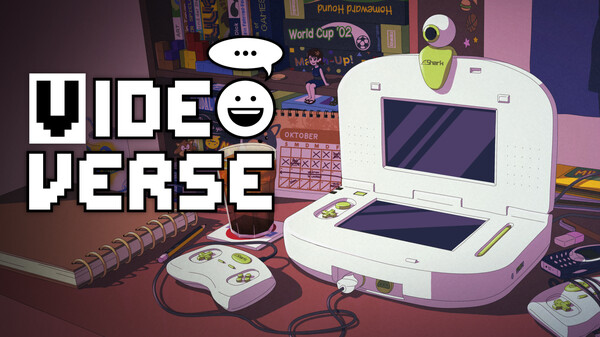
Relive the days of the early internet and dive into this fictional video game era, where the 'Kinmoku Shark’ gaming system and its online social network 'Videoverse' were still popular…
Modeled estimate, not a reported figure. How we estimate →
Media
About
Relive the days of past social gaming networks in VIDEOVERSE – A decision-based narrative adventure focusing on character development, friendship and love, from the developer behind One Night Stand.
As Emmett, a young video game fan and aspiring artist, dive into this fictional video game era, where the Kinmoku Shark gaming system and its online social network, Videoverse, were still popular. Strengthen Emmett’s friendships, share fan art and browse the lively gaming communities. Make decisions that will change how Emmett grows, his approach to Videoverse and, ultimately, the final outcome!
Will your actions help Videoverse thrive, or will you get caught up in teenage drama, video game fandoms and corporate conspiracies?
VIDEOVERSE is inspired by Miiverse, MSN messenger, early internet forums and 00’s technology. The chill soundscape of the Kinmoku Shark, composed by Clark Aboud (Slay the Spire, Kind Words), will uncover memories of your favourite retro gaming consoles.
Meet a huge cast of characters, unlock multiple side stories, enjoy the pixel doodles, and seek out the truth behind the troubled social gaming network! Personalise your Videoverse experience by choosing your avatar, personal quote and favourite theme.
Accompany Emmett as he plays the Kinmoku Shark’s most popular JRPG, Feudal Fantasy. Swap theories and discover tips from other FF fans in its exclusive Videoverse community…and find out whether or not Hanzo will be able to stop the evil Nobunaga!
VIDEOVERSE contains several accessibility options:
Clear Font
Closed Captions
Colourblind Friendly Themes
Content Warnings
Sound, Music and Voice Volumes
Tip Button
Genres
Stats
All-time low is the lowest price we've recorded for this game since we started tracking it.
Engagement
Hours played at review time, across 40 reviews with recorded playtime.
Reviews
Themes across 40 recent reviews and how positive each mention is. A keyword signal, not full sentiment analysis.
positive critical· bar length = how often the theme comes up
Reviews
配信内で一部読み上げながら8時間でエンディングまで到達しました。 少し狭いコミュニティで、見知らぬ人と出会うことができるツールとして誕生したインターネットの新鮮さが描かれていました。 DMでやり取りするとき、相手がタイプしている間一瞬待たされるのがまたリアルで、こういった細かい拘りが随所に感じられました! 後半主人公が成長するにつれ共感できて、それぞれのキャラにも愛着がわきました。 ただ、ひとつ日本語訳が「プレイできないほどではない」のですが、ニュアンスの違いや不自然な点があり、キャラとのコミュニケーションを難しくさせているのでは…と思う点がありました。 これは言語の壁も関係あるのかもしれないですが、繊細な話題に触れるシーンで少しもどかしく感じて残念でした。 大まかなストーリーや雰囲気、キャラクター、ビジュアルは好きでした! 面白かったです!
A fun visual novel. Seems to have quite a bit of optional stuff to find.
Cute game. One of a very small subset of games that make me extremely wistful for the early days of the internet - the internet I grew up on. I enjoyed my short time with it.
VIDEOVERSE, developed and published by Kinmoku, is a narrative-driven experience that captures the spirit of early 2000s online communities with remarkable authenticity and emotional depth. Framed around a fictional social platform dedicated to fans of a beloved JRPG, the game blends visual novel storytelling with interactive social simulation. Rather than focusing on traditional gameplay mechanics, it centers on dialogue, relationships, and the evolving dynamics of an online space that feels both nostalgic and deeply personal. The story follows Emmett, a teenage gamer and aspiring artist who spends much of his time on the Kinmoku Shark handheld console and its companion social network, Videoverse. Through message boards, private chats, and public threads, players guide Emmett’s interactions with other members of the community. Conversations range from lighthearted fandom debates to vulnerable discussions about identity, friendship, and belonging. The interface mimics early internet forums, complete with pixel-art icons, emotive avatars, and familiar message board layouts, grounding the experience in a specific era that many players will recognize instantly. What makes VIDEOVERSE particularly compelling is its focus on relationships and choice-driven development. The decisions players make during conversations influence how others perceive Emmett and how friendships evolve over time. These choices are rarely framed as obviously “right” or “wrong.” Instead, they reflect the subtle social negotiations common in online spaces: when to support a friend publicly, when to confront negativity, and when to remain silent. The writing treats these interactions with care, portraying online friendships as meaningful and sometimes fragile connections that can shape personal growth. The game also explores the impermanence of digital communities. As the narrative unfolds, Videoverse faces an uncertain future due to corporate decisions and shifting technology. This looming shutdown adds emotional weight to every interaction. What initially feels like a simple coming-of-age story gradually becomes a meditation on digital ephemerality and the importance of spaces that allow people to connect authentically. The impending loss of the platform underscores how online communities can profoundly influence identity and memory, even if they eventually disappear. Visually, VIDEOVERSE embraces a pixel-art aesthetic that reinforces its early-2000s setting. The interface design captures the charm of old forum layouts and handheld gaming menus without feeling outdated. Small details, such as animated typing indicators and expressive avatar reactions, contribute to immersion. The soundtrack, subtle and atmospheric, supports the tone without overwhelming the dialogue-driven format. Together, the art and audio create a cohesive experience that feels like stepping into a preserved slice of internet history. The pacing unfolds across multiple chapters, mirroring the passage of time within the community. As weeks progress, relationships deepen, tensions arise, and personal revelations surface. The narrative structure allows for multiple endings, reflecting the cumulative effect of player choices. While the core storyline remains consistent, the nuances of how characters grow or drift apart depend heavily on how players engage with them. This replayability enhances the emotional investment, encouraging reflection on different conversational paths. Beyond nostalgia, VIDEOVERSE tackles themes of inclusivity, creative expression, and the search for belonging. It portrays the internet not merely as a source of conflict or escapism, but as a meaningful space where individuals can explore identity and find support. The game does not shy away from addressing harassment and misunderstanding, yet it balances these heavier moments with warmth and humor. The result is a narrative that feels grounded and empathetic. Ultimately, VIDEOVERSE succeeds as a heartfelt exploration of digital connection and personal growth. By focusing on the social fabric of an online community rather than conventional gameplay challenges, it delivers a reflective and emotionally resonant experience. Its blend of nostalgic presentation, nuanced writing, and meaningful choice makes it stand out among narrative-driven indie titles. For players who have ever found friendship, creativity, or comfort within an online space, VIDEOVERSE offers a thoughtful and memorable journey through the echoes of a digital past. Rating: 9/10
Videoverse is another in an increasingly popular genre of "fake OS" simulators that I think was really made popular by Hypnospace Outlaw. It's really a visual novel wrapped up in a retro computer interface, in the vein of the Emily is Away games. Like those games, this one was really relatable for me as a kid who spent much of the early and mid-2000s online. Videoverse is centered around a small community of fans of a fictional gaming console, the Shark, that is slowly being phased out in favor of the new console, the Dolphin, and the community is being shut down. You play as Emmett, and post in little forum communities and have friends you DM and even dabble into romance. It's a concept I think anyone who's between the ages of around 28-35 can really relate to if you were a fan of nerdy things as a young teenager. I myself spent a ton of time in gaming forums and in chatrooms like MSN Messenger, and while many of those services have shut down or are ghost towns these days, those memories are still important to me and I think have influenced my life and career choices as an adult. Videoverse does a great job of capturing that sense of nostalgia for me, maybe the best of all these types of games. The story is a little too sweet, a bit saccharine, but it's earnest and relatable and doesn't overstay its welcome. If you have any nostalgia for hanging out in forums or chatting with your online friends on MSN, check this one out. It's only a few hours long and well worth a few bucks. In this age of everything being on Discord and the near-total mingling of our personal and online lives (a total departure from back then - remember when you weren't even supposed to give out your first name online?), Videoverse is a nice trip down memory lane, especially for people of a certain age and interests.
Pretty decent game. It did take me back to when I used to hang around on Gaia Online and FF.net forums, talking with other people with similar interests and eventually losing contact with those people. The game balances out the bittersweet and frustrating moments with the more fun, jovial times.
I really enjoyed the game and achievement hunting. The story was nice and gave a bit of an Emily is Away feel where you can interact on a social media that feels nostalgic even though it isn't based off of something like AIM or Facebook.
really touching story about being a teenager who loves video games on early 2000's proto-social media. Haven't played all the paths, but the writing is lovely.
I thought I’d be over this in no time… ended up spending the whole day playing it. It made me incredibly reminiscent of my teenage years.... And the dialogues were so realistic, sometimes even painfully awkward, I tried to exit them and make charackters stop talking at some point...still, minutes later I kept diving in for more... I got so emotionally invested that I kept telling myself just 15 more minutes, and somehow hours passed. It’s been a long time since any kind of media made me feel like this. … maybe I should say how I feel to them ....teenage years may be long gone, but the fear of being rejected clearly has no age limit. I think i'll carry this game with me for a while...
The reason this is called a "retro game" instead of "historical fiction" is because the millennials are still in denial over the fact that they are old.
Related
Related
Trends
Modeled estimate over time, reconstructed from Steam's monthly review histogram.
Momentum
Pace estimated from the game's recent review growth (our daily snapshots) at its own sales-per-review ratio — a momentum signal, not booked sales.
Audience
Languages: English*, Japanese*languages with full audio support
Estimated from the language of this game's reviews — a proxy for where players are, not official Steam demographics.
Related
| Mercury Fallen | $92.3K | 316 | 78% | $9.99 |
| Chaos Galaxy | $92.3K | 300 | 83% | $14.99 |
| Rocket Science | $92.3K | 175 | 81% | $19.99 |
| 每日亲亲洛丽塔 | $92.3K | 400 | 76% | $8.99 |
| Warhammer 40,000: Space Marine - Master Crafted Edition | $92.3K | 390 | 53% | $39.99 |
| Creepy Tale 2 | $92.3K | 1.6K | 87% | $4.99 |