Varney Lake is a story-driven supernatural mystery that combines interactive fiction, retro horror, and coming-of-age drama within a deliberately compact adventure. Developed by LCB Game Studio and published by Chorus Worldwide Games, it is part of the Pixel Pulps series and carries forward the collection’s fascination with old paperback horror, strange phenomena, and vintage computer-game aesthetics. Rather than relying on complicated mechanics or constant scares, the game concentrates on atmosphere, character relationships, fragmented memories, and the unsettling uncertainty surrounding an encounter that refuses to remain buried in the past.
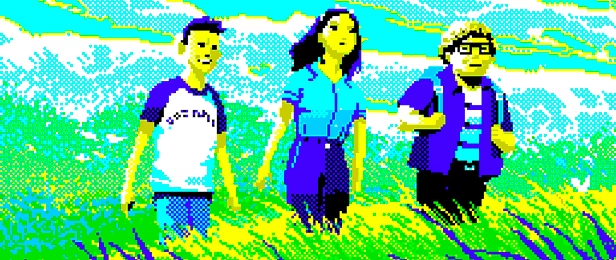
The narrative moves between two distinct periods. During the summer of 1954, teenagers Jimmy, Doug, and Christine spend their days around Varney Lake, enjoying the sort of adventures and minor troubles associated with youthful summer freedom. Their concerns include friendships, attraction, bullies, games, and an effort to save a local drive-in. This initially innocent atmosphere is gradually disrupted after they encounter a mysterious figure they believe may be a vampire. What begins almost like a nostalgic childhood adventure subsequently takes on a darker character, particularly as the consequences of that summer become increasingly difficult to understand.
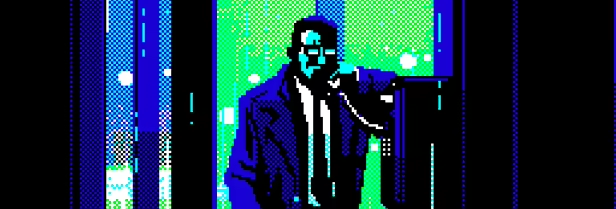
The other side of the story unfolds decades later, when paranormal investigator Lou Hill attempts to determine what actually occurred at Varney Lake. Jimmy and Christine are now adults, and their memories of the past become essential pieces of the investigation. This structure gives the game more depth than a straightforward vampire tale because recollection itself becomes part of the mystery. Memories can be incomplete, contradictory, distorted by time, or influenced by painful experiences. The player is consequently encouraged to examine not only what the characters say happened but also why different versions of events may not fit together perfectly.
Gameplay largely consists of reading dialogue and narration, making decisions, investigating circumstances, and completing occasional interactive sequences or puzzles. Varney Lake is much closer to an interactive pulp novel than a traditional point-and-click adventure. Choices provide opportunities to explore different possibilities, while branching elements give players reasons to revisit portions of the story. The decision-making is not overwhelmingly complex, but it helps prevent the experience from becoming completely passive and reinforces the feeling that the player is participating in the reconstruction of an unusual mystery.
The puzzles and minigame-like sequences are intentionally straightforward. They create variety between stretches of dialogue without significantly interrupting the narrative's momentum. Players looking for intricate logic puzzles or extensive mechanical systems may find this aspect rather modest, but the simplicity works within the game's priorities. Storytelling remains at the center, and the interactive elements exist mainly to support pacing and immersion rather than dominate the experience.
Its visual presentation is arguably one of its most memorable qualities. The pixel artwork draws heavily from the appearance of older home-computer games while also capturing the dramatic composition of vintage pulp illustrations. Limited colors, large pixels, expressive portraits, and carefully framed scenes establish a distinctive atmosphere without requiring detailed animation. Fernando Martinez Ruppel's artwork is particularly effective at transforming apparently simple images into moments that can feel nostalgic, eerie, or threatening depending on the context. The restrictions of the visual style ultimately become part of the game's personality rather than an obstacle.
The writing by Nico Saraintaris complements the artwork by keeping the narrative relatively focused. Dialogue establishes the personalities and relationships of the central characters without unnecessarily stretching individual scenes, while the supernatural elements are introduced gradually. The horror frequently comes from anticipation and uncertainty instead of continuous shocking imagery. The game contains violence, adult language, and darker subject matter, but its most effective moments generally rely on suggestion and the player's imagination. This restraint fits particularly well with the pulp-horror concept.
Varney Lake is relatively short, which can be either appealing or disappointing depending on expectations. Its limited duration allows the mystery to progress without excessive filler, giving the overall experience the rhythm of a short horror novel or an episode of an anthology. On the other hand, players seeking a lengthy visual novel, extensive exploration, elaborate puzzles, or substantial progression systems will find the experience comparatively small. Replay value primarily comes from investigating alternative choices, finding additional narrative material, and pursuing achievements rather than mastering complex gameplay mechanics.
Steam Deck compatibility is favorable from a practical standpoint. The game's lightweight presentation, straightforward controls, controller support, and emphasis on dialogue and simple interactions make it well suited to handheld play. It does not require demanding precision or extensive keyboard input, so the basic experience translates naturally to the Steam Deck. The retro artwork also works comfortably on a smaller display, although players should still be aware that official Steam Deck verification status can differ from practical playability as Valve updates compatibility classifications over time.
As a complete experience, Varney Lake is most successful when approached as an interactive supernatural novella rather than a conventional adventure game. Its mixture of youthful nostalgia, vampire mythology, decades-old secrets, unreliable memories, investigative storytelling, and distinctive pixel artwork creates an atmosphere that remains engaging even when very little is happening mechanically. The mysteries surrounding the characters provide the strongest motivation to continue, while the presentation gives the game an immediately recognizable personality.
Its concise length and simple mechanics may leave players wanting more substantial gameplay, but its strong atmosphere, memorable visual direction, carefully constructed mystery, and effective blending of coming-of-age drama with supernatural horror make it a compelling example of narrative-focused retro gaming.
Rating: 8/10