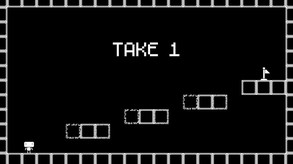
Triple Take is a fast 2D precision platformer where the stage evolves as you complete it! Run, wall jump, climb and swim through increasing difficult levels in vibrant colored worlds!
Modeled estimate, not a reported figure. How we estimate →
Media

About
Stats
All-time low is the lowest price we've recorded for this game since we started tracking it.
Languages: English**languages with full audio support
Engagement
Hours played at review time, across 40 reviews with recorded playtime.
Reviews
Themes across 40 recent reviews and how positive each mention is. A keyword signal, not full sentiment analysis.
positive critical· bar length = how often the theme comes up
Reviews
Absolutely loved the hours that I put into this game. I enjoyed collecting all of the scrolls and the difficulty of the levels (minus a spike from world 4 to 5). However, the third phase of the final boss was so incredibly frustrating and poorly designed that it has tainted my experience with the rest of the game. Spoilers and details ahead. [spoiler]The third phase is reminiscent of the Kraken boss in world 3. In the original fight, you play in a spaceship that has free movement across the screen in any direction. The bullet hell the boss produces is fun to dodge and weave, and you shoot at the boss from below in an attempt to defeat it. You also have 3 hits before you restart a phase (which can be healed by finishing a series of attacks by a dropped heart). Unfortunately, all of this contributes to a horrible whiplash in the final boss. The final version of this boss has you playing the regular 'Player'. You are able to jump and run, but cannot move in any direction like the spaceship could. The bosses attacks are of course 'enhanced' to meet your new skill since this is the last boss. In addition, you do not have to shoot the boss to win and you have 1 hit to defeat the phase (getting hit once sends you back to the start of phase 3). This provides a completely different context with which to beat the fight, but in the worst way imaginable. Going from indefinite health and high freedom of movement to 1 hit and much lower freedom of movement makes this boss a NIGHTMARE. Another thing I didn't mention is that this version of the boss does not pause between attacks, and is fully willing to go from a powered-up set of homing projectiles to a slog of fast-moving rain particles with no breathing room. It doesn't help that things like the new opaque glitch texture and the boss' face moving back and forth make it much more difficult to see where certain attacks are coming from. All of this in total makes for one of the fastest swings from a fun overall game to something I'm not sure I even want to complete. I know I could do it, but I'm not sure I want to spend the time it would take to get through it now that I know what I have to do for that to happen. [/spoiler]
This is a tough one. I mostly had fun. I mostly have a positive opinion of this game. But there are just too many things that detract from that positive opinion. (Minor spoiler warnings throughout). - Things that are too slow. Restarts after you die. Waiting for the boss to scream before it starts. Waiting for cycles (e.g. fire pillars). Far too much dialogue (maybe someone will appreciate this). - The whole "go into your file system thing"... I get it - it's part of the "story". But every time this came up, I felt very sad. I would very much prefer if these parts were taken out. And while we're at it - the dialog boxes too. - Hitboxes feel unfair. There were multiple times in the final boss where I died apparently from nothing, presumably because I got too close to an obstacle, yet the obstacle continued to move past me. From what I can tell, the game errs on the side of "if there is any overlap at all between the player's hitbox and the obstacle, then the player died". Which sounds reasonable, but generally always results in hitboxes that feel unfair. Instead, make it just a little more lenient. Give the player the benefit, slightly (or, adjust the hitboxes to be just a little more forgiving). Then adjust the difficulty by designing the levels and other gameplay around this. Unfair hitboxes are the wrong kind of hard. - I see that a lot of complaints about the bosses, especially the last one. I actually found the bosses pretty reasonable, except generally the hitbox issue mentioned above. And the screenshaking. - The movement is... fine, but not great. Platforming games with no acceleration and no deceleration at all very often have super precise and finicky controls. This game fits very well into that category. - Too many obstacles and game elements are exactly what I would call janky. The water - specifically, exiting the water, but also generally moving through the water. Bouncy platforms - specifically, controlling your bounce height (see previous point). Moving bouncy platforms... that you need to ride across spikes or other hazards... that bounce on platforms themselves... just yikes. Vines - specifically, jumping off of them. The cannon things (not sure what they are actually supposed to be) - specifically when they are moving. - The whole "do each level 3 times" gimmick ended up weak and forced, in my opinion. A large amount of the levels aren't variations of the same level, but are actually 3 completely separate paths that you are forced to take by blocks (or other level elements) that disappear. All of these are literally 3 different levels. Look at Never Give Up if you want to see a game that makes much better use of this gimmick.
Quick Score: 3/5 Notes: Based on the glowing reviews I was expecting a lot more than what I got. The "meta" elements of the game are honestly a bit annoying and don't add a whole lot. The story overall is meh. The gameplay is okay if you like platformers, but its pretty simplistic and not that interesting. Difficulty wise, I finished the game with all the scrolls in probably under 30 deaths if I had to guess, so it's relatively low. This isn't really a recommendation, but I didn't hate the game. If you can get it on sale it's not a bad purchase, but there are much better games.
Version longue : https://dystopeek.fr/jouer/triple-take/ Version courte : Une excellente expérience. Je m’attendait à un mélange low cost entre un Super Meat Boy et un VVVVVV, mais Triple Take m’a bien feinté avec ses solides arguments et une vraie personnalité. Ce petit jeu qui ne paye pas de mine a été une très bonne surprise pour moi qui ne suis pourtant pas la cible du genre. Une durée de vie de quelques heures, une difficulté proprement dosée et un petit prix : la définition d’une hidden gem indé qui mérite votre attention.
shockingly bad movement and level design for a platformer, jumping feels awkward and you're constantly hit with obstacles that make you wait or that simply aren't fun to interact with. but the worst offender here is how awful the springboard controls are, getting the proper bounce is extremely finicky for no reason and especially when you're jumping on to one off-screen it's a huge pain. and the writing is also very generic and lazy. baby's first meta narrative that needlessly forces you out of the game and into your file browser to do simple file tricks you've seen before
Triple Take is a precision platformer developed by FlyAway Studios and published by Bonus Stage Publishing that transforms a familiar side-scrolling formula into something far more unusual through clever design and surprising structural ideas. At first glance, it resembles a traditional retro-inspired platformer built around hazards, movement mastery, and increasingly demanding stages. However, the game quickly reveals a stronger identity through mechanics that challenge player expectations and reshape how progression works. Instead of simply pushing players through levels one time before moving forward, Triple Take builds its entire experience around repetition, adaptation, and unpredictability. The core idea immediately separates it from countless other platformers. Every stage requires three separate completions, but repetition never functions as padding or artificial length. Levels evolve after each successful run. Hazards shift positions. Routes transform. Familiar environments become unfamiliar. Players who believe they fully understand a stage quickly discover that mastery is temporary. Triple Take continuously changes the rules without abandoning the systems players have already learned, creating a progression structure that remains engaging from beginning to end. The platforming mechanics themselves remain tight and focused. Movement revolves around running, jumping, climbing, wall interactions, and navigating increasingly dangerous environments designed around timing and precision. Controls prioritize responsiveness and consistency, rewarding players who gradually improve execution rather than relying on external upgrades or simplified progression systems. Success often comes from patience and repetition rather than raw reflexes alone. One of the strongest qualities behind Triple Take lies in its stage design. Precision platformers often succeed or fail based on how effectively they teach players movement expectations while maintaining challenge growth. Triple Take handles that balance impressively well. New obstacles appear steadily throughout progression without overwhelming players immediately. Early sections establish foundational mechanics before later stages begin introducing more demanding combinations of hazards and movement challenges. The evolving level structure keeps familiarity from becoming predictable. A section that felt manageable during the first completion may become significantly more dangerous during later attempts. Previously safe routes may disappear entirely. Environmental changes force players to rethink strategies rather than simply memorizing solutions. The result creates a satisfying sense of uncertainty that strengthens engagement throughout progression. The game spans multiple distinct worlds, each introducing different visual themes and environmental ideas while preserving mechanical consistency. Variety remains strong without abandoning the central identity driving the experience. New environments contribute fresh challenges while helping maintain pacing across longer sessions. Boss encounters also provide effective variation between platforming sequences. These moments introduce different pressures that require adaptation beyond ordinary stage navigation. Rather than functioning purely as difficulty spikes, bosses reinforce movement fundamentals while adding memorable moments that help progression maintain momentum. Visually, Triple Take embraces a retro-inspired presentation built around pixel art and minimalist environmental detail. The visual style favors clarity over complexity, ensuring hazards remain readable during more demanding sections. Different areas carry distinct visual identities without compromising gameplay visibility. The presentation feels intentionally nostalgic while remaining polished enough to avoid feeling outdated. Audio design complements gameplay effectively as well. Music reinforces atmosphere while supporting pacing during more challenging sections. Sound effects remain clear and functional, helping movement and environmental interactions feel satisfying without overwhelming the experience. Combined together, the audiovisual presentation creates a cohesive identity that strengthens the game's arcade-inspired direction. What elevates Triple Take beyond simple platforming mechanics is its willingness to introduce surprising narrative ideas alongside its gameplay structure. Without relying heavily on exposition, the experience gradually introduces unexpected storytelling elements that shift player expectations. Strange moments begin appearing where players least expect them. The game slowly evolves beyond straightforward platforming into something more unusual and memorable. The experience naturally demands patience. Later stages become significantly more demanding, and players unfamiliar with precision platformers may encounter moments of frustration while mastering more difficult sections. The repetition-focused structure may also divide players depending on personal preference. Those seeking constant new environments rather than evolving challenges may require time to appreciate the design philosophy. However, players willing to engage with its systems will discover a platformer built around creativity rather than convention. Triple Take understands that challenge alone does not create memorable gameplay. Surprise, adaptation, and unpredictability become equally important pieces of its identity. What ultimately makes Triple Take stand out is how effectively it transforms repetition into progression rather than redundancy. Familiarity becomes uncertainty. Mastery becomes temporary. The game consistently encourages players to remain attentive rather than comfortable. Triple Take succeeds by taking established platforming fundamentals and building something inventive around them. Strong level design, rewarding movement systems, and unusual structural ideas combine into an experience that feels nostalgic while remaining refreshingly original. Triple Take delivers excellent precision platforming, creative progression systems, memorable level design, and surprising experimentation that combine into a rewarding experience for players who appreciate challenge-driven platformers with fresh ideas. Rating: 8/10
Puzzle being hard does not Equal to the Puzzle being evil. Please consider that most people can concentrate on one thing at a time, as Solving Movement puzzle while dodging da Fletching bullets And Jumping over Regular leveled platform stage while the plot is advancing with critical points AND CONTROLLING MIRROR SELF ALL IN ONE GOD-FORBIDDEN SAME TIME is not doable for everyone. It's like You gatekeeped old, rusty bones at the very end of the story and Pommeled them with mirror. Especially after You let them Inside and Let them advance, It would hurt a lot more. See, This is the problem of Dev team full of Gamedoers. Ye can't sympathize with Light gamers. Let there be a Non-Gamedoer around your team. They will expand your world and Target audience.
Very good, very nice
An excellent little platformer with a nifty little semi-meta narrative. Jump in and start taking on each level, completing each in triplicate with elements changing every time - and hints given on what to expect next. Meet a small cast of zany characters and team up with them to take on an unexpected foe. And most importantly: spend no more than 7-8 hours time on this gem of a precision platformer, then walk away wholly satisfied with your experience for the price point! This is a little piece of buried treasure here on Steam. If you like your platforming fast, clever, and with a bit of unexpected silliness thrown in then do not hesitate!
I like it. It is a really nice game. Perhaps not for everybody, but I find it really nice and unique.
Related
Related
Trends
Modeled estimate over time, reconstructed from Steam's monthly review histogram.
Momentum
Pace estimated from the game's recent review growth (our daily snapshots) at its own sales-per-review ratio — a momentum signal, not booked sales.
Audience
Estimated from the language of this game's reviews — a proxy for where players are, not official Steam demographics.
Related
| NEON SPEED | $11.3K | 52 | 63% | $6.99 |
| SANRI | $11.3K | 52 | 58% | $6.99 |
| Cyberpunk Girls | $11.3K | 52 | 56% | $6.99 |
| NAMCO MUSEUM ARCHIVES Vol 2 | $11.3K | 143 | 85% | $4.99 |
| Rainy Butcher | $11.3K | 92 | 72% | $5.99 |
| Space Elite Force | $11.3K | 187 | 89% | $2.99 |