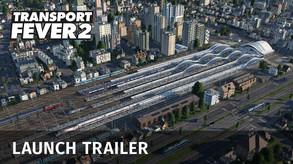
The classic transport simulation genre has a new gold standard with Transport Fever 2. Discover a whole new world by navigating transport routes through land, water and air. May progress and prosperity find their way!
Modeled estimate, not a reported figure. How we estimate →
Each in the currency that store quoted — not converted: the gap between two rows is the publisher's pricing, not an exchange rate.
Every market we collect.
Charts
Each storefront's own chart, in its own country — the closest public signal to sales where none is published. A country missing from a list is one we don't collect there, not one where the game doesn't chart.
No United States chart position — it charts only in the markets below.
Discounts
Every price cut of more than 20% we have observed, in each market that quoted one, with this game's chart position on either side of it. These are episodes, not a model: a sale is one event, and one event cannot tell you what the next one will do.
Reviews, worldwide (the counter carries no country): 8/day in the week to Sep 8 → 18.86/day in the week after.
About


Add-ons
Each DLC is estimated with the same model as a game, then summed — a modeled figure, not reported DLC sales.
Sums Steam only; GOG, Epic publish no volume signal, so the true total is higher by an unknown amount.
Updates
Build ids and update times come straight from Steam's PICS — the same source SteamDB reads. Patch history grows as we record new builds.
Engagement
Reviews
Themes across 1354 recent reviews and how positive each mention is. A keyword signal, not full sentiment analysis.
Reviews
1850 년대 부터 시작해 2050년 까지 발전 시키며 성장 과정을 지켜 보았는데 2000년대 초 중반 년도 부터 모든 도시의 시민들이 공항을 갑자기 이용을 안 함 공항 유지비만 축내게 됨 혹시 몰라서 도시가 더 성장 하면 이용 하겠지 하고 놔두어 보기도 했는데 변함 없음... 처음엔 100명 140명 넘게 공항을 이용 하다가 갑자기 발길을 끊으니까 이상함 공항은 걍 안 짓는게 나음... 항공기도 처음엔 3대 운영 하다가 2대 그리고 저조해 져서 1대로 유지 함 부두도 비슷하게 처음 중간 까지는 이용 많이 하다가 발길이 끊김 고속 버스와 기차만 이용함... 2030년 부턴 도시 외관이 크게 바뀌는건 없고 건물들 스킨이 이전 과거에 쓰던 건축물들 돌려 쓰면서 올라옴
теперь трансаэро снвоа летает 10/10 банкротств
Media

Related
Related
Price dynamics, follower growth, revenue and sales trajectories with interactive tooltips
This and every other Pro feature is free until October 20, 2026. A free account is all it takes.
Latest in each market: best DE #59, worst PL #93 · 5 markets collected
Reviews, worldwide (the counter carries no country): 6.75/day in the week to Jul 21 → 17/day in the week after.
Too few observations to say whether a discount moves this store's chart at all: across the last 30 days Steam · Top Sellers · Poland has just 18 day-to-day chart moves that followed a price cut, against 2,498 that did not. We are publishing the count instead of a direction — 20 is the fewest we will draw a conclusion from, and price collection outside the United States began on 6 August 2026.
Prices outside the United States have been collected since 6 August 2026 and chart positions since 19 July 2026, so a cut older than that has no market to compare and a market that joined later has no history yet. Nothing here is converted between currencies.
Genres
Stats
All-time low is the lowest price we've recorded for this game since we started tracking it.
Languages: English*, French, German*, Spanish - Spain, Japanese, Dutch, Polish, Russian, Traditional Chinese, Simplified Chinese, Italian, Korean +1 more
| $39.99 |
| — |
| — |
| — |
| not modelled |
Matched by title — a reused name can pair the wrong games. * is a critic aggregate. Prices and positions are each store's United States storefront; Epic charts worldwide. Audience and Score too, except Steam's, which is worldwide.
Hours played at review time, across 1.4K reviews with recorded playtime.
positive critical· bar length = how often the theme comes up
After nearly 30 hours with Transport Fever 2, I have reached a blunt conclusion: its infrastructure-building interface is not merely unintuitive or dated. It is a professionally indefensible design failure at the centre of a game supposedly built around transportation infrastructure. I am precisely the audience this game should appeal to. I enjoy public transportation, railway operations, passenger flows, network planning, and interchange design. Yet Transport Fever 2 managed to drive me away—not through meaningful complexity, but through an astonishing accumulation of opaque controls, missing feedback, inconsistent snapping, and unfinished construction tools. The familiar defence that “Transport Fever 2 is not Cities: Skylines” is irrelevant. I am not asking for a city painter. I am asking a transportation game to provide competent tools for building transportation infrastructure. Roads, tracks, bridges, tunnels, junctions, and stations are not peripheral city-building features. They are the foundation of your own game. The current system repeatedly fails at the most basic level: Roads and railway tracks snap together without being asked, after which the game may immediately complain that the resulting proposal contains a collision. The interface actively creates the problem and then blames the player for it. “Not connected” is not an explanation. It is the software equivalent of shrugging. The game refuses a construction proposal while withholding whether the cause is elevation, slope, curvature, collision, snapping, node mismatch, or some hidden constraint. Expecting players to diagnose invisible internal rules through demolition and repeated trial and error is not difficulty; it is inadequate software design. A transportation game with extensive tunnel construction has no proper, persistent underground-view toggle. Underground tracks can only be partially exposed under specific construction conditions. Inspecting or editing underground junctions, signals, and broken connections becomes an exercise in fighting the camera and accidentally selecting surface objects. This omission would be embarrassing in an early-access prototype. In a finished commercial product, it is indefensible. Essential controls are hidden behind bizarre defaults with virtually no useful guidance. N/M rotate objects, comma/period control elevation, and C suppresses snapping. These bindings disregard established conventions, yet the interface does little to communicate them. Players cannot be expected to search forums to discover that a punctuation key controls one of the game’s most fundamental construction dimensions. Bridge pillars cannot be positioned intelligently. Ordinary underpasses and elevated structures frequently require manual terrain surgery, repeated demolition, collision overrides, pillarless bridge mods, node-editing tools, and decorative bridge components. Modders have effectively been forced to finish the construction system that Urban Games shipped. Fundamental information—node elevation, gradient, curve radius, clearance, collision target, and the precise reason a proposal is invalid—is absent or inadequate. Community mods such as Track/Street Builder Info and Build with Collision are not merely optional enhancements; they compensate for basic functionality that should have existed in the base game. A competent interface would provide messages such as: “Connection failed: endpoint elevation difference is 1.2 m.” “Construction failed: minimum curve radius not met.” “Construction failed: bridge pillar intersects road lane.” “Connection failed: segments do not share a node.” Instead, Transport Fever 2 frequently provides a vague rejection and leaves the player to reverse-engineer the problem. That is not sophisticated simulation. It is poor communication disguised as complexity. What makes this particularly disappointing is that there is an excellent public-transport game buried underneath this interface. Unfortunately, the construction system treats the player’s time as disposable. Nearly every routine task is made more laborious by missing diagnostics, hidden controls, arbitrary restrictions, or inconsistent behaviour. Transport Fever 3 will not deserve to call itself the “ultimate transport tycoon” if it carries forward this contempt for basic usability. A proper underground view, conventional and visible controls, optional snapping, controllable bridge placement, reliable node editing, and precise construction diagnostics are not extravagant requests. They are the minimum expected of a modern transportation game. After almost 30 hours, I stopped playing because I was tired of fighting the interface rather than designing transportation networks. That is a remarkable failure for a game whose central fantasy is building transportation networks. The modding community has demonstrated that many of these deficiencies can be mitigated. The fact that unpaid community members had to do so only makes the condition of the base game more embarrassing. I sincerely hope Urban Games studies these failures before releasing Transport Fever 3. If the next game again expects players to compensate for unfinished core tools with forum archaeology and a collection of essential mods, then it will deserve the same criticism.
The game's campaigns are ok, but the generated maps are devoid of any common sense. Wheat makes bread, bread is a basic staple, but yet, the town next to wheat farms and bakery doesn't need bread. It's needed somewhere else where I can't get by road, having only a cart - I need a ship! So production networks are randomly scattered over the map with zero resemblance to any real economy, which is a hard break of immersion! There should be production hierarchies, where operating distances scale up with product complexity, but if it's only about carrying grain from the farmer to the manufacturer and then to the next town, this should be simple, basic and possible everywhere. Not to speak of modeling the transition from regional small-scale production to mass production and mass consumption. So the game either guardrails you through a campaign, which gives you at least some immersion (if you're underage), or it casts you into a random world with entirely arbitrary supply-demand-chains. I gave the game a try after shelving it for years, only to be reminded why I quit on it last time.
-Started a free game -Placed a depot -Accidentaly bought a lot of horse carts 10/10 would by horse carts again
Trevligt spel helt enkelt. Ser fint ut och har en rolig kampanj.
God, I love trains
:-)
very good
sehr gutes Spiel besonders mit Mods, man kann einige Stunden mit dem Spiel verbringen und bei mir zumindest auch die Zeit dabei vergessen.
Active players
Estimated daily and monthly active players (DAU/MAU) modeled from peak concurrency.
Players by region
Where this game's players are, estimated from review languages.
Players also reviewed
The games this title's players most often review too — audience affinity.
Related
| Game | Estimated lifetime revenue | Reviews | Review score | Price |
|---|---|---|---|---|
| — | 0 | — | — | |
| $10.9M | 10.8K | 83% | $29.99 | |
| $116M | 92.8K | 56% | $34.99 | |
| $2.5M | 3.5K | 64% | $19.99 | |
| $290K | 1.3K | 67% | $6.99 | |
| $49.9K | 63 | 48% | $19.99 |
Related
| Game | Estimated lifetime revenue | Reviews | Review score | Price |
|---|---|---|---|---|
| $27.2M | 19.4K | 90% | $34.99 | |
| $27.3M | 46.2K | 85% | $29.99 | |
| $27.3M | 138K | 97% | $9.99 | |
| $27M | 189.3K | 81% | $8.99 | |
| $26.9M | 19.6K | 87% | $59.99 | |
| $26.7M | 21.4K | 59% | $31.99 |