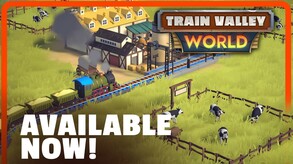
Train Valley World is an engrossing transport tycoon inspired by the genre classics. Build and manage efficient railroads across the globe, create sophisticated logistics chains, design your own levels, and become a business mogul – solo or in multiplayer!
Modeled estimate, not a reported figure. How we estimate →
Media

About
Enjoy creative freedom of railway management that’s easy to learn and challenging to master. Create a thriving transport empire during the peak of the Industrial Revolution as you optimize railway networks, dispatch trains, and set up automated delivery routes. Immerse yourself in a deep and engaging tycoon gameplay experience inspired by Railroad Tycoon 2 and Sid Meier’s Railroads!
Travel all over the globe of the early 1900s and visit both New and Old World countries - the United States, England, Greece and Egypt to name a few - to solve unexpected and seemingly fictional logistical problems. Help Captain Nemo build his famous submarine, blow up obstacles to redirect flooding, set up antibiotics production to fight a pandemic, and help the townsfolk distract the Loch Ness Monster!
Discover a powerful level editor* – design your own levels, and share them with other players within the thriving Train Valley community. Utilize all-new scripting tools, create complex landscapes, add unique gameplay objectives and build logistics challenges fit for a high-caliber transport enterprise.
Enjoy the thrill of a good old transport tycoon competition in online multiplayer mode. Form alliances to grow railway networks together, or sabotage and outwit rival businesses – see who emerges victorious in an ultimate capitalist stand-off!
Genres
Stats
All-time low is the lowest price we've recorded for this game since we started tracking it.
Languages: English, French, Italian, German, Spanish - Spain, Japanese, Korean, Portuguese - Brazil, Russian, Simplified Chinese
Engagement
Hours played at review time, across 41 reviews with recorded playtime.
Reviews
Themes across 41 recent reviews and how positive each mention is. A keyword signal, not full sentiment analysis.
positive critical· bar length = how often the theme comes up
Reviews
Unlike the rest of Train Valley franchise games, this one is way off the mark. It's just confusing and doesn't make any sense, the way you play it is also completely different to other games and I didn't like it.
Train Valley 1 and 2 were puzzle games; Train Valley World is more like a simple Railroad Tycoon game, with some puzzle features. Because it leans into the business aspects of a train game so much, it's difficult not to notice its deficiencies compared to more robust Railroad Tycoon games. The economy is pretty simple, though it does have pleasing production chains, like coal + ore -> steel, steel + fish -> canned fish. Traffic control in a railroad game can be a thorny problem. The original release of Train Valley World gave up on the problem entirely, and simply allowed trains to "ghost" through each other, though this results in delays as one train stops when this happens. This is still the "normal" mode for the game. The problem here is that the game's awfully easy in "normal" mode, with no real challenging decisions. Just connect sources to destinations and build trains, for the most part. The game now has signals. In "Signal" mode, trains will crash if they run into each other, and you have to designate rail blocks with signals. The game's more challenging in Signal mode, but the signals are still pretty rudimentary compared to many more sophisticated rail games. Sometimes trains will collide even though they're in different rail blocks. This happens when a train loads a lot of cars at a station, and the new cars extend out of the block for the station. Leaving some extra space around stations avoids this. Probably the biggest problem is that the game doesn't handle double-track well at all. A left-turn switch on the right rail can't cross a parallel left rail unless there's a considerable gap between the rails. Since the maps are already somewhat cramped, this means you can only really run double track with no turns. Generally this means you'll only run a single train on most rails, since multiple trains requires double tracking. This forces you into simpler solutions to most things, and means you often can't serve the full capacity of an industry, since that would require multiple trains. There's a technology tree where you unlock alternate locomotives and specialists who can boost trains. The locomotive selection's very simple, at each level there's a "standard" locomotive, and a faster passenger locomotive and a higher capacity freight locomotive. The idea's nice enough, but undercooked. You unlock locomotives and specialists with "stars" from completing levels. Since it's easy to 3-star every level, you'll always have enough stars to unlock everything in the tech tree as it becomes available. Still, at the end of the day, it's a decent enough train game, if not quite as good as the earlier Train Valley games, or a real tycoon game like Railway Empire 1.
A good follow-up in the Train Valley series. A little bit different, but based on the other games. Worth it's money if you like this type of games.
Train Valley World is a refined and welcoming evolution of the Train Valley formula that leans into strategic planning, logistical problem-solving, and creative expression rather than dense micromanagement. Developed by Flazm and published by tinyBuild, the game builds upon the foundations of its predecessors while deliberately smoothing out friction points, resulting in an experience that feels more fluid, approachable, and broadly appealing without abandoning the thoughtful challenge that defines the series. It positions itself comfortably between a puzzle game and a light management sim, offering satisfying decision-making without overwhelming complexity. At its core, Train Valley World is about designing efficient rail networks under economic constraints. Each scenario presents a self-contained challenge where you must connect resource producers, factories, and cities using a limited budget and available terrain. Goods must flow in the correct order, and poorly planned routes can quickly drain funds or stall progress. The satisfaction comes from identifying optimal layouts, anticipating future expansion, and watching a once-chaotic map transform into a clean, functional network. The economic loop is intuitive and forgiving, encouraging experimentation rather than punishing mistakes too harshly. One of the most significant design shifts in Train Valley World is the removal of traditional train collisions. Instead of catastrophic crashes, trains can now pass through each other, with priority determined by their order and assignment. This change fundamentally alters the game’s focus, shifting attention away from constant micromanagement of switches and timings and toward higher-level planning. While some veterans may miss the tension that collisions once introduced, the new system reduces frustration and keeps the player focused on long-term optimization rather than moment-to-moment firefighting. The introduction of specialists adds another layer of strategic depth without complicating the core systems. These characters can be assigned to individual trains to grant bonuses such as increased speed, higher profits, or improved efficiency. Choosing where and when to deploy specialists becomes an important consideration, especially in later scenarios where margins are tighter and objectives more demanding. This mechanic encourages players to think about their network as a dynamic system, where individual trains have roles rather than being interchangeable units. Campaign levels are structured like carefully designed puzzles, each with primary goals and optional objectives that reward efficiency and clever planning. Star ratings and secondary challenges encourage replayability, inviting players to revisit earlier maps with better strategies and refined layouts. While the main campaign may not be extensive compared to larger tycoon simulations, its pacing feels deliberate and respectful of the player’s time. Each level introduces a new twist or constraint, keeping the experience fresh and mentally engaging. Beyond the campaign, Train Valley World significantly expands its longevity through multiplayer and creative tools. Multiplayer allows players to collaborate or compete in shared scenarios, turning logistical problem-solving into a social experience that rewards communication and coordination. The inclusion of a robust map editor further elevates the package, empowering the community to design, share, and explore custom levels. This feature transforms the game from a finite experience into an evolving platform, where player creativity continually extends the game’s lifespan. Visually, the game adopts a clean and readable style that prioritizes clarity over spectacle. Environments are distinct enough to convey regional identity without cluttering the screen, making it easy to track routes, trains, and resources at a glance. The presentation supports the game’s puzzle-like nature, ensuring that information is always accessible even as networks grow more complex. The soundtrack and ambient audio complement this design philosophy, providing a calm, focused atmosphere that suits long planning sessions. In terms of depth, Train Valley World deliberately avoids the complexity of hardcore transport simulations. There are no sprawling tech trees or deeply layered economic systems, and the challenge rarely comes from overwhelming the player with data. Instead, difficulty emerges organically from spatial constraints, budget limitations, and the need to anticipate future demands. For players seeking a relaxed but mentally stimulating strategy experience, this balance is a strength; for those craving heavy simulation depth, it may feel restrained. Ultimately, Train Valley World succeeds by knowing exactly what kind of game it wants to be. It refines the series’ identity into a smooth, puzzle-driven railway strategy experience that emphasizes creativity, efficiency, and satisfaction over stress and micromanagement. Whether approached as a thoughtful solo challenge, a collaborative multiplayer exercise, or a canvas for community-made content, it offers a polished and rewarding take on train-based strategy that feels both modern and timeless. Rating: 7/10
Of the Train valley games, I have enjoyed this one much more. I enjoy the game play of trying to gather good and bring to cities, much more than the controlling of switching tracks. I powered through this game pretty quick, I wish their were more Train Valley games that matched this game play, I was very disapointed with Train Valley Origins, I was hoping it was going to be more like this than the Train Valley 2 game. So yes, this game is awesome, best one in the Train Valley Series
Pretty fun train logistics games, from the creator of train valley. I really like the normal mode, without having to worry about signals.
At first I thought the tutorial was broken, but the truth is worse: the whole game feels like it was held together with tape. Pausing the game already messes things up. If you do the tutorial steps while the game is paused, they often do not register properly. The train spawns somewhere else in the fog and if you unpause the game, you immediately get an invalid path. The same nonsense happens when you build more than one station next to each other - the tutorial acts like it does not count, and the routing logic gets even more confused. Trains end up on the wrong tracks, or they are not sent to the station at all and just fail with "cannot find route." And if you save, quit, and load back in, the tutorial is gone. Train signals do not work the way the tutorial says they should, and trains get stuck constantly for reasons the game never explains. It is also impossible to tell when one train is blocking another on a red light if you have a lot of trains running at once, so the whole thing turns into a traffic jam of silent failures. It gets worse. I had one train crash, and the sound and explosion effects just kept going until the FPS started tanking and I had to force quit the game. Deleting train tracks is tedious as well. This is not "challenging." It is unfinished. The mechanics are simplified to the point of being broken, and the game does not feel polished in any way. It has potential, but right now it is a bug fest. I could not finish it because it is just broken. How this passed QA is beyond me.
This is kind of puzzle and tycoon mix game. I did find it pretty satisfying but it dont expect to meet it like TV3, it's a mix of factorio and TV2, may be more casual variant of Mashinky. There is definitely fun in this game. PS After completing campaign should say the game is highly addictive and I'd be glad to see new levels/campaign DLC added
(EN ver. below) Ogólnie gra jest przyjemna. Są pociągi, gra ma bardzo miłą dla oka grafikę (nieco mniej low-poly niż poprzednio), ma osiągnięcia (co uwielbiam), ma zadania, które są osiągalne. Ma też spory poziom trudności i skomplikowania i możliwość przełączania między poziomem łatwym a trudnym. Gra się fajnie. Jednocześnie uważam że z całej serii najsłabsza. Niestety ale pokochałam pierwszą odsłonę i jej prostotę. Mam wrażenie, że w tej odsłonie chodzi o coś zupełnie innego niż w poprzednich odsłonach serii. Już nie wysyła się pojedynczego pociągu do stacji ale się je zapętla, system budowy torów jest też bardzo inny, stacje nie pojawiają się same tylko trzeba je budować. O i nie ma języka polskiego, mimo że w pozostałych były. To na spory minus. Znam angielski, mam certyfikat by to poprzeć, i bez problemu daję sobie radę w grze, ale nie o to chodzi. Zawsze miło jest kiedy widzę, że ktoś pomyślał o innych. A warto zaznaczyć, że w dobie kiedy wszyscy wszędzie wszystkich "inkludują", że jest ta moda na bycie "inclusive" w każdym obszarze (czasem aż do przesady) wykluczenie grupy graczy ze względu na język to spora wtopa. Tak czy inaczej. Jest inna, ale nadal gra się fajnie. Polecam :) Edit: I'll also post English version :D In general I think the game is very pleasant. It has trains, lovely graphics (although it is less low-poly than before) it has achievements (which I love), it has tasks that are achivable. It also has quite high difficulty level and possibility to switch between easy mode and hard one. It's cool. At the same time, however, I think it is my least favourite of them all. Unfortunately but I fell completely in love with the first game of the series and this one is... just too different. Just doesn't deliver the fun it used to. I feel like it is about something else than before. You don't send one train from the station anymore but loop it instead. The track buiilding system is different and I had trouble to get the hang of it at first. The stations don't just appear you have to build them first. Is it bad? Is it good? It's hard to tell, I think it is very subjective, but it is definetly different. There is one important thing that is wrong though. There is no Polish language. And it used to be. The old games had my language (which was an absolute surprise, but a very nice one). I can speak English, and I have no problem orienting myself in the game but it is always nice to see that people care. Put some effort into accomodating others. But it is missing now and it feels very wrong. These days when everyone, everywhere is all about being inclusive for others excluding one group of players is a true bummer. Still. I liked the game. It's different but it is still quite fun. I can recommend :)
Excellent value for money, I've spent more hours playing this than I care to count.
Related
Related
Trends
Modeled estimate over time, reconstructed from Steam's monthly review histogram.
Audience
Estimated from the language of this game's reviews — a proxy for where players are, not official Steam demographics.
Related
| Metal Dead | $42.9K | 504 | 87% | $4.99 |
| Svoboda 1945: Liberation | $42.9K | 191 | 98% | $15.99 |
| Merge & Blade | $42.9K | 138 | 79% | $9.99 |
| Submarine Titans | $42.9K | 362 | 87% | $4.99 |
| LAST HAREM | $42.9K | 73 | 73% | $16.99 |
| Din's Champion | $42.9K | 99 | 94% | $19.99 |