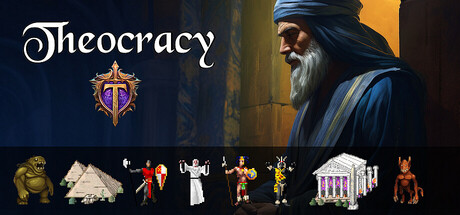
Classic 4X turn-based strategy game, where you manage a theocratic empire, conquer and convert pagans and enemies by divine power or brute force, cast mighty miracles and enact dogmas. Advance and expand your theocracy into dominant world empire. And if necessary... release the Kraken!
Modeled estimate, not a reported figure. How we estimate →
Media

About


Stats
All-time low is the lowest price we've recorded for this game since we started tracking it.
Languages: English
Engagement
Hours played at review time, across 32 reviews with recorded playtime.
Reviews
One more turn and I will finish writing this review...
Definitely recommend. At first sight I did not expect it to be so addictive. Tried a couple of civilizations, still to play the rest. Monsters are fun. Atheists are pure evil :D Unlike rebels, who at least state a valid reason for their existence, those faithless bastards just pop up out of nowhere armed to the teeth. Looking forward to further development. Hope to see new maps, so far there is just earth in several sizes. EDIT: just found there is a random map feature with various settings. So not just a couple of earths after all. This game is already lots of fun and still bears great potential.
This is my new favorite civ-like, as it hits my complexity sweet spot (being simpler than Civilization I) and feels very fresh, almost like a parody of Civilization. In terms of how simple and clean it feels, it is similar to the excellent but almost unknown open source Civilization clone C-evo (another Windows program). [h2]Religion-focused streamlined Civilization[/h2] Theocracy is a typical 4X game, i.e. it is based on the successful formula: eXplore, eXpand, eXploit, eXterminate. The two main archetypes of this genre are Civilization (1991) and Master of Orion (1993). Theocracy is a civ-like: it is based on Civilization. The default game takes place on a real world map (81 x 50 tiles, the largest of three available sizes), where real cultures/religions are placed in their real locations. As this limits the exploration dimension of the game, one can play on a random map instead. The player leads one religion through history and tries to make it dominate before the end of the world happens or one of the AI opponents wins. The 'pagan' religion is special; similar to the Barbarians of Civilization it represents the disorganized primitives. There are pre-made cities spread all over the world, although in this game they are called regions and we cannot found our own. You control a region if your religion is the strongest one there. At any time a region produces either a fixed building, here called improvement, that costs a certain amount of money per turn in upkeep in return for certain benefits, or a military unit. Each region has a population size that determines its influence and the amount of benefits produced by its improvements. A fundamental concept in this game is (religious) power. It is a second currency (in addition to money) that you can use to buy miracles. Almost more importantly, where power is created, it creates influence in its neighborhood and causes the gradual conversion of citizens (even abroad) to your religion. Power is also radiated by holy mountains (which you acquire by discovering them), by shrines that you can place in the landscape and upgrade, and by holy men who you are either awarded in certain situations or buy for power as a miracle. You can see the influence of a region or shrine by hovering the mouse over it and pressing Shift. Influence decreases as the distance gets greater. Influence is cut off at its radius, which you can increase globally with dogmas or locally with buildings. Dogmas correspond to Civilization's wonders of the world. Like miracles, they are bought with power for a price that grows exponentially with each purchase. Like Civilization's wonders, each dogma can be held only by one player, some are better than others, and the supply is quite limited. The victory points they provide are substantial. You can speed up the conversion process for a region by attacking it with a military unit. To protect one of your regions against attacks, you can build improvements that give it defense points, and place a military unit in it that will have to be killed before the region itself can be attacked. Miracles can be very powerful, but each type quickly gets much more expensive with every use. One type of miracle is a monster of your religion. It is a powerful unit that moves under AI control and attacks regions and foreign shrines. Regions and their improvements can produce research, which will let you advance in a research tree. This gives you advantages such as faster food production = region growth, or the ability for military units to operate in water. There is only one kind of military unit you can produce at any time, but your position in the research tree determines which it is. If a stronger unit type becomes available, you can pay to upgrade a unit that is currently in (or on land next to) a region. You can also pay to make a military unit faster. However, both stronger units and faster units require more upkeep. Theocracy feels like a blend of Civilization and Battle of Polytopia (2020). Polytopia is a radically simplified Civilization clone originally developed for the free-to-play multiplayer mobile market. Theocracy makes the religion mechanics of later Civilization installments shine by turning it from an afterthought into the main objective and simplifying everything else pretty much like Polytopia did. (Sometimes even more radically, as in dropping the road system and practically everything related to the production currency.) By staying in the original domain of multi-hour single-player PC games, Theocracy feels more like an improved Civilization and less like something entirely new than Polytopia does. The games are shorter than in Civilization, but not as radically shorter. If you don't know Battle of Polytopia, think of Theocracy as a streamlined Civilization I with some Civilization IV elements and a clean and simple modern user interface. In some respects the user interface is almost too clean, as some basic quality of life features are missing. [h2]Technical issues[/h2] Overall, Theocracy is old-fashioned but quite polished for a one-man indie project. However, I think I should mention some technical deficiencies: [list] [*] Music volume can be changed, but there is no way to change the sound effect volume. The work-around is to set the system volume outside the game so that you are happy with the sound effect volume, and [i]then[/i] adjust the music volume. [*] This game runs in full-screen mode only, making it cumbersome to switch between the game and other windows. [*] Very occasionally I am getting a popup about a division by zero error, but with no apparent consequences. [*] The user interface is minimal. For example, when you are prompted to select a region's next production, the region is not centered. You need to click the prompt, then cancel the selection dialog to see what the region needs, then click the prompt again. There are also no production queues. You can only immediately select the next production. [*] The integrated help seems complete though not very large, but it's not always clear where to find a certain piece of information. [/list] Apart from that, the main issue is that the help is probably a bit confusing/overwhelming to new players who are not familiar with civ-likes. [h2]Steam Deck and Linux[/h2] On my Debian laptop, Theocracy does not run with recent versions of Proton. However, with the old Proton version 5.13 it runs with no issues beyond those that exist on Windows. Theocracy is officially classified as incompatible with Steam Deck due to screen resolution issues. But this seems to be erroneous or based on a previous version. The official minimum resolution is 1280 x 768, and the Steam Deck has a resolution of 1280 x 800. In fact, unlike on my Linux laptop, on the Deck the game nearly works with default settings, though ultimately it's unplayable that way due to problems with overlay windows. Just like on my laptop, Theocracy runs fine on the Steam Deck after selecting Proton 5.13. You just nee to ignore the incorrect warning. Obviously the text is a bit small and the interface is optimized for a mouse, but the game is quite usable. That said, this is definitely one of the games that I prefer to play with a mouse and larger screen. (Someone in the forum mentioned playing the game successfully on Mac OS with CrossOver.) [h3]Linux full screen issues[/h3] The following may depend on the desktop environment used. With KDE and Proton 5.13, the game runs in full screen mode with no way to make it windowed. By pressing Alt-Tab you can switch to the window of another running program (not Steam) and get your taskbar. Update: I wrote the above while using Debian 11 on my laptop. I have since upgraded my operating system to Debian 12, so I am now running KDE with Plasma 5.27 (Wayland version). This has made the game basically unplayable because when moving the mouse, the taskbar keeps appearing and disappearing, shifting the (fullscreen) window.
A pretty nice spin on 4X with extra abilities. Reminds me of Stronghold Crusaders Extreme, but instead of supernatural things being the "i win" button, it works in an organic way (you can actually protect against enemy stuff and most of the miracles require followers of your own religion to already be there at at least 10%, so you have to work with growing tall/wide regardless; also you can't spam them). Also good UI/UX and balance work.
This is a great simplified "civilization-like" indie game with focus on religions and its intricacies. The mechanics are simple enough so you don't end up micromanaging your cities but also complex (and sometimes funny) to keep you hooked for one more turn... :) The are also few surprising twist so don't read too much into all the tutorials later in the game, its better to find them on your own. Really loving this fresh and personal approach to a classic!
Theocracy lets you pick between 15 or so religions to get different bonuses to play. Like the Aztecs get a 50% discount to solar eclipses, Crazy Horse gets a speed increase when travelling through forests, and Ra has higher power income. You use power to cast miracles which can expose areas on the map, or induce floods that convert cities to your religion, or wreak other forms of havoc. But keep in mind that every time you cast a miracle, it doubles in price the next time you want to cast it - or roughly something like that. It might be even more extreme than that, like maybe a miracle stays at its low price until you cast it and then the subsequent cast will be 2^x times the original price, where x is the number of times you have cast *any* miracle. So the first time for each individual is relatively affordable, but you certainly want to avoid casting them as much as possible, because the prices go up so exponentially. Sometimes some cities will have the nerve to say they want the religion to have amendments, and if you allow that, the efficiency of most of your kingdom will go down. But if you don't, there can be a revolt in that city and rebels might arise. Or you can release the kraken on those heretics. I haven't tried that yet, but I really enjoy rejecting the heretics. I haven't yet had the chance to conquer the Byzantines - they are the Christians. I imagine there will be some sense of satisfaction conquering that sect - and it's admittedly the only reason I bought the game. In the normal "gamey" things, for a TBS 4X it plays like others, and one game to the next can be widely varied in how difficult it plays. Sometimes pagans will overrun all your cities and they can be a real nuisance, and other times they are hardly an issue. That said, it plays very predictably - if you've played 4X before there are no negative surprises here, and a few positive ones. I like that the game defaulted to the music volume being turned all the way down! I had to go into the menu and turn it on, and I was pleasantly surprised that it sounded good. For as affordable as the game is, I think it deserves a bigger adoption. I mean, come on. Where are the Ex-xians? You know who you are. :)
Anyone who likes Civilisation and Dominions should try this game. The design is very neat, simple (contrary to Dominions), and there's something really funny in how television can reduce science and increase your faith on the one hand, and how too much science is bad for your theocracy. Simple mechanics, interesting gameplay. Awesome game.
This is a very well-designed 4X game, and it's a lot of fun to play. I just won the beginner game, which took me just under 7 hours. The time flew by - it really has that one more turn feeling and I highly recommend it. Your aim is to convert as many people as possible to your theocracy, and control the biggest part of the map. The gameplay is similar to Civilization in that you have regions (cities) that you want to grow and develop. City locations are pre-defined, so you have to go out and convert the ones that don't belong to you. It's also similar to Master of Magic, where every so often you can cast miracles (spells) on the map to create new units, convert population or destroy it. There is no diplomacy in the game. Each theocracy wants to gain as many followers as possible, so you are always at war with everyone. The game has a very good tutorial where tips guide you through everything from basic interface icons to advanced game mechanics. At no point did I feel lost. There's also an extensive in-game help that provides more details. I really like the graphics. They are very clear and colourful. I can see at a glance what's going on. Overall the gameplay is less complex than the 'big' 4X games out there - in a good way. You still have plenty of interesting decisions to make, but you're not chasing multiple objectives or juggling mechanics. So it's a great experience if you're looking to just have fun playing a 4X.
Get converted, idiots. wololo
[b]This is how indie games should look like.[/b] First of all it is freshly released but already a complete game. Not just an early version that might or might not get completed eventually. It is very intuitive to play. And let's you go right ahead without the need of dedicated tutorial. Initial tooltips will set you up for all your domination needs. On the strategy side - I really like how streamlined and down to earth this game is. While still being (very!) strategically challenging. It will let you focus on the joy side of planning exploring and expanding. Not drown you in overwhelming layers of too many overlapping mechanics. Don't get me wrong. It is still a difficult game and victory is not guaranteed. I recommend one of the lower difficulties for the first run. And believe me - there will be many more.
Related
Related
Trends
Modeled estimate over time, reconstructed from Steam's monthly review histogram.
Momentum
Pace estimated from the game's recent review growth (our daily snapshots) at its own sales-per-review ratio — a momentum signal, not booked sales.
Audience
Estimated from the language of this game's reviews — a proxy for where players are, not official Steam demographics.
Related
| Titanfall - The Final Hours | $7K | 309 | 38% | $0.99 |
| Don't Touch this Button! | $7K | 138 | 93% | $3.99 |
| 夏日事件簿 Summer Fantasy | $7K | 50 | 94% | $10.99 |
| Casting Clicker | $7K | 68 | 79% | $2.99 |
| Case 03: True Cannibal Boy | $7K | 56 | 96% | $5.99 |
| Paint It Black | $7K | 69 | 81% | $4.99 |