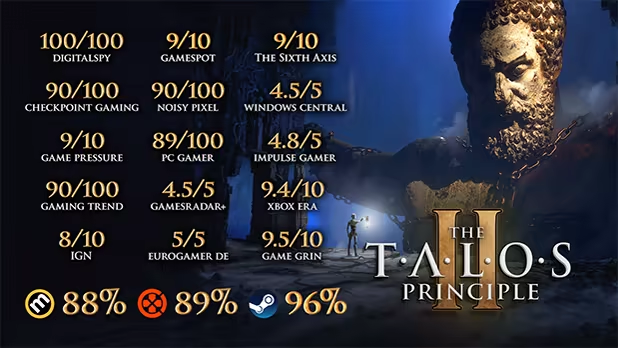
The Talos Principle 2 is a thought-provoking first-person puzzle experience that greatly expands on the first game's philosophical themes and stunning environments with increasingly mind-bending challenges.
Modeled estimate, not a reported figure. How we estimate →
Media

About

Genres
Stats
All-time low is the lowest price we've recorded for this game since we started tracking it.
Updates
Build ids and update times come straight from Steam's PICS — the same source SteamDB reads. Patch history grows as we record new builds.
Engagement
Hours played at review time, across 71 reviews with recorded playtime.
Reviews
Themes across 71 recent reviews and how positive each mention is. A keyword signal, not full sentiment analysis.
positive critical· bar length = how often the theme comes up
Reviews
İlk oyunu sevdiyseniz, devam oyunu beklentilerinizi rahatlıkla karşılıyor. Bulmacalar yine lazerler, dönüştürücüler ve önceki oyundan tanıdık araçların yanında zihin aktarımı, yerçekimi silahı gibi yeni mekaniklerle sürekli çeşitleniyor. Her yeni mekanik önce tek başına öğretiliyor, ardından diğerleriyle birleşerek oldukça zorlayıcı bulmacalar ortaya çıkarıyor. İlk oyuna kıyasla bu kez bulmacalardan çok dünyanın kendisine ve karakterlerle kurulan diyaloglara ağırlık verilmiş. Keşif hissi çok daha güçlü. Ormanlar, çöller, karlı bölgeler ve devasa antik yapılar öylesine güzel tasarlanmış ki bazen bulmacaları bir kenara bırakıp sadece etrafı dolaşmak istiyorsunuz. Manzaralar, atmosfer ve müzikler bu hissi oldukça iyi destekliyor. Hikayesi ise sadece bulmacaları birbirine bağlayan bir bahane olmaktan çok daha fazlası. Yapay zeka, bilinç, insanlığın geleceği ve medeniyet üzerine düşündüren sorular sorarken, farklı karakterlerin bakış açıları sayesinde tek bir doğru cevap dayatmıyor. Diyaloglar zaman zaman uzun hissettirse de anlattığı hikaye ve kurduğu dünya merak uyandırmayı başarıyor. Bulmacaları ilk oyuna göre biraz daha kolay olsa da, dünyası, atmosferi ve hikayesiyle bunu fazlasıyla telafi eden, bulmaca türünün en iyi oyunlarından biri.
A Sequel That Expands the Scale but Loses the Spark The Talos Principle 2 aims higher than its predecessor in almost every way — bigger environments, a broader narrative, more complex ideas. On paper, it should be a clear evolution. But in practice, it often feels like the game traded its tight, focused brilliance for something more bloated and less impactful. The puzzles are still clever, but they’ve lost some of the elegance that made the first game so satisfying. Instead of concise, “aha!” moments, many challenges feel stretched out, relying on layered mechanics that can become more tedious than rewarding. You’re often juggling multiple tools across large spaces, and while that adds scale, it also slows the pacing and dilutes the sense of clarity. Solving a puzzle doesn’t always feel like a breakthrough — sometimes it just feels like you finally got through the clutter. The open structure doesn’t help either. Larger hub areas and optional content sound appealing, but they introduce a sense of sprawl that works against the experience. There’s more walking, more downtime, and more moments where the game loses its momentum. The original thrived on its focused progression; here, that focus is often missing. Narratively, the game tries to go even deeper into philosophical territory — questions about consciousness, society, purpose, and humanity. But where the first game felt intimate and thought-provoking, the sequel can feel heavy-handed and overextended. Dialogue is longer, themes are repeated more bluntly, and the subtlety that once made the writing so compelling is often replaced by exposition. It’s ambitious, but not always effective. Visually, the game is undeniably beautiful. The environments are varied and detailed, and there’s a clear effort to create a sense of scale and wonder. But that beauty sometimes feels disconnected from the gameplay, serving more as a backdrop than an integrated part of the puzzle design. The Talos Principle 2 isn’t a bad game — there are still moments of brilliance, and fans of puzzle games will find things to appreciate. But as a sequel, it struggles to capture what made the original so special. Bigger doesn’t always mean better, and in this case, the added scope comes at the cost of focus, pacing, and emotional impact. In the end, it’s a thoughtful but uneven experience — one that expands the formula, but never quite matches the quiet, lasting brilliance of the first game.
The Talos Principle 2 is probably my favorite puzzle game and the follow up to The Talos Principle. The game starts with a short recap of the first game. Humans are extinct but before they vanished they created a simulation to create an artificial intelligence that has the same mental capacity and potential that humans had. The player solves various puzzles to escape the simulation and start a new civilization. The second game is set centuries later, the original player character, now called Athena, created other robots like herself and built a city called New Jerusalem in which all the human robots live. To honor their creators, they took on the name of humans and live on their legacy. You are the last robot to ever be created calles 1000 or 1k for short. On the day of your creation a holographic being appears and invites the citizens of New Jerusalem to a nerby island to claim something called "the flame". You and a bunch of other humans start an expedition to the island where they find a giant pyramid that they dub the megastructure. They also discover a travel system that connects to several nerby locations and when they explore the first location they realize that the entire island is full of puzzle rooms similiar to the simulation. And this is where the actual game starts, as you can expect, this is a puzzle game just like the first one but it also adds some light adventure elements to the game. But since the meat of the game are the puzzles, let's start there. As in the first game, puzzles are a mix of lasers, pressure plates, jammers and fans to open force fields until you can reach the goal. Almost all the tools from the first game have returned and the first minutes of the game lets the player in fact solve some puzzles of the simulation before leaving it to explore New Jerusalem. The puzzles on the island are an evolved form of the original puzzles. Each region introduces a new element and the puzzles of that location are usually themed after that new element, making good use of it. The first few puzzles are usually there to introoduce players to the new element and understand how it works, afterwards the puzzles become harder when that new element is used in new and interesting ways, often in combination with older elements from other locations. For example, the very first location expands the standard laser puzzles in which you have to redirect lasers to receivers of the same color. TPP1 only had red and blue lasers but TPP2 introduces green as color. But instead of just adding a green colored laser socket, in order to get green you have to combine red and green with the new RGB connector tool. But that tool not only creates green from red and blue, if you combine green (from another RGB connector) with one of the other two colors, you get the color that you didn't use. This creates much more interesting puzzles than the first game in which you have to figure out how to get specific colors exactly where you need them. A good change from the first game is the removal of some of thje more annoying elements, mainly bombs and turrets. These were no fun in my opinion, they were an obstacle created to stop players from solving puzzles and you often had to disable them in order to progress. What made them so annoying was that if you got killed, you had to restart the entire puzzle, so a slight misstep meant you had to do all the steps again until that point. This game has no such issues, you cannot die during puzzles and most puzzles are designed in away that you cannot lock yourself out of the solution if you mess up. There are a few cases where it's still possible and you have to reset, but since the puzzles overall are more compact than the first game you don't receive such big setbacks as before. While the puzzles are overall smaller, the game itself is much bigger. There are 12 explorable regions full of puzzles, each one contaioning 8 main puzzles, 2 hidden "lost puzzles", two star puzzles and a gold puzzle that opens up once yopu finished all the standard puzzles. Each location is massive but they are cleverly interconnected with signs pointing you towards the next puzzle. It will route you through the entire region and eventually loop back to the beginning where you have to create tetromino bridges to reach and activate the tower of each region. You have to solve 8 main puzzles but two can be replaced through one of the lost puzzles if you found them, those are overall harder to solve however. The star puzzles are very different this time. There are two statues on each location that require to solve a unique puzzle unmlike the main puzzles. SPhinx statues require you to find and activate hidden switches with a small picture being the only hint you get. Prometheus statues require you to find a small particle cloud and follow it back to the statue. This requires some platforming and sometimes you have to find a way to reach the cloud in an inaccessible location. The Pandora statues are the hardest, they require you to connect a laser to the statue but these lasers have to come from the main puzzles and you have to find out how. After you solves three regions, you are allowed to enter the megastructure in which you will face more puzzles but this time on a larger scale and inside a large labyrinth. These can be a bit trickier because they don't exactly follow the same rules as the standard puzzles even if they use the same elements. Outside of solving puzzles you can find and talk to your expedition members. They won't solve any puzzles for you or provide tips but they add more to the story of the game and depending on your dialog choices you will influence the story and ending of the game. Like before, this is all very philosophical with questions about what makes us human but more importantly, should we be allowed to expand humanity on the risk of destroying nature. Purpose and growth are big themes of the game. A lot of the story is told through text files, just like before, but you don't have to read them all to advance the story and having actual NPCs you can talk to this time is a refreshing change and makes the game flow much more naturally. A highlight of the game in my opinion is the exploration of New Jerusalem in the beginning, it's a big open city with several structures to explore, many NPCs to talk to and even some fun games to play. All of this is optional but it adds more charme to the game. After finishing every puzzle you unlock golden puzzles that are incredibly hard which is why they only appear at the end of the game. These are optional but unlock a better ending for the game so if you are invested into the story or simply want to challenge yourself with harder puzzles, this is the way to go. Just like the first game, the atmosphere is top notch. Beautiful landscapes and a soothing soundtrack make exploring the regions of the island a fun endavour. However, get used to a lot of walking because some regions are extremely big. I think a quick travel men that lets you move directly to puzzles you have already seen would have been welcome here. Overall I think this is a great game for any puzzle game and a perfect step up from its precedessor. If you liked the first game you will fall in love with the sequel too.
Just a note this is coming from someone that loved The Talos Principle, and did everything in the original game. 1st This is the only Non-VR Game to ever give me notion sickness. Tried the motion sickness options, and while experimenting to not want to vomit I didn't notice I spent over 4 hours trying to make the game work so I don't need a bucket next to me, and now can't refund this thing. So if you get any form of motion sickness in the 1st hour REFUND THIS GAME IMMEDIATELY it only gets worst. In truth I didn't start feeling sick till about 30-40 minutes in(but that was also a lot of long cutscenes), and now if I play for 5 minutes I feel sick to my stomach. The entire section of the menu dedicated to motion sickness doesn't seem to help at all, and IMO is just there so you spend time monkeying with the settings so you go past 2 hours of play, and can't refund it as how can you tell if a setting has worked without playing for a few little bit each tweak to see if it lessened. That isn't the only reason for the negative 2nd is the puzzles from what I seen so far are about as difficult as the put the square block into the square hole puzzles for toddlers. Even the extra ones which are supposed to be difficult are extremely short.(note I've gotten to act 2 so this is over 27 puzzles done and I think it too me more then 20 seconds to figure out maybe 2 puzzles... Will they get harder? Who knows from my understanding what I read it would take another 10-15 hours of playing to see any form of difficulty increase which I won't do as I so far the most difficult thing about the game is not keeping my lunch, or dinner from not vomited up. 3rd is the walking it takes longer to find the puzzles then do the puzzles. This game is a walking simulator with short breaks in between more walking, and from what I seen as far as I got it just gets worst and worst. 4th is the awful writing, and non stop chatting the 1st game would just pose philosophical thoughts while leaving you to do puzzles in isolation giving you time to think about what was said. This game is non stop chatting to where you just want it to end.
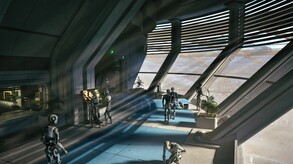
Decent puzzles but the graphics were so unbelievably botched it seriously detracted from the game's tone. Imagine looking at a lake while standing beside a tree, and seeing the tree that is beside you reflected in the lake. Imagine shadows flickering on and off alternatively every frame because of some poorly programed TAA system. The opening cutscene of the game includes a moment where you stare out a window while lore is being given to you, and the reflection of a nearly plant in that window is so buggy that I remember being appalled by it SPECIFICALLY nearly 2 years later. I didn't even know it was possible to manage some of the graphics bugs in this game until now. Which is extra sad because the original 'The Talos Principle' was actually so much more beautiful using carefully positioned moderate-quality graphics. Then this comes along and tries to shoehorn in so much ultra fancy modern graphics on an unfamiliar engine that they ended up looking far far worse.
Pretty good. I enjoyed 1 more personally. I think this games biggest flaw is there is WAY too much walking around. Maps are too big for no reason. Puzzles and story felt less rewarding over all than the first game. 7.5/10
Not as good as the first game but still fun enough for the puzzle solving alone. The biggest issue I had was the story. During the first game, you really only had Milton and Elohim as your primary mouthpieces. It was a very straightforward way to tell the story, with Elohim acting as the representation of blind faith, Milton as the nihilist who was eager to argue against everything you believed, and Drennan's recordings somewhere in the middle with her love of humanity, with the terminals adding lots of supplemental material that did make you think about the things you believed. Conversations with Milton were one of the highlights of the first game because you got this sense that Milton really believed in everything he was saying as a result of his understanding of things through the archive, which made conversing with him feel quite genuine. In this game, you have way too many side characters in addition to the party of robots who goes along with you, and nearly all of them broadly agree with what you're doing anyways, which doesn't make them interesting. The worst you get are some "well I don't know...." type responses when you express enthusiasm for some ideas. The very few true dissenters aren't interesting either, because you get the sense that they are only dissenters because the game wants them to be dissenters. It's not like an argument with Milton; at best, it's half of what an argument with Milton would be. The characters themselves aren't particularly interesting, which is made worse by the fact that the robot models have extremely uncanny faces. Terminals do make a return, but there's a lot more of what I would call junk entries in them. The absolute worst part of the story is everything surrounding your OG robot from the first game, which is immediately apparently when you learn that your robot took the name Athena and is using Drennan's voice, which I immediately rolled my eyes at. I don't have the words to properly explain why this whole plot stinks. It just sucks. Everything involving Miranda also sucks. Another huge problem are the huge worlds. The worlds in Talos 1 were very contained, which was perfect as the primary objective was to solve puzzles, and the less time you have to go between puzzles, the better. This game has the same problem that Elden Ring has: the environments are very pretty, but it feels like a total slog to navigate through them. I'm playing the game for the puzzles, not to run around like a ♥♥♥♥♥♥ looking for things on the other side of the map. The puzzles themselves are still good, but unfortunately leave something to be desired. Because of the way the worlds work where they introduce a mechanic and build on that mechanic over subsequent levels, your average world usually has 6 of the 8 standard puzzles feeling incredibly easy, especially if you're familiar with the game. Thankfully, the golden gate puzzles and the abandoned puzzles can offer some challenge, so it's not like you're gonna breeze through the whole game on your first playthough. Some other miscellaneous thoughts: - Prometheus sparks are nice, much better than the messenger mechanic from the first game. I didn't use any, but I can see how they'd be useful. - Tetromino bridges are cool the first game but get old FAST. I think there were more of these than there were tetromino puzzles in the first game. - Pandora and the Sphinx aren't that interesting to talk to. Prometheus is only interesting to talk to because his voice is cool. - Performance wasn't an issue at 1440p on Ultra settings. If you're cautious about buying, get the game on sale.
Game looks janky visually, the first person camera game me headache for some reason even with high FOV, maybe because the player is too fast or maybe because the controls feel delayed. First few puzzles were somewhat easy and on the ones i was stuck it was more like "how did i miss that" instead of aha moments, maps are huge, takes around a 1-2 minutes just walking between the tests. Narration is over the top, explaining everything like you are a toddler, plus robot group calls (lol) that just breaks the pacing sometimes. New puzzle elements are fun. Bridge puzzles on the end of each island feel like a drag and they aren't interesting [i] overall i would rather play the first part because it feels more polished there, this just feels like appeal to the masses: open world for no reason, a lot of rpg dialogue, puzzle drag [/i]
SO MUCH BETTER THAN THE FIRST ONE OMG I CAN'T STOP PLAYING IT also am I getting better at this or the puzzles are easier?? the story is really ♥♥♥♥♥♥♥ good and the visuals OMG this game is so beautiful and fun to play
А где лягушки то?
Related
Related
Trends
Modeled estimate over time, reconstructed from Steam's monthly review histogram.
Engagement
DAU/MAU are modeled from peak concurrent players (≈×8 and ×28) — Steam publishes no active-user counts, so treat these as rough estimates, not reported figures.
Audience
Audience
Games most often reviewed by the same players — an audience-affinity signal from our review sample, not full ownership data.
Languages: English*, French, German, Spanish - Spain, Japanese, Korean, Polish, Portuguese - Brazil, Russian, Simplified Chinese, Traditional Chinese, Turkish*languages with full audio support
Estimated from the language of this game's reviews — a proxy for where players are, not official Steam demographics.
Related
| The Talos Principle 2 | — | 129 | 92% | $8.99 |
| The Talos Principle: Reawakened | $1M | 1.1K | 91% | $39.99 |
| Lifeless Planet Premier Edition | $858.1K | 3.6K | 77% | $9.99 |
| The Talos Principle | $32.9M | 32.9K | 95% | $29.99 |
| Indiana Jones and the Great Circle | $31.1M | 19.9K | 90% | $69.99 |
| Deliver Us The Moon | $3.6M | 7.4K | 88% | $24.99 |
Related
| SimCity™ 4 Deluxe Edition | $7.2M | 9.8K | 82% | $19.99 |
| STORY OF SEASONS: Friends of Mineral Town | $7.3M | 5.2K | 93% | $39.99 |
| Cube World | $7.2M | 18.7K | 37% | $19.99 |
| Absolver | $7.3M | 11.5K | 74% | $29.99 |
| Forts | $7.2M | 20.9K | 93% | $14.99 |
| F1® Manager 2024 | $7.2M | 6.8K | 83% | $13.49 |