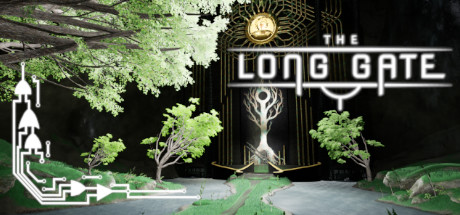
Explore mysterious caverns and solve the puzzles of the ancient machines that fill them.
Modeled estimate, not a reported figure. How we estimate →
Media

About

Key Features:
Three different classes of puzzles: digital, analog, and quantum
Optional levels of puzzle hints
A beautiful original soundtrack
Mysterious locations to explore and hidden secrets to discover
The Long Gate is a challenging and beautiful single-player, first-person, puzzle game. On a mission from the enigmatic creators of this place, you will explore ancient caverns filled with mysterious devices and traverse relaxing oases of nature while learning to solve the three primary types of puzzles that wind through them. Repair the ancient circuits and unravel the mystery of what happened to their creators.
Nearly all The Long Gate’s puzzles are based on real world technologies, and it contains accurate depictions of quantum circuits and a 4-bit quantum computer, verified by scientists at D-Wave Systems, the world’s first commercial quantum computer company. To progress through the game, you will learn the basic principles that form the backbones of each puzzle type. You do not need a technical background to finish the game, but if you have an interest in any STEM field these puzzles will be particularly interesting to you.
Levels and many puzzles can be completed in any order and many have more than a single possible solution for you to discover, and mastering a circuit type will provide keys to new areas and secrets. If you ever get stuck on a puzzle you can explore somewhere else, then come back later, or you can open the settings menu and turn on the hints.
The Long Gate also features an original soundtrack by musician Nick Newman.
Stats
All-time low is the lowest price we've recorded for this game since we started tracking it.
Languages: English**languages with full audio support
Engagement
Reviews
Themes across 40 recent reviews and how positive each mention is. A keyword signal, not full sentiment analysis.
Reviews
I just want to say from the outset that I like the idea behind the game. I also have a degree in computer science - with a course or two on digital circuitry - so I was actually really looking forward to the analogue/quantum parts of the game. I really want to like this game, but even after just under an hour of play time I've decided to ask for a refund. Here's an incomplete list of all the problems I came across in that short amount of time: * Changing the graphics settings around I was able to crash the game * Moving the window to another display stops mouse input from working * After exiting to the main menu and loading back up puzzle progress was reset * For a game with a rather simple aesthetic its performance is quite lacking. I can't get above 70fps with the lowest possible settings using an rx580 & 3700x. * The UI layout is completely bizarre with "return" mixed in randomly with other things on the right (and of course esc doesn't work) * There's nothing to introduce the controls - and the first time I tried clicking again on the first door it didn't work only the e key worked * The introductory digital puzzle weirdly toggles the success door whenever you happen to get the right answer making it faster to just randomly toggle buttons than actually look at the circuit * The camera is constantly snapping around with absolutely no indication for when I can move again * Moving the gates around is really clunky: It changes your sensitivity, doesn't really work properly while walking and never easily connects up the way you want it to. * Somehow the difficulty settings was changed from under me - I initially set it to engineer, but changed it back to normal, then midway through I opened up the menu and it was back on engineer. * There's no indicator that you can switch the levels of the elevator - I first thought it just cycled through them and then had to wait for the crazy long animation to cycle 7 times before being able to look at the first puzzle again. * On level 2 the game requires you to program you "gun" with a matching code. There's no indication of how this should be done and the "hint" given on the easiest mode is to "look behind you" which is entirely unhelpful when whats behind you is a wall. * Additionally part of the puzzle on level 2 did not function until I completed an "earlier" part even though the two are entirely disconnected.
Related
Related
Trends
Concurrent players on Steam, sampled daily since tracking started.
Hours played at review time, across 40 reviews with recorded playtime.
positive critical· bar length = how often the theme comes up
Technical jank and UI jank can be forgiven, but the real problem is that the puzzle design is awful. This game's idea of a puzzle is a binary addition calculator, already laid out for you. You do not need to, and cannot fiddle with the calculator in any way. All you need to do is generate the input, through a long and tedious process which is entirely identical across multiple puzzles. And you need to do this four times. That's not a puzzle for the player, it's a puzzle for the designer. For the player it's a homework assignment. There are some interesting ideas in there, to be sure. But it's squandered on tedious puzzle design where all the interesting stuff is already hardcoded.
A logic game that covers a wide range of circuits and electronics topics. It's a good learning experience, and makes it really interesting to play with concepts that are normally kinda bland. I would recommend this if you really like logical puzzles, want to play with computing in an alternate way, or want to get more of an understanding how electronics work. I would probably not recommend this if you are looking for easy puzzles, or are looking for a story game. This game's about the puzzles, and expect them to take some effort.
This 2020 (!!) game suffers from a major design problem: Already on "level 2", you are being asked to solve complex puzzles that use the "LATCH" mechanism, with no introductory 'easy' variant that would explain what the hell it actually does. This is very common for single-designer puzzle games, where the author over-estimates what the players know or how they think. The reason why I'm mentioning the year when this game came out is that this is 13 years after PORTAL, which spends the first 5 or so levels without giving you the portal gun, then another bunch of levels before it gives you full control over both portals. This is because the developers actually tested the game with real humans and saw how much ordinary people struggle getting the basic concepts. So they toned it down more and more until testers were actually able to get through. In The Long Gate, you will unfortunately solve few puzzles (such as the Floor 2) by accident, with no real understanding WHY your 'clickety click click gosh darn it work click' approach worked. And the moment you do solve it, the game / designer incorrectly assumes that you KNOW why it worked, so you are expected to then use that knowledge in future puzzles, which get even harder. The game needs a massive rework of the early stages. Apparently, almost everybody goes to the Guide section and reads the solutions, which is probably not what the developer wanted. Edit after progressing further: Through sheer luck and perseverance, I managed to get roughly to the half-point of the game, until I reached a puzzle that is a HARD STOP. This puzzle contains a brand new component that is also a black box (i.e., you cannot look inside to see how it works, internally), it _may_ be on a timer, and it's controlled by 6 buttons. You need to use this device correctly 8 times, otherwise it resets to the beginning. Without solving this puzzle, it is impossible to proceed further. There is no "Reset to initial configuration" function in the game, and I managed to get the puzzle into a state from which the solution in the guides section does not work, so I guess I am out of luck. I've spoken about this game with people on the Discord who are apparently well-versed in engineering and circuits, but even they admit that frequently, they had no idea how the puzzles work. I remain convinced this game's design is deeply flawed.
Just finished the game. Excellent! I was blocking at one segment and by chance I realized that there was a specific thing to do before searching for help on the internet. Nice quantum level. I did not understand everything, and far from me to understand how a quantum computer works. I just made the inputs mostly by intuition, which was apparently sufficient. I wish i could have had this game when learning about boolean algebra, pass-by filters, binary conversion, RLC circuits or Q-bits at early years of university.
Brilliant transformation of mathematics and physics into puzzles. Missing only few quality of life improvements, mostly in visual and control department.
[url=https://www.youtube.com/watch?v=hVPONDN5XJE] Video Review [/url] A really fascinating game with gorgeous visuals and interesting puzzles based on real life technical concepts (logic gates, binary, circuitry, analogue and digital electronics etc.). The scale of the game's setting and the realism in the puzzle mechanics makes you feel like some sort of space age engineer working your way through some grand, futuristic, sci-fi environment. Definitely has a high and quite academic barrier for entry (you will need to know what a logic gate is first before you play..) but if you can hurdle that then there's a very interesting and atmospheric game here for you. Not perfect, and has some clunkiness/slowness at times, but very strong overall
Amazing game! Beautiful areas, immersive soundtrack, and super challenging puzzles! It took me many hours to figure out the mechanics, but it was all worthy it! Oh, and the secrets, they are so cool! Prepare yourself for some shocking moments!
TL;DR: Buy this game if you want to solve challenging and logical puzzles! You'll need some patience to learn what it wants to teach you, but it's worth it! Full review: The Long Gate is an enjoyable and minimalist puzzle game. It's a game where every time I walk into a new area I'm like "oh ♥♥♥♥ off" because the problems seem too difficult at first glance. At the same time, I've yet to come across a puzzle that hasn't made sense, or that I couldn't solve, or that I didn't enjoy solving. I say this in the best way possible. There's a great satisfaction in solving the Long Gate's puzzles because the solutions often aren't immediately apparent, but they truly do make sense. When you work out the correct solution or sequence of actions, there's a strong sense of reward for the patience you showed while trying to make sense of the unfamiliar. I've not yet finished the game, but have really enjoyed it so far. It's been quite stress relieving and I find myself coming back to it quite easily. I did a year of programming back at the start of uni a few years back, so I was familiar with some of the concepts the game introduces early on. I've also dabbled with redstone projects in Minecraft and the puzzles you solve with circuitry in The Long Gate are sort of similar. If you don't want to learn binary, or bit flipping or how circuits work, then this isn't the game for you. If you can't accept that this game was made by a very small team and isn't perfect, then this game isn't for you. Otherwise, the puzzles definitely are challenging, but I do think that keen newcomers unafraid of a challenge could give this a go and enjoy themselves. I've found the game runs alright too on a gtx 1070 and ryzen 3600, though I do wish there was a cleaner AA implementation. The highest setting obscures texture detail in the distance, but turning this down introduces aliasing. With that said, it's still a good looking game with a clear atmosphere that is well supported by a low-key soundtrack. The sound effects are very mechanical too, which really adds to the cyber-industrial aesthetic of the game. I think this game is very underrated and definitely recommend giving it a go. I bought it at full price and am very happy with my purchase :).
Challenging and straight forward, non-stop puzzles for those who like to solve them for the sake of solving, don't expect a big reward for it!
Momentum
Pace estimated from the game's recent review growth (our daily snapshots) at its own sales-per-review ratio — a momentum signal, not booked sales.
Audience
Estimated from the language of this game's reviews — a proxy for where players are, not official Steam demographics.
Related
| Three kingdoms story: Conussia | $12.9K | 140 | 51% | $6.99 |
| CastleMiner Warfare | $12.9K | 96 | 52% | $5.99 |
| Adverse Effects | $12.9K | 186 | 89% | $2.49 |
| Pixel Galaxy | $12.9K | 190 | 86% | $2.99 |
| O3DX | $12.9K | 64 | 56% | $7.99 |
| League of Evil | $12.9K | 64 | 80% | $7.99 |