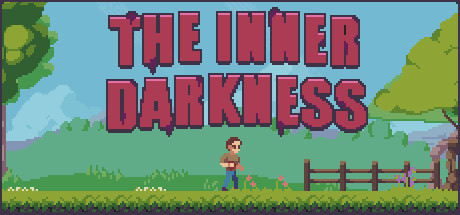
The Inner Darkness is a short but atmospheric indie puzzle-platformer that leans heavily into mood, symbolism, and mechanical restraint to tell its story. Developed and published by Nauris Amatnieks, the game opens with a deliberately unsettling premise: a wounded man awakens in an unfamiliar world, bleeding and disoriented, with no clear explanation of how he arrived there or what awaits him. This sense of vulnerability and confusion sets the tone for the entire experience, positioning the journey as both a physical struggle for survival and a metaphorical descent into a fractured inner psyche.
Gameplay centers on a dual-world mechanic that allows the player to shift between two dimensions at will. Each dimension represents a different version of the same space, with platforms, hazards, and pathways changing depending on which reality is active. Progress often depends on careful observation and thoughtful timing, as obstacles that are deadly in one dimension may be harmless or nonexistent in the other. This constant toggling transforms even simple platforming sequences into layered puzzles, requiring players to plan routes across both realities rather than react to a single static environment. The mechanic is intuitive to use but demands deliberate thinking, reinforcing the game’s slow, methodical pace.
The platforming itself is relatively restrained, favoring precision and awareness over speed or reflex-heavy challenges. Jumps, movement, and hazard navigation are designed to support the puzzle structure rather than dominate it, ensuring that problem-solving remains the focus. While the controls are simple, mistakes are often punished with instant death, reinforcing the sense of fragility that defines the protagonist’s condition. Checkpoints are generous enough to prevent frustration from becoming overwhelming, allowing players to experiment and learn without excessive repetition.
Visually, The Inner Darkness employs a pixel art style that prioritizes atmosphere over detail. The environments are moody and often bleak, filled with shadowy silhouettes, distorted landscapes, and unsettling contrasts between the two dimensions. Switching realities not only alters gameplay elements but also subtly reshapes the tone of each area, reinforcing the idea that the world itself is unstable and reflective of the protagonist’s mental state. This visual duality is one of the game’s strongest aspects, as it makes the act of dimension switching feel narratively meaningful rather than purely mechanical.
Sound design plays a similarly understated but effective role. Ambient audio and minimalistic music underscore the loneliness of the journey, enhancing tension without drawing attention away from gameplay. Silence is used deliberately, allowing moments of stillness to heighten unease and giving weight to environmental changes. The overall audio presentation complements the visuals well, creating a cohesive atmosphere that supports immersion despite the game’s modest scope.
Narratively, the game adopts a sparse and introspective approach. Story elements are delivered primarily through internal monologue and brief text segments, offering insight into the protagonist’s thoughts and emotional state. While this approach helps clarify objectives and themes, it can occasionally feel direct, spelling out ideas that might otherwise be inferred through environmental storytelling. Even so, the narrative succeeds in providing context and motivation, framing the journey as an exploration of inner turmoil as much as an escape from a hostile world.
One of the most notable aspects of The Inner Darkness is its brevity. The experience can be completed in a relatively short time, often within a single sitting. This concise structure works in the game’s favor by maintaining focus and preventing its mechanics from becoming stale, but it also limits the opportunity for deeper mechanical evolution or more complex puzzle variations. Players looking for a lengthy or content-rich platformer may find it lacking in scope, while those who appreciate tightly contained, idea-driven experiences are more likely to view its length as a strength.
Overall, The Inner Darkness stands as a thoughtful and atmospheric indie title that uses a single core mechanic to explore themes of disorientation, vulnerability, and self-reflection. It does not aim to revolutionize the puzzle-platformer genre, but it delivers a cohesive experience that blends gameplay, visuals, and narrative into a unified whole. For players who enjoy introspective games with a strong mood and a focus on clever spatial puzzles rather than raw challenge, The Inner Darkness offers a brief but memorable journey into a world shaped as much by the mind as by physical space.
Rating: 6/10