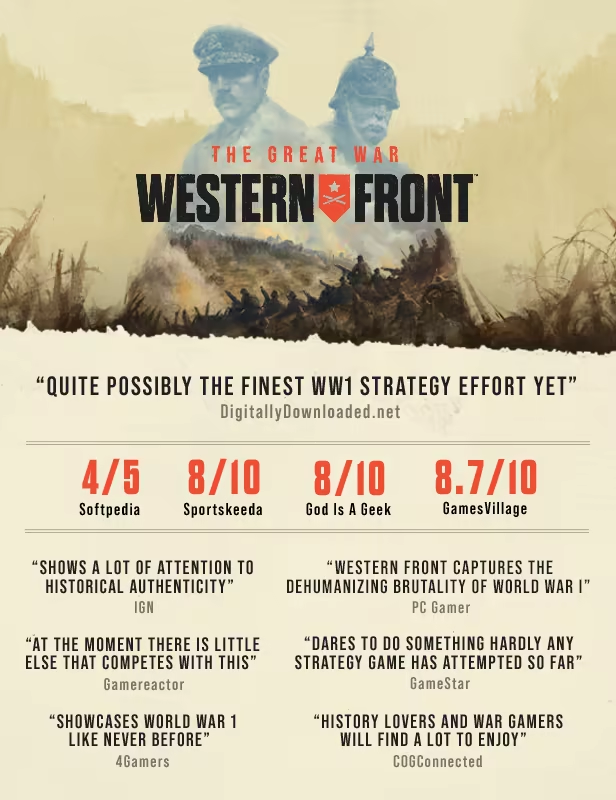
The Great War: Western Front is the definitive WW1 strategy game. Play a deciding role in history with this real-time tactical experience as you take charge in the iconic Western Front from 1914 to 1919. Pick your faction and lead your forces to victory.
Modeled estimate, not a reported figure. How we estimate →
Prices
Each in the currency that store quoted — not converted: the gap between two rows is the publisher's pricing, not an exchange rate.
14 of 15 markets; the rest we haven't asked for this title, not markets where it is unavailable.
Availability
We put this game to every storefront we collect. A market that answered not sold has told us something about the game; a market we never asked has not, and the two are never drawn the same.
Discounts
Every price cut of more than 20% we have observed, in each market that quoted one, with this game's chart position on either side of it. These are episodes, not a model: a sale is one event, and one event cannot tell you what the next one will do.
About


Updates
Build ids and update times come straight from Steam's PICS — the same source SteamDB reads. Patch history grows as we record new builds.
Engagement
Reviews
Themes across 810 recent reviews and how positive each mention is. A keyword signal, not full sentiment analysis.
Reviews
I like it, but a major issue is that it leans too much into the tedious aspects of WW1 battles. It portrays the conflict very well, but that's not exactly fun to play. The game gets boring after a few dozen turns.
从各个兵种,到无限拉扯的玩法,以及各自影像、文字资料和“帝国战争博物馆”,可以看出制作组对于“一战”这个题材确实用心了。 好消息:高度还原一战。 坏消息:高度还原一战。 喜欢一战历史的玩家推荐一下,但是想着玩类似于一战套皮版《红色警戒》的玩家可以离开了,因为这个真的是“教科书级”还原一战:蹲坑蹲坑还是蹲坑,一道接一道的堑壕,永无止境的烂仗对轰,难以推进的战线,炮兵轰步兵冲,人海排队枪毙,肉身怼机枪……相信这也是一战题材游戏较少的原因之一吧。 “我们已不再年少。我们不再想征服世界。我们是逃兵。我们既逃避自己,又逃避生活。” ——《西线无战事》
Media

Related
Related
Price dynamics, follower growth, revenue and sales trajectories with interactive tooltips
This and every other Pro feature is free until October 20, 2026. A free account is all it takes.
14 on sale1 answered “not sold”0 we did not ask
The 1 “not sold” market is read from the Steam price pass of Aug 31: that day the store answered for this game elsewhere and gave no price there. The 14 priced markets are the same rows as the table above — each the latest price we hold, dated here when it is older than that pass. The 0 marked “not asked” were not put to this store at all — either it has no storefront there or we do not collect it yet, and neither is a statement about the game. A refusal is a refusal on one day; a store can list a title again tomorrow.
Reviews, worldwide (the counter carries no country): 0.57/day in the week to Aug 11 → 1.14/day in the week after.
For scale, across Steam · Top Sellers · Brazil over the last 30 days: the 26 chart moves that followed a price cut of more than 20% went a median of 7 places towards #1, and the 2,400 moves with no price cut behind them went 2 away. One store, one chart, one country — it is the only place we have enough observations to say even that.
Prices outside the United States have been collected since 6 August 2026 and chart positions since 19 July 2026, so a cut older than that has no market to compare and a market that joined later has no history yet. Nothing here is converted between currencies.
Genres
Stats
All-time low is the lowest price we've recorded for this game since we started tracking it.
Languages: English*, French*, Italian, German*, Spanish - Spain*, Polish, Russian*, Simplified Chinese, Turkish*languages with full audio support
Hours played at review time, across 812 reviews with recorded playtime.
positive critical· bar length = how often the theme comes up
A great concept let down by serious flaws in its execution. Making a faithful RTS about the Great War was always going to be tricky. By its nature, a grind is essential to the feel of combat, and defenders need a clear advantage that clever attackers have to overcome. In the outlines, the Great War has those elements. The meta-map of the game is great. Big view, fun tech tree decisions, and an "but they can't defend everywhere" sense of opportunity and worry as you look over the map. But then there's the RTS combat itself. And to start with, the computer can see everything you're doing. In a war where fog of war was so important the French lost an entire year planning an attack on somewhere the Germans deliberately abandoned, that's not great. Trying to build up forces? Expect an artillery barrage on the men as they muster. Trying to probe a weak spot? Expect more of the same. In turn, the troop AI further compounds the problem by having terrible pathfinding. Want to kill an artillery piece? Better hope you're moving! Grenades don't work otherwise. The results are half hour long battles where the answer is both obvious (cluster your artillery, concentrate infantry, bite, hold), and tedious without offering much joy or challenge. Just the occasional, "oh for god's sakes why are you all flailing around above that trench". There's just not enough here to compel me to play a full campaign, much as I'd love to see flamethrowers or tanks or gas or all else, I don't see how it breaks that fundamental slog. It's a shame, but this one should stay forgotten.
The bones are there, the game is fun and the setting is rich, but they released the game and immediately bailed out. It is not a maintained and cared for project, they have not touched it in a very long time.
10 hrs in and I think it's over for me. Initially I was so impressed with the scale and the vision, but it shocked me just how quickly it all starts to feel very stale and repetitive. I think the main problems for me are 2 fold: 1) the mechanic whereby, in order to achieve true victory and capture provinces, you have to capture all control points and the command bunker. Every. Single. Time. And I'm playing with the 1 star general mod which lets you take territory after just one great victory. It's still too tedious. 2) others have said this, and I can't confirm necessarily, but it certainly feels like the AI can do things that you just can't. For example, as far as I'm aware you can only field 30 infantry units at any one time: yet as soon as you capture a point off the AI, they can keep all of their trenches manned [i]and[/I] send thousands of men at you to retake the point you just captured, whilst you struggle to reinforce and eventually just succumb to the weight of numbers. It certainly does convey the sense of waste and exhaustion of ww1 warfare; even so, I can't imagine any developer saying to themselves "I hope players [I]sigh[/I] whilst playing my game". It's all so achingly predictable after just a couple of battles that it genuinely feels like a chore to play. I did have some moments of fun: the best battle I fought was defending and I really felt like I was holding with limited manpower and ammunition - it was tense stuff! Also, starting a campaign in 1914 is just a mistake - without anything like gas/smoke rounds, different troop types and armour unlocked, the tactical options are just mind numbingly limited. So i'd say, it is potentially worth investing in on sale [I]if[/I] your tolerance for repetition is extremely high. Mine is not so, I just can't recommend it. But kudos for giving the setting a really well considered and thoughtful go!
It's not an awful game but it's not a very good one either. If i could i would have put it somewhere 5/10. Ever since this game was realesed i've come back to play it every now and then. Because it has something that i can't find anywhere else. The problem is that it gets boring after some hours, so i never managed to play an entire playthrough. The tactical battle can be kinda fun, but get repetetive after a while. The biggest problem for me i think is the "winning" conditions of capturing a region. Every region has a star value ( 1,2,3 etc) and to capture a region you must reduce it to 0. The way to reduce the value is by winning battles. This is all fine. But it's pretty much all or nothing victorys that count. So either capture every controlpoint on a map or kill enough troops so the enemy surrenders. And they only surrender once they are down to pretty much their last few squads. This would also be fine. But an attacker can also offer a ceasfire to the enemy. The enemy may then chose to either accept the ceasefire or make a counterattack. The problem is, even if an attacker captures all but one controlpoint, then offers a ceasfire and the enemy accepts, the attacker dont get to keep those controlpoints for the next battle. Making very little point in offering a ceasefire. Likewise, if a defender chose to counterattack, you then have to capture all the enemies controlpoints or make them surrender. Otherwise it will count as a loss for the defender. This also makes defending a region very easy. I've defended with just one company against 12. I don't have to care if I lose all but one point, becuse you just have to hold one, if the enemy don't take it you will just get the others back after the battle. I'd rather if the attacker (or the defender if counterattacking) would keep the points they've captured. Even if this would not reduce the starvalue, it would still give a little more tactical and strategical depth. The biggest letdown however and the reason for the negative review, the devs just abandoned the game a few months after realese. This is a niche game for a niche audience and would never reach the mainstream as i think the devs had hoped for. At the very least the could have sticked around abit longer for those that did like the game. Taking in their thoughts and opinions and built the game around that.
The Great War: Western Front is an ambitious strategy game that tries to capture the difficult realities of commanding armies during World War I rather than simply using the era as a backdrop for conventional real-time warfare. Developed by Petroglyph and published by Frontier Foundry, it combines turn-based strategic management with real-time tactical battles across the Western Front. Its defining characteristic is attrition. Capturing territory matters, but preserving manpower, maintaining supplies, choosing favorable engagements, and gradually exhausting the enemy are often more important than achieving spectacular victories. The campaign places considerable responsibility on the player at the strategic level. Armies must be positioned along the front, resources allocated, technologies researched, and offensives planned with an understanding that every battle carries a price. This creates an interesting relationship between short-term tactical victories and long-term strategic survival. A successful attack that costs enormous numbers of troops may actually leave the player in a worse overall position. Conversely, holding an important sector efficiently can be more valuable than launching an unnecessary offensive. This emphasis on calculated expenditure makes the campaign feel substantially different from strategy games built around constant territorial expansion. Once a battle begins, command moves into real-time tactics, where preparation becomes extremely important. Players can construct trench networks, establish artillery positions, deploy infantry, position machine guns, and create defensive layouts before combat fully develops. Trench placement is particularly satisfying because thoughtful designs can dramatically improve survivability and movement between positions. Poorly prepared defenses can collapse quickly, while a carefully organized network can make even a numerically superior attacker pay heavily for every section of ground. Offensive operations demand an equally methodical approach. Charging infantry directly into prepared defenses is rarely sensible, so artillery bombardments, reconnaissance, supporting weapons, and coordinated advances become essential. As technology develops, additional options such as tanks, aircraft, and chemical weapons broaden the available tactics. Research therefore has genuine strategic importance because technological priorities can influence how future battles are fought. The player is constantly balancing immediate military requirements against investments that may provide greater advantages later in the campaign. One of the game's most distinctive systems is battlefield persistence. Fighting leaves visible consequences on contested locations, including damaged terrain, shell craters, devastated landscapes, and established defensive positions. Returning to a familiar sector can therefore feel like continuing an earlier engagement rather than loading an unrelated map. This gives individual locations a history of their own and reinforces the exhausting back-and-forth struggle associated with the Western Front. Weather and seasonal conditions add further complications by influencing movement and battlefield effectiveness. The presentation supports this atmosphere effectively. Battlefields gradually become devastated rather than remaining pristine arenas, and the visual design communicates the industrial scale of the conflict without turning warfare into a heroic spectacle. Period equipment, artillery, infantry formations, tanks, fortifications, and environmental details contribute to the historical character. The involvement of the Imperial War Museums in the game's historical approach is noticeable in the attention given to recreating the equipment and conditions associated with the period. However, the same commitment to attritional warfare can create repetition. Long campaigns naturally involve attacking or defending similar locations multiple times, and certain tactical patterns can become predictable after the player discovers reliable methods for combining artillery, infantry, trenches, and supporting units. The artificial intelligence does not always respond creatively enough to prevent these strategies from becoming routine. Players expecting rapidly changing front lines and dramatic breakthroughs may consequently find the deliberate pace frustrating. There is still a worthwhile amount of content outside the central campaign. Historical Battles provide scenarios based around significant engagements, while Skirmish offers quicker access to tactical combat. Multiplayer allows the game's systems to become less predictable because another player can exploit weaknesses and adapt more intelligently than the AI. Steam Workshop integration also provides an avenue for community-created material and helps extend the game's usefulness beyond the included scenarios. Steam Deck compatibility is a significant limitation. The game does not have official Steam Deck support and is not designed primarily around handheld controls. Its interface, numerous tactical commands, strategic menus, and reliance on precise pointer-style interaction are much better suited to a mouse and keyboard. Attempts to run it through SteamOS may also encounter compatibility or performance considerations depending on the current Proton configuration. Players specifically seeking a comfortable handheld strategy experience should therefore treat Steam Deck play as unsupported rather than expecting a polished, verified experience. The Great War: Western Front ultimately succeeds at giving World War I strategy its own identity. It understands that the conflict cannot be represented convincingly simply by replacing modern units with older equipment. Attrition, fortifications, artillery preparation, technological development, persistent battlefields, resource management, and the consequences of casualties are woven into both the strategic and tactical layers. These mechanics occasionally create slow or repetitive stretches, but they also produce the game's most compelling decisions. For strategy enthusiasts interested in military history and deliberate operational planning, it offers a thoughtful interpretation of a difficult period to translate into an entertaining game. Its strongest moments come when the player realizes that winning a battle and winning the war are not necessarily the same objective. The tactical AI and repetitive nature of prolonged campaigns prevent it from reaching its full potential, while the lack of dependable Steam Deck support reduces its appeal for handheld players. On a traditional PC setup, however, its unusual combination of campaign management and persistent real-time battlefields makes it a distinctive addition to the historical strategy genre. Rating: 7/10
I WISH THERE WAS AN OPTION FOR MIXED RECCOMENDATION!!!!!! I'm choosing to leave a positive instead of a negative review, despite the issues this game has, and the lack of development from the devs. For what it offers, it's unique enough that I've enjoyed my time with it. That said, this game is not for everyone, and I'd think some of yall would have had more sense before purchasing something WE BOTH KNOW YOU WERE NEVER GOING TO LIKE. If you're a fan of WWI history, a hardcore RTS fan, then you can have a decent amount of fun here. If you're not those things, or someone huge on gameplay and graphics this won't be for you. More for the folks like me who like to stair at a screen for 10 minutes thinking on what our next moves should be lol
Game feels like its not finished. Is abandonned by devs (at least no bugs are being addressed anymore). Fun concept, but after a few turns ingame, you realize its literally nothing new anymore. There are ingame (world) events that are just flavor. You are very limited by supplies, however the enemy seems to be completely unaffected by supplies/gold reserves. Losing battles leads to replenishing dead troops with "Gold Reserves", but you can go into the negative without any repercusion (outside not being able to buy planes/upgrades on the map; which are useless anyway). Game sometimes struggles to run, especially when you do double speed during battles, many hiccups and units getting stuck. Wish I could go back in time to tell me to not buy it at launch, but wait for a 5euro sale.
It's a fun game but they have completely abandoned it. Now It's ok for some games to be "finished" and "complete" but there's a lot of stuff that really should be in the game that isn't. Like others have said only buy on sale.
Selling now
See how fast this game is selling right now — estimated copies and revenue per day from recent review growth.
Active players
Estimated daily and monthly active players (DAU/MAU) modeled from peak concurrency.
Players by region
Where this game's players are, estimated from review languages.
Players also reviewed
The games this title's players most often review too — audience affinity.
Related
| Game | Estimated lifetime revenue | Reviews | Review score | Price |
|---|---|---|---|---|
| — | 0 | — | — | |
| $40.9M | 40.2K | 57% | $23.99 | |
| $127.6K | 104 | 86% | $59.99 | |
| — | 0 | — | — | |
| — | 0 | — | — | |
| $21.1M | 16.1K | 80% | $39.99 |
Related
| Game | Estimated lifetime revenue | Reviews | Review score | Price |
|---|---|---|---|---|
| $434K | 3.7K | 81% | $9.99 | |
| $434.3K | 1.1K | 78% | $9.99 | |
| $434.3K | 2K | 84% | $14.99 | |
| $433.8K | 866 | 75% | $19.99 | |
| $433.7K | 1.2K | 93% | $24.99 | |
| $433.6K | 959 | 83% | $19.99 |