The Charnel House Trilogy, developed and published by Owl Cave, is a haunting point-and-click adventure that merges psychological horror with atmospheric storytelling in a short but unforgettable experience. Released in 2015, it is presented as a trilogy of interconnected chapters—“Inhale,” “Sepulchre,” and “Exhale”—that together tell a story about loss, guilt, and the unsettling spaces between life and death. What begins as a seemingly grounded narrative about two ordinary individuals quickly unravels into something surreal and chilling, capturing the feel of a fever dream that grows darker with every click. Owl Cave uses minimalistic mechanics and a strong sense of mood to craft an experience that lingers long after it ends, despite its brevity and simplicity.
The opening chapter, “Inhale,” introduces Alex Davenport, a young woman dealing with loneliness and lingering trauma from a recent breakup. Her mundane evening in a small, rain-soaked apartment establishes a tone of quiet melancholy. When she receives a mysterious train ticket to a place called Augur Peak, curiosity leads her to embark on a journey that will forever change her understanding of reality. The following chapter, “Sepulchre,” shifts focus to Dr. Harold Lang, a reserved man traveling aboard the same train. His interactions with the eerily calm passengers and the gradual descent into surreal horror create an unnerving sense of disorientation. The final chapter, “Exhale,” returns to Alex, now on the same train herself, where the fragmented narrative threads begin to intertwine and reveal a deeper, more psychological meaning behind the events. Rather than providing neat answers, the game chooses to leave its mysteries open-ended, inviting players to interpret the story through symbolism and suggestion.
The narrative works not because it offers resolution, but because it evokes an atmosphere of creeping dread and emotional unease. Owl Cave’s writing is restrained, allowing implication and subtext to carry much of the weight. The dialogue oscillates between naturalistic and cryptic, and while some of the humor and self-referential banter in the first chapter can feel slightly out of place, it serves to disarm the player before the true horror takes hold. By the time the story reaches its midpoint, the game has shifted tone entirely, wrapping its characters in an oppressive sense of inevitability. Themes of regret, mortality, and the fragility of identity run through every conversation and every silent moment, culminating in a finale that leaves the player unsettled rather than satisfied.
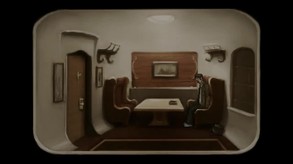
Visually, The Charnel House Trilogy embraces pixel art to deliver a distinctive and effective sense of atmosphere. The low-resolution aesthetic might appear simple, but it’s used masterfully to evoke isolation and claustrophobia. The game’s environments are soaked in shades of blue, gray, and black, punctuated occasionally by stark flashes of red or sickly green to heighten the tension. The train, in particular, becomes a character in its own right—its narrow corridors, dimly lit compartments, and rhythmic clatter create a setting that feels at once ordinary and otherworldly. The sound design complements this visual approach perfectly. The ambient noises of rain, steel, and faint murmurs contribute to the pervasive unease, while the score shifts between moody piano themes and quiet, dissonant drones. Combined with solid voice acting from an indie cast, including performance cameos from well-known adventure game personalities, the presentation immerses the player completely in its nightmarish world.
As a game, The Charnel House Trilogy keeps its mechanics simple. It’s a classic point-and-click adventure in form, though stripped down to its essentials. The puzzles are straightforward and largely serve to keep the story moving rather than challenge the player’s problem-solving skills. This design choice places emphasis squarely on the narrative and atmosphere, making it feel more like interactive fiction than a traditional adventure. For some players, this minimalism enhances immersion by removing barriers between the player and the story. For others, it might feel overly linear or lacking in depth, as there’s little room for exploration or meaningful interaction beyond the required steps. Yet in this simplicity lies intention—Owl Cave ensures that every click serves a purpose, every action a beat in the unfolding dread.
The game’s pacing and structure reflect its literary inspirations more than typical game design. Each chapter functions like a short story, and while they share a setting and overarching mystery, each has its own rhythm and emotional focus. The transitions between them are sharp, mirroring the feeling of waking from one dream only to fall into another. The fragmented storytelling may frustrate players seeking clarity, but it effectively mirrors the psychological disorientation of the characters themselves. The train acts as a perfect metaphor for this approach—an endless journey through darkness where time, memory, and logic cease to matter. The Charnel House Trilogy’s refusal to provide easy answers is part of what makes it so compelling. It asks players to accept ambiguity and interpret the horror through feeling rather than exposition.
Despite its strengths, the game has noticeable flaws. The tonal inconsistency between the first and later chapters can feel jarring, as the early humor clashes with the somber, unnerving tone that dominates the rest of the experience. The brevity of the game—lasting only two to three hours—also limits the depth of its world-building and character development. There are hints of something grander beneath the surface, a mythology waiting to be explored, but the story ends just as it begins to unravel its true potential. Some of the dialogue delivery and animation can also feel stiff, and the simplicity of the puzzles might leave players craving more complexity. Still, these imperfections feel secondary to the game’s greater accomplishment: the creation of a mood so specific and sustained that it transcends its technical limitations.
The Charnel House Trilogy stands as a testament to how atmosphere and writing can outweigh scale and spectacle. It’s not about what you do, but what you feel as you do it—the quiet dread of walking down a dimly lit train corridor, the slow realization that nothing around you makes sense, and the creeping suspicion that the characters are as lost in their own minds as they are in the physical world. It’s a story about journeys both literal and psychological, about people who can’t escape the ghosts of their past no matter how far they travel. For fans of narrative-driven indie games and psychological horror, it offers a beautifully compact experience that feels like reading a ghost story in a single sitting. It may not answer every question it raises, but the sense of unease it leaves behind is precisely what makes it so memorable—a dark, quiet ride that ends, fittingly, without ever really stopping.
Rating: 8/10