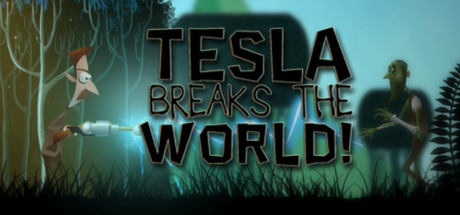
Tesla Breaks the World!, developed and published by Archetype Global, is an eccentric indie platformer that attempts to blend steampunk invention, light puzzle-solving, and absurd humor into a single 2D experience. It stars Nikola Tesla, the brilliant yet perpetually unlucky inventor, who—through an experiment gone wrong—accidentally unleashes a catastrophic wave of chaos across the world. The resulting rift tears open the boundaries between science and the supernatural, flooding the environment with zombies, bizarre machines, and distorted landscapes. From this premise, the game builds an adventure that feels both comedic and chaotic, inviting players to navigate strange mechanical puzzles and swarms of enemies in an attempt to restore order. The concept is inherently intriguing, promising a mix of brainy problem-solving and fast-paced action, but the execution reveals both flashes of creativity and deep structural flaws.
At its core, Tesla Breaks the World! is a side-scrolling platformer that combines environmental puzzles with light combat and exploration. The player must use Tesla’s various inventions—hovering devices, portable coils, and energy-based gadgets—to traverse the environment and defeat enemies. Each gadget serves as both a weapon and a tool for progression, creating moments where mechanical creativity is encouraged. The puzzles themselves revolve around activating switches, bridging electric circuits, and strategically using energy to manipulate machinery. The game occasionally surprises with clever design ideas, especially when multiple devices must be used in tandem to progress through a level. Unfortunately, these flashes of ingenuity are undermined by inconsistent pacing and mechanical roughness. The controls lack precision, and the platforming often feels slippery, making it difficult to execute jumps or time actions with accuracy. In a genre that thrives on responsiveness, this looseness quickly becomes one of the game’s most frustrating aspects.
The combat system, while conceptually interesting, suffers from similar issues. Tesla’s inventions double as weapons, and players must balance their use between offense and puzzle-solving. Enemies include a mix of undead creatures and malfunctioning robots, designed to reflect the absurd consequences of Tesla’s scientific mishap. Fighting them, however, is rarely satisfying. The hit detection feels inconsistent, and Tesla’s attacks lack the weight or feedback that would make combat feel meaningful. Enemies often repeat behaviors or spawn in predictable patterns, turning encounters into repetitive chores rather than tense or strategic engagements. There are occasional moments of tension, particularly when puzzles and combat overlap, forcing players to think on their feet, but these moments are fleeting. More often, the experience alternates between brief enjoyment and mounting frustration as technical limitations overshadow creative ambition.
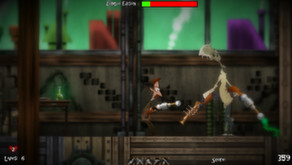
Visually, the game embraces a hand-drawn steampunk aesthetic that captures the tone of its premise. The environments depict a twisted industrial world filled with gears, copper pipes, flickering machinery, and crumbling architecture. The art style carries a certain rustic charm, with expressive animations and an exaggerated cartoonish tone that fits the humor of the story. However, despite the appealing design direction, the visual variety is limited. Many areas share similar backgrounds and assets, making later levels feel visually redundant. The same applies to character and enemy designs, which repeat too frequently without meaningful variation. The graphical fidelity is modest but serviceable for an indie title; what matters more is how consistently the world conveys Tesla’s blend of science and madness. The developers succeed at creating an atmosphere that is quirky and slightly absurd, though technical glitches—occasional stuttering or animation errors—sometimes break immersion.
Sound design fares somewhat better. The music leans toward whimsical, European-inspired melodies with a touch of mechanical ambiance, evoking the spirit of a 19th-century laboratory running amok. The soundtrack complements the game’s eccentric tone without overwhelming it. Sound effects, particularly those for Tesla’s electrical devices and enemy growls, add flavor and depth to the action. The crackle of energy and the rhythmic hum of engines help reinforce the setting’s mechanical identity. Voice work is limited, and much of the storytelling relies on visual gags or text boxes, but the tone remains consistent—a mix of parody and pulp science fiction. The game’s humor is self-aware and often absurd, poking fun at the mythos of Tesla and Edison with exaggerated personality traits and tongue-in-cheek dialogue. It’s a style that won’t appeal to everyone, but for those who appreciate campy science humor, it brings occasional charm.
Despite its ambition, Tesla Breaks the World! struggles to maintain balance between its different gameplay elements. The puzzle sections, while interesting at first, become repetitive due to the limited variety of mechanics. The same basic circuit or switch puzzles recur with minor tweaks, leading to a sense of monotony. The randomization of level layouts, a feature intended to enhance replay value, adds little meaningful diversity. While the idea of shifting layouts suggests unpredictability, in practice the variations are too small to change the overall experience. This repetition, combined with unrefined controls, makes the game feel more exhausting than engaging over time. The difficulty curve is inconsistent as well—some sections are forgiving to the point of boredom, while others spike sharply due to erratic enemy placement or awkward jumping sequences.
The narrative, while light and comedic, serves primarily as a vehicle for the game’s absurd tone. Tesla’s battle against his own technological catastrophe is portrayed with over-the-top flair, and the inclusion of zombies and reality-warping machines pushes the story into deliberate ridiculousness. The problem is that the writing never quite capitalizes on its premise. There are moments when the humor works—particularly in visual jokes and exaggerated situations—but it lacks the clever pacing or structure to sustain a comedic rhythm. Still, the theme of an inventor literally breaking reality with his ambition provides enough context to carry the player through the campaign, even if the story ultimately feels more like background dressing than a driving force.
Technically, the game is modest in scope and performance. It runs efficiently on most systems and has a low hardware requirement, though occasional bugs and minor slowdowns can occur. The interface is clean but not particularly polished; menus and transitions feel functional rather than refined. What holds the experience together, despite its flaws, is a sense of individuality. Tesla Breaks the World! does not feel like a derivative indie platformer—it has its own peculiar personality. Its fusion of science fiction absurdity, puzzle-platforming, and humor makes it stand out, even when its design falters.
In the end, Tesla Breaks the World! is a game of ambition outpacing execution. It’s full of creative ideas that never fully coalesce into a polished whole. The concept of playing as a manic inventor armed with experimental gadgets is compelling, and the steampunk world brims with character, but sluggish controls, repetitive design, and uneven pacing prevent it from reaching its potential. It’s a title that will likely appeal most to players who enjoy unconventional indie experiments—games that prioritize creativity and atmosphere over technical precision. For those willing to forgive its rough edges, Tesla Breaks the World! offers an eccentric, occasionally entertaining, but undeniably flawed journey through the chaotic mind of one of history’s most fascinating inventors.
Rating: 4/10