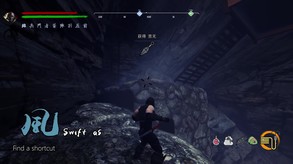
Play as a ninja through the Sengoku period of Japan. There are many possible ways to assassinate the target and find your own nindou.
Modeled estimate, not a reported figure. How we estimate →
Media
About
Stats
All-time low is the lowest price we've recorded for this game since we started tracking it.
Languages: Simplified Chinese, English, Russian, Portuguese - Brazil
Engagement
Hours played at review time, across 40 reviews with recorded playtime.
Reviews
Themes across 40 recent reviews and how positive each mention is. A keyword signal, not full sentiment analysis.
positive critical· bar length = how often the theme comes up
Reviews
非常垃圾的一款遊戲!我勸大家不要買了,買了就後悔!操作像屎一樣!系統做的很差!還有Bug!
商家是不是骗完钱已经跑路了?感觉到现在还是测试版一样的......
Good Ninja Game!
Wäre toll mit deutschen untertitel den es ist selbst mit englisch etwas schwierig heraus zu finden was man machen muss Aufträge etc....pp leider kann man nicht abspeichern
Tale of Ninja: Fall of the Miyoshi is an okay action ninja game, despite its flaws. Alright let’s talk about the story. It’s the Sengoku period, the warring states era where small kingdoms rise and fall in an instant and the Miyoshi clan is such a group which has rapidly raised and dominates Kinki and Shikoku in just a few decades, but quickly declins in only just 10 years and this is how. Now what are the likes, the gameplay is pretty good despite its bugs, in the game you must assassinate a member of the Miyoshi clan but how you go about it is completely up to you, like you can go in slashing and killing or you could take a sneaky approach and stealth your way in, you could even be a detective and gather information and talk to people in order to find other ways to complete your mission, I found that very good and felt very ninja-like. The story is good as it takes real events from history and plays it straight, there's no like supernatural elements or craziness it's just you're a ninja and you must complete your mission, it felt very realistic. I also enjoyed the little tidbits of history that was in the story. The graphics are good with very good use of color and beautiful scenery that makes you want to stop and stare, the levels are very good and pretty diverse with plenty of nice detail and very good set pieces that captures the feel of old Japan. The characters are okayish, they don't really have personality they're mostly just, hey this is your character, they don't have a back story other than just they're a ninja. Really there is no real difference to the characters other than one's a woman and one's a man, they can also be customized the same way as well, it wasn't bad I just felt it could have had a little bit more to it. The enemies and bosses were good each one with their own unique look and each type of enemy has their own attack, there are simple Samurai, there are spear wielders they're even rival ninjas and it all really captured the feel and look of historic Japan. Now what are the dislikes, the game has a lot of bugs and I mean a lot of bugs, nothing really game breaking, but it can be quite frustrating like in one level I got these three keys to open a box, but when I tried to open it wouldn't let me open it even though I hid it multiple times. And on that same level I helped this thief and he gave me a key to go into the back door of the palace, but when I got to the back door and hit enter to let me in the back door wouldn't open no matter what I did, it's just stuff like that, that was really frustrating. The game also should have had full controller support don't get me wrong playing with a mouse and keyboard isn't bad I just felt the game could have been better with full controller support, also having button mapping were you can choose which key does what was needed. I also wish the two main characters you can play as also had a little more agency in the world, like maybe they have a backstory on why they're doing this or a personal grudge they want to settle. It doesn't have to be a big complicated backstory, just you know something that gives the characters agency. Also I don't like when you beat the game there's no credits after beating the game, after beating the last level the game just ends, no credits, no fanfare I just think something more could have been done with that. I also would have liked more weapon variety for the two characters like I mean we can only pick between two different swords and a few ninja tools that I barely use except for the thing that restored health and the noise maker, I felt like there could have been more done with it like maybe adding a bow and arrows or maybe caltrops, you know something to diversify the weapons a bit. Also the English dialogue feels a bit off like I don't know just doesn't seem to flow well, maybe it's better in Japanese but I feel like the English subtitles could have been better written So with that said, Tale of Ninja: Fall of the Miyoshi is an okay action ninja game, despite its flaws. It has pretty good gameplay, a good story and good graphics. So do I recommend this game, yes I kind of do despite its flaws it's still an okay game and I feel like if the flaws were addressed the game would be even better. Plus the game’s like $5 so you're not going to really break the bank by getting it.
Although an early acess it is really good. Remnids me of an improved pc tenchu, with even more things to do. I hope it will be soonly finished, and not abandoned
i got this for the same reason as most, i loved tenchu. however, I did try to play it with a clear mind. I have to say i like the game, but theres just too many issues, stuck outside of boss fight rooms, fish swimming in the air, your characters body gets stuck places sometimes, i even lost a fight because i was stuck on a boss's head many times and the only way out of it was smoke bombs. i like the game, but it has too many issues to be enjoyable.
기본 언어가 중국어
内容就是讲在各个场地搞死对面领导,可以选择暗杀、火拼、计谋等,没事还是可以玩玩的精品
Tale of Ninja: Fall of the Miyoshi is an indie action-stealth title developed and published by S.Y. GAMES that places players in the violent and politically unstable landscape of Japan’s Sengoku period. Rather than presenting a purely fantastical ninja narrative, the game roots its premise in real historical upheaval, focusing on the decline of the Miyoshi clan, a once-powerful family that dominated key regions before fracturing under internal conflict and external pressure. This historical framing gives the game an educational undertone, positioning each mission within the broader collapse of a feudal power structure and inviting players to view their actions as part of a larger political shift. The gameplay is structured around individual missions that revolve primarily around infiltration, assassination, and intelligence gathering. What distinguishes the design is the presence of multiple tactical philosophies, often referred to in the game as “ways of the ninja.” Each mission can be approached in different styles, whether prioritizing speed, stealth, direct confrontation, or minimal bloodshed. This system encourages experimentation rather than funneling players into a single prescribed path. Successfully completing objectives under a chosen philosophy results in performance evaluations that reflect adherence to that approach, creating replay value for players interested in refining their strategies. Stealth plays a central role, but it is complemented by puzzle elements that require observation and environmental awareness. Missions rarely provide complete instructions from the outset; instead, players must explore areas, gather clues, and interpret contextual hints to determine how best to achieve their goals. This design choice emphasizes thoughtful engagement over linear progression. In some cases, optional guidance can be accessed, but pursuing objectives independently often yields better mission ratings, reinforcing the idea that a ninja’s strength lies in awareness and adaptability rather than brute force. Combat mechanics exist as an alternative to stealth, though they are not the primary focus. Players can engage enemies directly, but doing so often increases risk and complicates objectives. The choice between open confrontation and calculated invisibility creates tension within each level. This flexibility reflects the game’s broader ambition: to offer a tactical sandbox where players determine how events unfold rather than simply reacting to scripted sequences. Narratively, Tale of Ninja aims to weave historical context into its missions. Key figures from the era appear within the storyline, and the fall of the Miyoshi clan serves as the backbone of the campaign. However, the storytelling is delivered in a restrained and episodic manner. Rather than cinematic cutscenes or deeply developed character arcs, the narrative unfolds through mission briefings and environmental context. This approach may appeal to players who appreciate understated historical framing, though others may find the delivery lacking in emotional depth or dramatic cohesion. Visually, the game adopts a functional 3D style. Environments are constructed to support stealth navigation and exploration, but graphical fidelity remains modest. Character models and textures prioritize clarity over detail, ensuring that mission objectives and enemy placements are readable. While the presentation does not reach the polish of higher-budget stealth titles, it serves its purpose in facilitating gameplay. Interface design and controls occasionally feel less refined, requiring players to adjust to certain quirks before achieving full comfort with movement and interaction. One of the defining aspects of Tale of Ninja: Fall of the Miyoshi is its ambition relative to its scale. It attempts to blend historical storytelling, tactical choice, stealth mechanics, and light puzzle-solving within a compact indie framework. The result is a game that offers moments of genuine strategic satisfaction when plans unfold successfully, particularly when a carefully orchestrated stealth route results in a clean and efficient mission completion. At the same time, its limitations are evident. Technical roughness, uneven pacing, and occasionally unclear objectives can interrupt immersion. Players expecting the fluidity and cinematic tension of larger stealth franchises may find the experience more restrained. However, those willing to approach it as a focused indie experiment rather than a blockbuster production may appreciate its dedication to offering multiple mission paths and historical grounding. Ultimately, Tale of Ninja: Fall of the Miyoshi stands as a niche stealth adventure that prioritizes player choice and historical atmosphere over spectacle. It delivers a strategic framework that rewards patience, exploration, and experimentation. While it may not redefine the ninja genre, it provides a distinctive interpretation rooted in Sengoku-era turmoil, offering a thoughtful if imperfect experience for players drawn to stealth gameplay and feudal Japanese history. Rating: 5/10
Related
Related
Trends
Concurrent players on Steam, sampled daily since tracking started.
Momentum
Pace estimated from the game's recent review growth (our daily snapshots) at its own sales-per-review ratio — a momentum signal, not booked sales.
Audience
Estimated from the language of this game's reviews — a proxy for where players are, not official Steam demographics.
Related
| Dehumanized | $5.6K | 139 | 65% | $1.99 |
| Furry Futa 💘 | $5.6K | 136 | 60% | $1.49 |
| DRACOMATON | $5.6K | 52 | 96% | $4.99 |
| Care | $5.6K | 72 | 96% | $4.99 |
| Midnight Ultra | $5.6K | 83 | 65% | $3.33 |
| That Level Again | $5.6K | 128 | 97% | $2.99 |
Related
| 7 Days to Die | $425.3M | 403.5K | 87% | $44.99 |
| Mount & Blade II: Bannerlord | $309.8M | 294K | 88% | $49.99 |
| Don't Starve Together | $164.7M | 539.5K | 95% | $14.99 |
| Mount & Blade: Warband | $101.9M | 171.6K | 98% | $19.99 |
| The Isle | $55.3M | 107.4K | 81% | $19.99 |
| Warhammer 40,000: Rogue Trader | $48.8M | 46.5K | 88% | $49.99 |