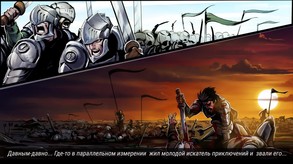
The Swordbreaker game is interactive fiction with lots of illustrations where you and you alone get to choose the storyline and the ending!
Modeled estimate, not a reported figure. How we estimate →
About
Stats
All-time low is the lowest price we've recorded for this game since we started tracking it.
Languages: English*, Russian**languages with full audio support
Engagement
Hours played at review time, across 40 reviews with recorded playtime.
Reviews
Themes across 40 recent reviews and how positive each mention is. A keyword signal, not full sentiment analysis.
positive critical· bar length = how often the theme comes up
Reviews
I found Swordbraker an entertaining, "short", fun and "light" gaming experience. The "game" is a minimum-text "choose your path comic". I wouldn't call it "book" (like Lone Wolf game-books) because there is minimum (to none) novel-writing-story here. The game is actually 333 pictures, and a "select-1-out-of-three options" web connecting them, so that the gamer sets the "path" (sequence of pictures/events) the hero takes. Only way to figure out the correct selections "code" to reach the end-of-the-castle is "try-and-error" : 2-3-1-2 = Death ... Lets try again. (note: the hero has 3 lives per run) BUT, death pictures are the humorous element of the game that kept me going and that makes me give a positive review :-) I couldn't hold back a smile and the thought "this is the lamest death I have seen on a game", when the hero opened a closet overstuffed with sharp swords, resulting on them dropping on his head, pointing out a Fatality. :-) So I recommend the game, at the price you decide is worth for 333 pictures and 999 lines of text. But my personal opinion about the statements on the game storepage is: - "Impressive enemies and inhabitants of the castle" : Nah... I have seen much more impressive art/characters at many other games. And in Swordbraker you cannot call them enemies. You actively fight enemies. Here we only have comic picture characters, and no tactical or active combat. - "Absolutely stunning artwork" : Absolutely not "stunning". The art style is interesting and nice-looking, but I have seen stunning artwork at other games and other comic-books. Swordbraker pictures are nice and atmospheric, but not something I would call "absolutely stunning".
有卡 有成就 没中文 破剑者:游戏版 浓雾之中,我们的英雄瞥见一座黑暗城堡的模糊轮廓。最终,那张被雨水浸透的旧地图将他带到了目的地。他身无长物,唯有心爱的佩剑、残破的旧铠甲,以及一件特殊装置 —— 破剑器。英雄环顾四周,迈步踏上了城堡的吊桥…… 这是一款关于命运使然、闯入废弃城堡的英雄的游戏。在寻找藏于城堡某处的宝藏的途中,他将遭遇重重阻碍,面对极具挑战性的敌人,解开一个个未解之谜。这一切的付出,都是为了最终赢得那份应得的奖赏! 《破剑者:游戏版》为你提供了一个罕见的互动小说体验机会,每位玩家都能走出专属的剧情线。每一个行动、每一次抉择,都会影响故事的走向与最终结局。你的某些举动会改变角色的因果报应,另一些则可能将你引向城堡最幽暗的角落,所以务必谨慎!因为你迈出的每一步,都可能是最后一步! 游戏主要特色: 引人入胜的完全非线性游戏剧情 多种结局设定 宏大神秘的城堡场景 丰富刺激的地点与事件 令人印象深刻的城堡敌人与居民 极具冲击力的美术设计 成就系统
[h1][b]Not Recommended[/b][/h1]
Визуальная новелла.
Норм) Неплохая трата времени.
Swordbreaker The Game is ironically named, because it's not a game, it's a mobile app that's been dumped on Steam. Even as a mobile app, it's not a mobile game, it's an e-comic-book Choose Your Own Adventure novel that's been dumped on Steam masquerading as a game. As a visual/interactive novel, this doesn't feature any notable gameplay, it's just a lot of clicking through short bits of text and looking at somewhat low resolution comic book fantasy art style images. Click on the right things until you get to the "end" of the comic. Did you ever read a comic book and say "Wow, that was a great game"? Of course you didn't. Nobody said that about Choose Your Own Adventure novels, either. So is this a game? Not by any reasonable standards. From a technical perspective, pretending this should be held to the same standards as PC games, the comic doesn't meet basic minimum requirements that most PC gamers expect as standard. It's apparent that little to no testing for the comic was done, at least on modern gaming PCs. In fullscreen, the comic doesn't display properly, with the comic area drawn outside the viewable space, only the top left appears, filling the screen. The other 3/4 can't be seen. This is caused by the developer not bothering to ensure the comic works on resolutions over 1080p, with very high resolution monitors that use resolution scaling. Because the comic area is not drawn correctly, it doesn't map to the mouse pointer properly, so the comic itself simply cannot be read. Gamers shouldn't be forced to accept defective products just because developers don't bother with basic testing on PC. The controls can't be customised because the comic has such a dumbed down, simplified interface that it's just iPhone screen tapping stuff. The fact that the interface is this dumbed down might be seen as a problem in itself, however... this is a fairly shallow experience if you're the kind of gamer that likes to play games with deep, rich control schemes and interaction. You'll get none of that here. Because this is a mobile app, it carries a number of deliberate design deficiencies. Compromises were made to cater to the iPhones that the comic was designed for. These are unfortunate handicaps and limitations that PC gamers shouldn't be forced to accept, but it's evident that PC was an afterthought for the iPhone developers who are to blame for this. The comic is deficient as a result of these choices, and would have been so much better without the handicaps that designing games for mobile phones forces upon a game. Once more, mobile devs have made gaming worse for everyone. I didn't spend thousands on building a gaming rig just so I could pretend it's an iPhone. Or an e-book/comic reader. Comically, the comic was written in Java (I'm not making this up). Talk about not using the right tools for the job. Might as well try to bake a cake with a screwdriver. The extremely poor choice of software engine here is a major contributing factor to the defects with the comic. These technical defects push this comic below acceptable standards for any modern PC game. Swordbreaker The Game (e-comic) didn't appeal much to the people who own a copy of it, either. It has achievements, and they show us a very clear picture that the comic didn't really capture any interest from gamers. The most commonly and easily attained achievement is for going through the "castle history" section of the comic, and only around 29 percent of players bothered to get that far before uninstalling the comic, less than half the players. Hardly a success story, gamers just weren't all that interested in the comic. Because it's not a game. You can get better quality books and comics for free online or from public libraries, or from bookstores for a fraction of the price of this "game". Steam isn't a comic book store, neither is it Netflix, it's for games. Your gaming rig is not a Kindle. It's impossible for me to recommend things to PC gamers that aren't really games. Swordbreaker The Game (e-comic) is relatively cheap at $3 USD, but it's cheaper on mobile phones. PC gamers don't deserve to be treated like second class citizens and price gouged by greedy mobile devs.
Неплохая трата времени. Очень быстро проходится после запоминания действий.
отличная игра, несколько часов провел в ней с огромным удовольствием)
Swordbreaker The Game is a deliberately old-school interactive fiction experience that embraces the spirit of classic choose-your-own-adventure books and translates it into a richly illustrated digital format. Developed and published by DuCats Games Studio, the game places narrative choice above all else, asking players to navigate a dangerous, mysterious castle where curiosity is both the primary driver of progress and the most common cause of death. It is a title that values discovery, consequence, and replayability far more than mechanical complexity, and it commits fully to that identity. From the outset, Swordbreaker establishes a tone of uncertainty and risk. You step into the role of a lone adventurer entering a fog-shrouded fortress armed with little more than a sword and a peculiar device known as the swordbreaker. There is no lengthy exposition or tutorial to ease you in; instead, the game immediately begins presenting choices that can lead to success, unexpected encounters, or abrupt failure. This design philosophy reinforces the idea that survival is never guaranteed and that knowledge, not power, is the most valuable resource you can acquire. Gameplay is almost entirely text-driven, supported by detailed hand-drawn illustrations that bring the castle and its inhabitants to life. Each screen presents a short narrative description followed by a set of choices, and selecting one pushes the story forward along a specific branch. There are no traditional combat systems, puzzles, or stats to manage in a conventional sense. Instead, the tension comes from understanding the implications of your decisions and remembering past outcomes. A single careless choice can end a run in seconds, encouraging players to start over with greater insight and caution. One of the game’s strongest qualities is the sheer breadth of its branching structure. The castle is not a linear sequence of rooms but a tangled web of paths, encounters, and outcomes. With hundreds of illustrated scenes and multiple endings, Swordbreaker is designed to be replayed many times. Each playthrough reveals only a fraction of the total content, and progress is often measured not by how far you get in a single run, but by how much of the castle’s logic and hidden structure you begin to understand across attempts. This approach turns failure into a form of learning rather than frustration. The choices you make also shape the moral tone of your journey. Actions influence a karma system that subtly alters how events unfold and how characters respond to you. You may find yourself becoming more cautious, more ruthless, or more compassionate depending on the paths you take, and these tendencies can unlock or close off future possibilities. While the system is not always explicitly explained, it reinforces the sense that the castle is reactive rather than static, responding to the kind of adventurer you become rather than simply to isolated decisions. Visually, the game’s illustrated style is a major contributor to its atmosphere. The artwork is expressive and often striking, giving personality to monsters, environments, and moments of danger or intrigue. These images do much of the emotional heavy lifting, compensating for the absence of animation or cinematic presentation. The overall aesthetic feels intentionally reminiscent of fantasy gamebooks, grounding the experience in nostalgia while still benefiting from digital convenience. The soundtrack and sound effects are restrained, serving mainly to support mood without distracting from the text-focused experience. The writing itself varies in tone and pacing, sometimes feeling terse and clinical, other times leaning into evocative fantasy imagery. Occasional awkward phrasing or translation quirks can appear, but for many players this becomes part of the game’s charm rather than a serious flaw. The emphasis is consistently on clarity of consequence rather than literary flourish, ensuring that players understand what is happening even when the outcome is grim or sudden. Swordbreaker The Game is not designed to appeal to everyone. Players who prefer action-heavy gameplay, intricate mechanics, or strong character development may find the experience sparse or repetitive. Reading and re-reading text is central to enjoyment, and patience is essential, especially when early deaths are frequent. However, for players who enjoy narrative experimentation, exploration through choice, and the satisfaction of slowly mapping an unknown space through trial and error, the game offers a deeply engaging loop. Ultimately, Swordbreaker The Game succeeds because it fully commits to its core idea: a dangerous fantasy world where curiosity must be tempered with caution, and where progress is earned through understanding rather than power. Its replay-focused structure, extensive branching paths, and evocative illustrations make it a compelling example of interactive fiction done with confidence and intent. While its appeal is inherently niche, those drawn to choice-driven storytelling and old-school adventure design will find a surprisingly deep and rewarding experience hidden within its unforgiving castle walls. Rating: 8/10
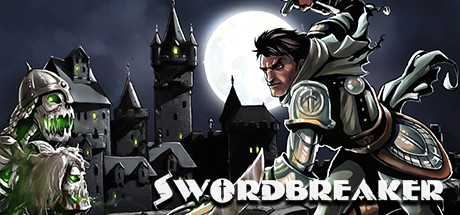
не плохой такой комикс, и вроде даже разные варианты развития, в общем читаем, любуемся..
Related
Related
Trends
Modeled estimate over time, reconstructed from Steam's monthly review histogram.
Momentum
Pace estimated from the game's recent review growth (our daily snapshots) at its own sales-per-review ratio — a momentum signal, not booked sales.
Audience
Estimated from the language of this game's reviews — a proxy for where players are, not official Steam demographics.
Related
| Star Singularity | $23.2K | 69 | 78% | $14.99 |
| Vicious Attack Llama Apocalypse | $23.2K | 69 | 77% | $14.99 |
| Idling Gears | $23.2K | 354 | 71% | $4.99 |
| Fracturefront | $23.2K | 102 | 95% | $8.99 |
| Supercow | $23.2K | 187 | 98% | $7.99 |
| Shattered Union | $23.2K | 168 | 54% | $4.99 |
Related
| 7 Days to Die | $425.3M | 403.6K | 87% | $44.99 |
| Euro Truck Simulator 2 | $421.6M | 932.3K | 97% | $19.99 |
| Mount & Blade II: Bannerlord | $309.8M | 294K | 88% | $49.99 |
| Palworld | $279.6M | 447.5K | 94% | $20.99 |
| The Forest | $254.8M | 678.6K | 96% | $19.99 |
| Project Zomboid | $239.1M | 461K | 94% | $19.99 |