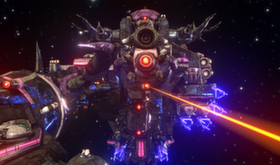
The Enhanced Edition contains Sword of the Stars II: The Lords of Winter and the first expansion, the End of Flesh. The new expansion introduces the new playable race, the Loa. All previous DLCs containing new avatars, new combat music, alternate voices, skins, and new badges for the warships are also included.
Modeled estimate, not a reported figure. How we estimate →
Media

About
Genres
Stats
All-time low is the lowest price we've recorded for this game since we started tracking it.
Languages: English**languages with full audio support
Engagement
Hours played at review time, across 40 reviews with recorded playtime.
Reviews
Themes across 40 recent reviews and how positive each mention is. A keyword signal, not full sentiment analysis.
positive critical· bar length = how often the theme comes up
Reviews
A competent galactic 4X game! BUT...get ready for that 2012 interface and gameplay mechanics. If you can get past some of the dated elements, the game is a worthy one to play.
Sword of the Stars II: Enhanced Edition is a sprawling and unapologetically complex space 4X strategy experience that embodies both the greatest ambitions and the harshest challenges of the genre. Developed by Kerberos Productions and published by Paradox Interactive, this Enhanced Edition represents the most complete form of the original Sword of the Stars II vision, bundling extensive post-launch updates, expansions, and balance changes into a single package. It is a game that demands patience, curiosity, and persistence, but for those willing to invest the effort, it offers a uniquely deep and systems-driven take on interstellar empire building. At its core, the game tasks players with guiding one of several wildly asymmetric alien civilizations from early spaceflight to galactic dominance. Exploration, colonization, diplomacy, research, and warfare are all present, but they are executed with an unusual level of granularity and unpredictability. Each race approaches space travel differently, using unique faster-than-light mechanics that shape expansion patterns and strategic priorities. This single design choice alone ensures that no two factions play alike, forcing players to rethink standard 4X strategies when switching civilizations and lending the galaxy a strong sense of diversity and identity. Research and technology form one of the most defining pillars of the experience. Rather than offering a fully transparent tech tree, Sword of the Stars II uses a semi-randomized research system where discoveries are influenced by faction traits and chance. This means players cannot rely on rigid build orders and must adapt to what technologies become available, creating a sense of uncertainty that mirrors real scientific development. While this approach adds replayability and tension, it also contributes to the game’s steep learning curve, as planning several steps ahead becomes more about strategic flexibility than optimization. Ship design and fleet composition are where the game truly shines. Players can construct highly customized vessels by mixing and matching hull sections, weapons, armor, engines, and specialized modules. This level of control allows for deeply personalized fleets tailored to specific tactical doctrines, whether focused on long-range bombardment, missile saturation, boarding actions, or brute-force brawling. The visual representation of ships reflects these choices directly, reinforcing the connection between strategic planning and battlefield execution. Designing a fleet that performs exactly as intended is one of the most satisfying aspects of the game. Combat itself unfolds in real time, providing a dramatic contrast to the turn-based galactic layer. Battles are large-scale, visually impressive affairs where positioning, weapon arcs, and fleet coordination matter greatly. While the tactical interface can feel cumbersome and occasionally overwhelming, the sense of scale and consequence is undeniable. Watching carefully designed fleets clash amid explosions, debris, and particle effects delivers moments of spectacle that few 4X games attempt, let alone achieve. Success in battle is less about micromanagement finesse and more about preparation, doctrine, and understanding how your technology interacts with the enemy’s. The strategic layer is further enriched by diplomacy, internal politics, and late-game threats. Relations between empires are shaped not only by treaties and wars but also by ideological differences and unpredictable AI behavior. Random events and existential threats can emerge to destabilize even the most carefully constructed empires, ensuring that complacency is punished and adaptability is essential. These systems reinforce the feeling that the galaxy is hostile, ancient, and indifferent to player ambition, an atmosphere that sets the game apart from more orderly space strategy titles. Visually, Sword of the Stars II: Enhanced Edition presents a striking but utilitarian aesthetic. Star maps, ship models, and combat effects convey scale and menace, though the presentation prioritizes function over elegance. The interface, while improved from the original release, remains dense and often unintuitive, requiring time and external learning to fully grasp. This lack of approachability is one of the game’s most persistent weaknesses, as it creates a significant barrier to entry even for experienced strategy players. Performance and stability are markedly better in the Enhanced Edition than at launch, reflecting years of post-release work. While occasional rough edges remain, the game is far more playable and cohesive than its initial incarnation. That said, it still expects players to tolerate complexity and friction in exchange for depth, a trade-off that will not appeal to everyone. Ultimately, Sword of the Stars II: Enhanced Edition is a game defined by extremes. It is daunting, intricate, and sometimes frustrating, yet also rich, distinctive, and deeply rewarding. It does not aim to be a smooth or welcoming introduction to the 4X genre, but rather a demanding sandbox for dedicated strategists who enjoy mastering opaque systems and embracing uncertainty. For players willing to push past its rough presentation and steep learning curve, it offers one of the most ambitious and mechanically dense space strategy experiences available on Steam, standing as a bold testament to how far the genre can be stretched when designers refuse to play it safe. Rating: 5/10
The first one crawled so this one could die. RIP SotS.
If You like complexity and can handle the fact that is abandoned, for some reason i just love this game
Random guy: Hey I've been playing this Pikmin game, it's about really small things and it has this cool macrophotography filter to really visually sell how small everything is! SotS 2 art director: This would look great in our game about giant space ships And that basically sums up the decision making that went into this game
Random unavoidable devastating attacks by things so ridiculous that it defies logic. How is this fun when it is simply a matter to time till something ends my people in a single turn
bad game
This game series had great promise but apparently greed from the Publisher killed any chance of this series seeing its full greatness.
O Jogo é otimo para quem curte um turn based com batalhas em tempo real É antigo mas tem seu charme, roda no meu pc entao provavelmente vai rodar no seu. O mais divertido é criar design das suas naves e velas em ação
Ugly. Opposite of punchy. I'm sure it has a good personality, deep inside there, but I can't stand the way this thing looks long enough to explore it.
Related
Related
Trends
Modeled estimate over time, reconstructed from Steam's monthly review histogram.
Momentum
Pace estimated from the game's recent review growth (our daily snapshots) at its own sales-per-review ratio — a momentum signal, not booked sales.
Audience
Estimated from the language of this game's reviews — a proxy for where players are, not official Steam demographics.
Related
| Realpolitiks | $589.7K | 1.2K | 62% | $14.99 |
| Monster Energy Supercross - The Official Videogame 6 | $589.6K | 574 | 71% | $49.99 |
| Monkey Island™ 2 Special Edition: LeChuck’s Revenge™ | $589.5K | 3K | 95% | $9.99 |
| Kinetic Void | $589.3K | 1.6K | 17% | $9.99 |
| Toy Soldiers | $590.5K | 1.5K | 89% | $9.99 |
| Warhammer 40,000: Armageddon (Classic) | $590.6K | 1.1K | 82% | $19.99 |