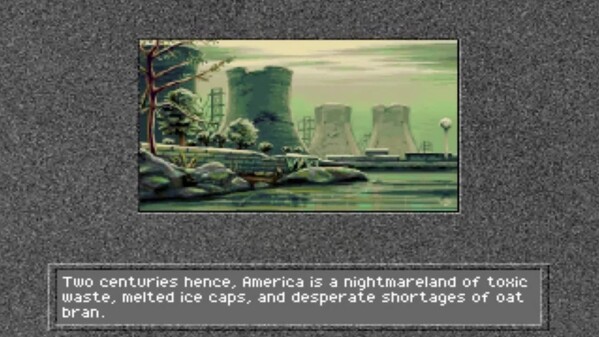
The U.S. is a nightmare of toxic waste, melted ice caps, and desperate shortages of oat bran. Horrible mutations roam the countryside. Monsters spawned of radiation, environmental toxins, and unregulated bio-engineering. But a small group of Superheroes band together to the rebirth of a new society.
Modeled estimate, not a reported figure. How we estimate →
Media

About
Stats
All-time low is the lowest price we've recorded for this game since we started tracking it.
Languages: English**languages with full audio support
Reviews
Fun classic point-and-click text adventure.
God i love this game! All the horrible mutated monsters and then there is the worst of all just plain "Lawyer" .haha! If you can make if past figuring out the janky controls you are in for a TREAT!
a fun classic old school fans should check out
Спустя 30 лет после первого прохождения, это всё ещё хорошая игра. Технически устаревшая, конечно, но хорошая.
Super Hero League of Hoboken, developed by Legend Entertainment and published by Ziggurat, is an unconventional RPG that stands out less for its mechanics and more for its personality. Set in a bizarre post-apocalyptic version of the United States, the game imagines a world where pollution and disaster have reshaped society into something absurd, and the only hope lies in a group of unlikely “superheroes” whose powers are anything but impressive. Instead of presenting a traditional heroic narrative, it leans heavily into satire, turning the idea of saving the world into something humorous, strange, and deliberately offbeat. The tone defines the experience from the very beginning. Rather than assembling a team of powerful champions, players recruit characters with odd, often useless abilities that feel more like punchlines than actual powers. This approach gives the game a distinct identity, as nearly every interaction—whether it’s dialogue, item descriptions, or mission objectives—is infused with humor. The world itself reflects this absurdity, populated with unusual enemies and scenarios that rarely follow conventional logic. It’s a game that constantly invites players to expect the unexpected, and much of its appeal comes from discovering how far it pushes its comedic ideas. Gameplay is a hybrid of point-and-click adventure design and traditional RPG systems. Players explore a large map, traveling between locations, gathering items, and interacting with the environment in ways that often require creative thinking. Puzzle-solving plays a significant role, with many objectives requiring players to combine items or use them in unconventional ways. Alongside this, the RPG elements introduce character stats, party management, and turn-based combat, creating a layered experience that blends different styles of play. This combination is both a strength and a source of inconsistency. At its best, the game offers a varied experience where exploration, puzzles, and combat complement each other. However, the pacing can feel uneven, as puzzle sections sometimes rely on obscure logic that may not be immediately intuitive. This can lead to moments of trial and error that interrupt the flow. Meanwhile, the RPG systems are relatively simple, lacking the depth found in more traditional role-playing games, which makes combat feel more like a secondary feature than a central focus. Combat encounters are straightforward and easy to understand, relying on turn-based mechanics where each character’s abilities and attributes determine their effectiveness. While functional, these encounters rarely evolve in complexity, and they do not provide the same level of engagement as the exploration and puzzle-solving aspects. Instead, they serve as a way to break up the pacing rather than define it, contributing to the overall structure without becoming a highlight. The world design is expansive for its time, offering a wide range of locations to explore, each filled with unique characters and situations. This sense of scale adds to the feeling of adventure, encouraging players to move freely and discover new areas at their own pace. However, navigation can occasionally feel cumbersome, especially when revisiting locations or searching for specific items needed to progress. These moments can slow the experience, particularly when combined with the game’s less intuitive puzzle design. Visually, the game reflects its era, with simple 2D graphics that prioritize function over detail. While the presentation may feel dated by modern standards, it still carries a certain charm, especially in how it supports the game’s comedic tone. Character designs and environments emphasize exaggeration and humor, reinforcing the game’s identity. The writing, however, remains the most enduring element, with dialogue and descriptions that consistently deliver clever and memorable moments. What makes Super Hero League of Hoboken stand out even today is its commitment to its concept. It does not attempt to conform to traditional expectations of the RPG genre, instead offering an experience that feels experimental and unique. The humor is not just an addition but the foundation of the game, shaping how players interact with its world and systems. Replay value is somewhat limited, as the main appeal lies in experiencing the story and its humor rather than exploring different gameplay paths. While players can experiment with different team compositions, the overall structure remains largely the same across playthroughs. As a result, the game is best appreciated as a one-time journey rather than a long-term investment. In the end, Super Hero League of Hoboken is a distinctive and memorable RPG that prioritizes creativity and humor over mechanical depth. Its blend of adventure and role-playing elements creates an experience that feels unlike most games in the genre, even if its systems are not always perfectly balanced. While its dated mechanics and uneven pacing may not appeal to everyone, it remains an interesting and entertaining title for those willing to embrace its unusual approach. Rating: 7/10
Plagued by DOSbox jankery!
Related
Related
Trends
Modeled estimate over time, reconstructed from Steam's monthly review histogram.
Momentum
Pace estimated from the game's recent review growth (our daily snapshots) at its own sales-per-review ratio — a momentum signal, not booked sales.
Related
| Dead Ground | $2.7K | 115 | 60% | $0.99 |
| Sister | $2.7K | 197 | 99% | $0.79 |
| Apocalyptic cat | $2.7K | 116 | 84% | $1.49 |
| Marble Trap | $2.7K | 86 | 88% | $1.79 |
| Super Jagua | $2.7K | 119 | 82% | $0.99 |
| AtmaSphere 2 | $2.7K | 174 | 78% | $0.79 |