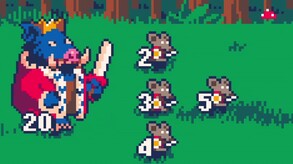
Super Algebrawl, developed and published by PUNKCAKE Délicieux, is a clever indie experiment that manages to turn basic algebra into the foundation of a tactical, roguelike-inspired experience. On the surface, it presents itself like a lighthearted pixel-art strategy game, but beneath that playful exterior lies a system where numbers, operations, and logic take the place of traditional combat mechanics. Instead of relying on attacks and damage values, the game asks players to think mathematically, transforming each encounter into a puzzle where success depends on how well you manipulate values to match or overcome your opponents.
The core gameplay revolves around controlling units that each carry a numerical value. Enemies also present values, and your goal is to use operations—such as addition, multiplication, duplication, or division—to adjust your numbers until they align with or surpass those of your targets. This creates a loop that feels less like fighting and more like solving equations under pressure. Despite the abstract nature of the system, the game does an excellent job of making it intuitive. Early encounters are simple and easy to understand, allowing players to grasp the basics quickly, while later challenges introduce more complex combinations that require careful planning and creative thinking.
What makes Super Algebrawl particularly engaging is how it builds layers of strategy on top of these simple mechanics. As you progress through a run, you gain access to new abilities and modifiers that expand the ways you can manipulate numbers. This opens up multiple possible solutions to each encounter, encouraging experimentation rather than forcing a single correct approach. Some strategies focus on efficiency, reaching the required values in as few steps as possible, while others prioritize safety, minimizing risk even if it takes longer. This flexibility gives the game a depth that goes beyond its initial simplicity, rewarding players who take the time to understand its systems.
The roguelike structure adds another dimension to the experience. Each run presents a different set of tools, forcing players to adapt their strategies based on what they are given. This unpredictability keeps the gameplay fresh, as no two runs unfold in exactly the same way. At the same time, it introduces a level of risk, as poor decisions or unlucky combinations can lead to situations that are difficult to recover from. This balance between control and randomness creates a satisfying tension, where planning ahead is just as important as reacting to the current situation.
Pacing is one of the game’s strengths. Runs are relatively short, making it easy to jump in for a quick session without committing a large amount of time. This structure complements the puzzle-based gameplay, as it keeps the experience focused and prevents it from becoming overly repetitive. However, this also highlights one of the game’s main limitations: its overall scope is quite small. While the core mechanics are strong, the amount of content is limited, and players will likely encounter most of what the game has to offer within a few hours. This can make the experience feel somewhat brief, especially for those who become invested in its systems.
Visually, Super Algebrawl carries a vibrant and expressive pixel-art style that adds personality to its abstract mechanics. Characters and environments are colorful and animated with a playful energy, helping to make the concept of “math combat” feel approachable and fun rather than intimidating. The interface is well-designed, presenting numerical information clearly while still feeling tactile and interactive. This clarity is crucial, as it allows players to focus on solving problems without being hindered by confusing presentation.
The audio design complements the game’s tone, providing a lively and upbeat backdrop that matches its quirky aesthetic. While the soundtrack may not be particularly memorable on its own, it supports the overall experience effectively, maintaining a sense of momentum and engagement throughout each run.
Despite its strengths, the game does have a few rough edges. As encounters become more complex, the amount of information on screen can occasionally feel overwhelming, making it harder to track all the variables at play. Additionally, while the central mechanic is inventive, it is not expanded upon as much as it could be, leading to a sense that the game’s potential is only partially realized. These issues don’t detract significantly from the experience, but they do limit its long-term appeal.
Ultimately, Super Algebrawl succeeds by committing fully to its unique concept and executing it with clarity and creativity. It transforms a subject that is often seen as dry or intimidating into something playful and engaging, offering a fresh take on both puzzle and strategy genres. While its limited content and scope prevent it from feeling like a fully expansive experience, what it does offer is polished, inventive, and consistently enjoyable.
In the end, Super Algebrawl stands out as a smart and imaginative indie title that proves how even the simplest ideas—when approached creatively—can lead to something memorable. It may not last long, but it leaves a strong impression through its originality and thoughtful design.
Rating: 7/10