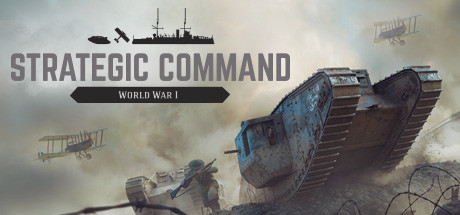
Strategic Command: World War I is a turn-based grand strategy game developed by Fury Software and published by Matrix Games that tackles one of the most complex and often underrepresented periods in strategy gaming. Rather than focusing on individual battles or small-scale tactics, the game places the player at the very top of the command structure, responsible for directing entire nations through the political, military, and economic realities of the First World War. From the opening moves in 1914 to the final offensives that decide the war’s outcome, the game emphasizes long-term planning, resource management, and the slow, grinding nature of industrialized warfare.
The core of the experience unfolds on a large hex-based world map that spans multiple theaters, including Western and Eastern Europe, the Balkans, the Middle East, and key naval regions. Units represent large formations such as corps and armies, and while the scale is abstracted, the strategic implications of their placement and movement are significant. Terrain, supply, entrenchment, and weather all influence how campaigns develop, making reckless advances costly and prolonged stalemates common. This design choice effectively captures the defining character of World War I, where progress was often measured in small gains achieved at enormous cost.
What sets Strategic Command: World War I apart from many other grand strategy titles is how seamlessly it blends military operations with diplomacy, research, and national morale. Players are constantly balancing where to commit their forces while also deciding how to allocate limited resources toward technological advancements such as improved artillery, aircraft, tanks, and naval capabilities. Diplomatic pressure can bring neutral nations into the war or keep them at bay, and these decisions often have far-reaching consequences that reshape the strategic landscape. The game encourages a holistic view of warfare, where victory is achieved not just by winning battles, but by sustaining alliances, managing economies, and maintaining the will to fight.
The campaign structure offers multiple starting scenarios that reflect different phases of the conflict, each with its own strategic challenges. Beginning in 1914 presents the full scope of the war, requiring players to prepare for a long and exhausting struggle, while later scenarios focus on critical turning points where decisive action can change history. These variations enhance replayability, as each campaign invites experimentation with alternative strategies, such as aggressive early offensives, cautious defensive postures, or unconventional diplomatic maneuvers. Even familiar historical paths can unfold differently depending on player decisions and battlefield outcomes.
Combat itself is resolved through a streamlined system that emphasizes preparation and positioning over micromanagement. Entrenchment levels play a major role, reflecting the defensive strength of fortified positions and the difficulty of breaking through well-prepared lines. Naval warfare adds another layer of strategic depth, as control of sea lanes affects supply, troop movement, and economic pressure. While the combat model does not attempt to simulate every detail of the battlefield, it succeeds in conveying the broader operational realities of the era, where attrition and logistics often mattered more than tactical brilliance.
Visually, Strategic Command: World War I adopts a clean and functional presentation that prioritizes clarity and readability. The map, unit icons, and interface are designed to present large amounts of information without overwhelming the player, though the game’s depth still demands time and patience to master. It is not visually flashy, but this restraint works in its favor, keeping the focus on decision-making rather than spectacle. Once players become familiar with the interface, managing vast fronts and coordinating multi-theater operations becomes intuitive and satisfying.
Artificial intelligence provides a solid challenge, particularly for players new to grand strategy. While experienced commanders may eventually learn its tendencies, the AI is capable of mounting credible offensives and defending key positions effectively. Multiplayer options further expand the game’s longevity, allowing human opponents to test each other’s strategic foresight across long campaigns that can unfold over weeks or months.
Strategic Command: World War I is not a fast-paced or immediately accessible game, but it is a deeply rewarding one for players willing to engage with its systems. It excels at portraying the strategic dilemmas, slow momentum, and enormous stakes that defined the Great War. By focusing on the interconnected nature of military, political, and technological decisions, it offers a compelling and thoughtful simulation of early twentieth-century global conflict. For fans of grand strategy and historical warfare, it stands as a rich and demanding experience that captures both the scale and tragedy of World War I with impressive depth and care.
Rating: 8/10