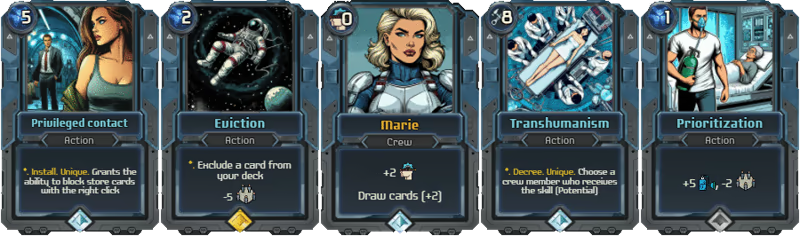
Stellar Orphans is a roguelike deckbuilding game that approaches the genre from a far darker and more survival-focused angle than most of its competitors. Developed and published by Artifex Parvus, the game places players in command of a fragile crew stranded aboard a failing spacecraft drifting through hostile space. Instead of focusing purely on combat encounters or building unstoppable card combinations, the game revolves around survival, crisis management, and the constant struggle to prevent total collapse. Hunger, illness, mechanical breakdowns, psychological stress, resource shortages, and random disasters all threaten the crew at every moment, creating an atmosphere that feels oppressive, tense, and emotionally exhausting in the best possible way.
From the very beginning, Stellar Orphans establishes that survival is never guaranteed. Every decision matters because resources are scarce and problems constantly pile on top of one another. A single poor choice can eventually trigger a chain reaction that destroys an otherwise successful run hours later. The game’s structure revolves around navigating emergencies while gradually improving the crew’s capabilities through deckbuilding mechanics. Cards represent skills, supplies, crew actions, and emergency solutions, and players must carefully balance offensive options, defensive preparation, and long-term sustainability while reacting to unpredictable situations.
One of the game’s strongest qualities is how effectively it creates pressure. Unlike many deckbuilders where players eventually become overwhelmingly powerful, Stellar Orphans rarely allows complete comfort. Even successful runs carry an ongoing sense of desperation because new crises continue appearing faster than players can fully stabilize their ship. Fires break out, crew members become sick, morale collapses, systems fail, and resources begin disappearing at alarming rates. The game constantly forces players to prioritize which disaster is most important at any given moment, and those difficult choices form the heart of the experience.
The deckbuilding mechanics are surprisingly deep once the systems fully open up. Different cards interact in interesting ways, encouraging players to experiment with builds focused on engineering, medicine, diplomacy, scavenging, efficiency, or survival optimization. Some runs reward aggressive resource generation while others demand defensive preparation and careful crew management. Discovering powerful synergies between cards can completely transform how a run unfolds, and there is a strong sense of satisfaction when a carefully designed deck successfully stabilizes an otherwise hopeless situation. The game constantly rewards adaptation because rigid strategies rarely survive long against the randomness of space survival.
What truly separates Stellar Orphans from other roguelike deckbuilders is its focus on layered problem solving rather than straightforward combat. Many encounters are not about defeating enemies as quickly as possible but instead managing overlapping emergencies before they spiral out of control. Players often spend more time extinguishing disasters, repairing systems, treating crew injuries, or rationing supplies than directly attacking threats. This gives the game a far more strategic and methodical feeling compared to action-oriented deckbuilders built around damage optimization. Every turn becomes a balancing act between immediate survival and long-term preparation.
The science-fiction setting plays a huge role in making the experience memorable. The isolated ship drifting through dangerous sectors of space creates a constant feeling of loneliness and vulnerability. Crew members feel less like disposable units and more like desperate survivors barely holding themselves together under impossible circumstances. Random narrative events and moral dilemmas strengthen this atmosphere further by forcing players into difficult decisions involving sacrifice, risk, and survival ethics. Some events ask players to endanger the crew for resources, while others force painful trade-offs that may permanently affect future progress. These moments help the game feel like an evolving survival story rather than a series of disconnected card battles.
Visually, Stellar Orphans embraces a gritty comic-book inspired presentation mixed with bleak science-fiction aesthetics. The art style may not appeal to everyone, especially given the use of AI-assisted visuals in certain areas, but the overall atmosphere remains cohesive and distinctive. The interface, ship environments, and card artwork all reinforce the feeling of exhaustion and desperation surrounding the crew. Dark colors, damaged machinery, and cluttered interiors help establish a believable survival atmosphere aboard a deteriorating spacecraft slowly falling apart under pressure.
The soundtrack and sound design also contribute significantly to the game’s oppressive mood. Ambient mechanical noises, distant alarms, and tense musical tracks constantly remind players that disaster is never far away. Quiet moments aboard the ship feel uneasy rather than peaceful, reinforcing the sense that survival is temporary and fragile. Combined with the gameplay systems, the audio helps maintain tension even during slower management-focused sequences.
Replayability is another major strength. Different crews, starting conditions, random events, card combinations, and difficulty levels ensure that no two runs unfold in exactly the same way. Some playthroughs evolve into desperate scavenging operations, while others become resource-rich but psychologically unstable survival journeys. The unpredictable structure encourages experimentation and long-term mastery because players are constantly adapting to new disasters and changing priorities.
However, Stellar Orphans is also an extremely punishing game that will likely frustrate many players. The randomness can occasionally feel excessive, especially when several disastrous events occur simultaneously with little opportunity for recovery. Certain runs seem doomed almost entirely due to unfortunate RNG rather than poor strategy, which can make losses feel unfair instead of educational. Experienced players can mitigate much of this unpredictability through careful planning, but luck still plays a larger role than some strategy fans may appreciate.
The difficulty curve is also brutally unforgiving. The game does not hold the player’s hand for very long, and newcomers will almost certainly experience repeated failures before fully understanding how the systems interact. Managing crew morale, resources, crises, and deck efficiency simultaneously can feel overwhelming during the early hours. Some players will enjoy this harsh survival atmosphere because it reinforces the game’s themes, while others may simply find it exhausting.
There are also some interface and pacing issues that occasionally interrupt the experience. Certain menus can feel cluttered when multiple crises stack together, and longer runs sometimes suffer from slower pacing due to the sheer amount of information players must process each turn. Minor technical issues and interface awkwardness are noticeable during extended sessions, although they rarely become severe enough to ruin the game entirely.
For players who enjoy punishing strategy games, survival management, and roguelike deckbuilders with heavy emphasis on tension and decision-making, Stellar Orphans offers an engaging and memorable experience. It may not always be fair, and its relentless difficulty will absolutely drive some players away, but the atmosphere, strategic depth, and survival-focused gameplay make it one of the more distinctive indie deckbuilders currently available.
Rating: 7/10