timeloop depression station ✦ In Stars and Time's prototype-thingy-thing
Modeled estimate, not a reported figure. How we estimate →
About


Genres
Stats
All-time low is the lowest price we've recorded for this game since we started tracking it.
Languages: English, Japanese
Engagement
Reviews
Themes across 63 recent reviews and how positive each mention is. A keyword signal, not full sentiment analysis.
Reviews
Really fun prologue to In Stars And Time. I would recommend playing after the main game, as it provides some more background that has the most emotional impact if you know the characters already. The gameplay should be familiar if you've played the main game, but is otherwise not hard to get into. Start Again isn't that long, but it drops you into the story right away and has a lot of unique dialogue and events. It's a bittersweet story that's definitely worth experiencing.
I shouldn't have bought this demo, which requires to PAY FOR IT. Are you serious? This is not even a slice of the game, just a 1 - 2 hour slow gameplay with no purpose.
Media

Related
Related
Price dynamics, follower growth, revenue and sales trajectories with interactive tooltips
This and every other Pro feature is free until October 20, 2026. A free account is all it takes.
Hours played at review time, across 63 reviews with recorded playtime.
positive critical· bar length = how often the theme comes up
Amo este juego y amo in stars and time
i played this after isat and i think that was the better choice for me, knowing what i know now. i finished isat a little over a year ago and was thinking abt it so i thought i should get around to playing this. yes, the gameplay is more rough and there are some scenes word for word from the main game (of course, its a time loop) but i actually think it does some interactions/tone better, or at least i prefer it to the main game. the short playtime actually works in its favour for me, it ends right when the loops start to get gruelling and the ending was just *chef's kiss*. definitely play if you liked isat, its an interesting look at how the game started and adds a little context.
pretty good game, interesting to see where ISAT gets that groove from. However, this game only works if you really liked ISAT, so yeah. play ts after ISAT if you be ♥♥♥♥♥♥' with it. good game
oh stars.
when estas cansado jefe:
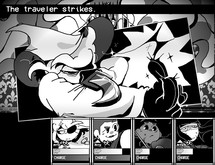
START AGAIN: a prologue is a compact narrative RPG that takes the familiar concept of a repeating time loop and uses it to explore isolation, frustration, friendship, and the emotional damage caused by remembering events that everyone else continually forgets. Created and published by insertdisc5, the game follows Siffrin, an adventurer traveling with a small group of companions on what should be the final stretch of their quest. Their objective is to confront the King and break the strange curse that has frozen the country in time. Unfortunately for Siffrin, death does not provide an escape. Whenever things go wrong, they return to an earlier point while their companions carry on without any memory of what previously happened. The premise becomes much more interesting because the time loop is treated as an emotional burden rather than merely a gameplay gimmick. Siffrin remembers conversations, mistakes, deaths, discoveries, and failed attempts, while everyone around them experiences each repeated moment as something completely new. At first, knowing what will happen can feel like an advantage. Gradually, however, familiarity becomes exhausting. Repeated conversations that once seemed amusing can become uncomfortable, and the protagonist's growing awareness creates a sense of loneliness even when surrounded by friends. This psychological progression gives the relatively short adventure considerably more emotional weight than its scale initially suggests. Character writing is the game's greatest strength. Siffrin's companions have distinct personalities, and their interactions establish a convincing sense that this group has already shared a significant adventure together. Humor is frequently used to make the characters likable and to prevent the darker elements from dominating every scene. Some conversations are intentionally silly, including the game's memorable fascination with crabs, while others reveal more personal aspects of the characters. The playful tone also makes the darker developments more effective because the transition from friendly banter to psychological distress can be surprisingly sharp. Gameplay follows a traditional top-down RPG structure with exploration and turn-based encounters. Combat incorporates an Active Time Battle influence alongside a rock-paper-scissors style relationship between certain attacks and weaknesses. This makes understanding an opponent and selecting appropriate actions more important than simply repeating the strongest available move. The system remains relatively approachable and does not attempt to compete with highly complicated RPGs in terms of equipment management, enormous skill trees, or extensive character customization. Combat instead serves the narrative, providing enough interaction and danger to make the repeated journey meaningful without overwhelming the story. Repetition naturally plays a major role in progression. Players revisit situations and locations as Siffrin continues looping, gradually gaining information that can influence later attempts. This creates an unusual relationship between player and protagonist because both become increasingly familiar with circumstances that remain new to the other party members. The concept is cleverly integrated into the storytelling, although players who strongly dislike retracing familiar areas may occasionally find the structure tedious. The repeated material is purposeful, but appreciating it requires accepting that monotony itself contributes to the atmosphere and Siffrin's deteriorating state of mind. There are multiple possible outcomes surrounding the final confrontation, including a True Ending. The variations encourage experimentation and provide reasons to pay attention to information gathered during previous attempts. These outcomes should not be expected to transform the game into a huge branching RPG containing completely separate campaigns, but they add replay value and reinforce the importance of learning from each loop. Finding the more complete resolution can be particularly rewarding for players who become invested in Siffrin and the party. The visual presentation uses expressive 2D pixel art that complements the game's intimate independent-RPG identity. Rather than relying on graphical spectacle, the presentation places emphasis on character expressions, dialogue, environmental details, and atmosphere. The recurring locations also benefit from this simplicity because the player becomes familiar with the surroundings, making changes in context or dialogue more noticeable. The soundtrack and overall presentation support the shifts between humor, adventure, tension, and psychological unease without distracting from the writing. Despite its title describing it as a prologue, the experience is designed to function as a standalone story. It is closely connected conceptually to the later In Stars and Time, but START AGAIN can still be appreciated independently. Its comparatively brief length works in its favor because the looping structure might have become exhausting if stretched across a much larger campaign. Instead, the game concentrates on establishing its characters, developing Siffrin's predicament, exploring the consequences of repetition, and bringing the central conflict toward a meaningful conclusion. The story also contains considerably heavier themes than the charming pixel-art presentation might suggest. Its examination of repeated death and emotional deterioration introduces material involving depression, self-harm, suicide, psychological distress, unreality, alcohol as a coping mechanism, and some disturbing descriptions and imagery. These subjects are tied closely to Siffrin's increasingly difficult circumstances rather than being included purely for shock. Players sensitive to such material should therefore approach the game with awareness that its humorous personality exists alongside genuinely bleak subject matter. Steam Deck compatibility is somewhat less straightforward than with games carrying an official Valve Verified badge. The game does not have an official Steam Deck compatibility rating that guarantees a completely optimized handheld experience. However, its lightweight 2D presentation and relatively modest technical demands make it the kind of PC game that may be playable through Steam Deck's Proton compatibility layer. Players should therefore consider its Deck status Playable rather than Verified, and minor control, display, or compatibility adjustments may be necessary depending on the current Proton configuration. Overall, START AGAIN: a prologue is a memorable example of how a small RPG can use mechanical repetition to strengthen characterization rather than simply extend playtime. Its combat is deliberately uncomplicated and its adventure is brief, but the quality of the dialogue, the chemistry among the party members, and Siffrin's increasingly painful relationship with the time loop give it a distinctive personality. Players interested in character-focused RPGs, unusual time-loop narratives, dark comedy, and psychologically driven storytelling will find a surprisingly substantial experience within its modest scope. Rating: 8/10
я съел голову рыбы
Juegazo, muy buen RPG, bastante conciso pero no se necesita más, muy bueno en todo aspecto, trama, personajes, música, apartado visual, todo, muy bueno, totalmente recomendado SPOILERRRRRRRRRR: Pero pasados de rosca, no pueden jugar así con nuestras esperanzas después de haber creído que finalmente cambiamos la historia pipipipipipipi
Players by region
Where this game's players are, estimated from review languages.
Players also reviewed
The games this title's players most often review too — audience affinity.
Related
| Game | Estimated lifetime revenue | Reviews | Review score | Price |
|---|---|---|---|---|
| $556 | 2 | 100% | $11.99 | |
| $337 | 4 | 75% | $4.99 | |
| — | 0 | — | — | |
| — | 0 | — | — | |
| $4.1M | 8.9K | 97% | $19.99 | |
| $34.8K | 96 | 94% | $18.99 |
Related
| Game | Estimated lifetime revenue | Reviews | Review score | Price |
|---|---|---|---|---|
| $141.4K | 674 | 89% | $9.99 | |
| $141.4K | 448 | 96% | $8.99 | |
| $141.4K | 93 | 90% | $39.99 | |
| $141.4K | 770 | 74% | $7.99 | |
| $141.4K | 270 | 75% | $22.49 | |
| $141.3K | 331 | 82% | $9.96 |