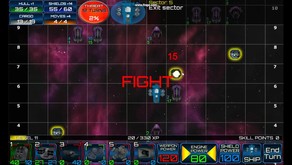
Delta Quadrant is a sci-fi turn-based strategy game with lite rogue-like elements. Destroy enemies to collect loot, gain experience to level up and use skill points to become stronger. Intended as a fun little sci-fi title, not too hardcore or difficult.

Modeled estimate, not a reported figure. How we estimate →
Media
About


Stats
All-time low is the lowest price we've recorded for this game since we started tracking it.
Languages: English
Engagement
Hours played at review time, across 40 reviews with recorded playtime.
Reviews
I don't understand this game at all. It's either I'm dumb as hell or this game is dumb as hell?
ㅤ🦝ㅤ
[h1] Not so so space strategy game. Shallow gameplay, simple visuals, could've been much bettah but it's not. I think you cas safely skip on this one. [/h1]
As a strategy rough like project, it is quite an enjoyable 2D indie game, and years ago I had some similar experience at my phone with something like this which took over 20 hours of gameplay. What is more, cards and cards fully compensate your game cost; every new game, you got some basic stuff and then progress with upgrades and new mechanics, yet overall simplistic gameplay does not make it feel worthwhile when there are way better indie and AAA projects in Steam. reVote 5/10
{ - Hikaye - } 🔲 Çok İyi 🔲 İyi 🔲 Orta 🔲 Kötü 🔲 Çok Kötü ✅ Oyunun Hikayesi Yok { - Oynanış - } 🔲 Çok İyi 🔲 İyi 🔲 Orta 🔲 Kötü ✅ Çok Kötü { - Grafikler - } 🔲 Çok İyi 🔲 İyi 🔲 Orta 🔲 Kötü ✅ Çok Kötü { - Oynama Süresi - } 🔲 100+ Saat 🔲 50 - 100 Saat 🔲 25 - 50 Saat 🔲 10 - 25 Saat 🔲 0 - 10 Saat ✅ Belirli Bir Oynama Süresi Yok
Yes.
Star Chronicles: Delta Quadrant, developed by Alister Software and published by Back to Basics Gaming, is a small-scale turn-based strategy game that combines light roguelike elements with a sci-fi adventure premise. The player assumes command of a lone exploration vessel thrust into hostile territory controlled by an alien faction known as the Dark Order. Tasked with surviving encounters, scavenging resources, and gradually upgrading their ship, the player embarks on a cyclical journey of combat and progression. It’s a familiar setup for fans of tactical strategy, but the game’s focus on simplicity and short, repeatable runs distinguishes it from more elaborate space simulations. Instead of grand fleet management or complex diplomacy, Star Chronicles emphasizes a tighter loop of incremental advancement—fight, upgrade, and survive just a little longer the next time around. From a gameplay perspective, Star Chronicles unfolds on a grid-based battlefield where positioning and resource management determine success. Each move and attack takes place within a turn-based structure, requiring forethought rather than reflexes. The roguelike influence becomes apparent through its progression system: defeating enemies yields loot and experience that can be spent on improving ship attributes like weapons, shields, and engines. As in many roguelikes, failure is expected, but each defeat brings a sense of learning and growth. The design encourages experimentation, letting players try new strategies or upgrade paths on subsequent attempts. What keeps the experience engaging early on is the satisfaction of incremental improvement—the feeling of turning a fragile starter ship into a more formidable war machine through persistence. Combat is straightforward but satisfying in its pacing. Each encounter demands that players weigh risk and reward carefully, choosing whether to press forward for additional resources or retreat before the next skirmish becomes overwhelming. The turn-based nature gives the player time to plan movements and manage limited energy reserves, while upgrades add a layer of customization that keeps the gameplay loop fresh during the opening hours. Unfortunately, the simplicity that makes the system accessible also limits its long-term appeal. Once players have mastered the basic rhythm of positioning and attack management, there are few surprises left to discover. Enemy types, environmental conditions, and available weapons do not vary enough to maintain momentum deep into repeated playthroughs, leading to a sense of routine rather than evolution. Visually, Star Chronicles: Delta Quadrant wears its indie status on its sleeve. The graphics are functional rather than flashy, with modest ship designs and flat, utilitarian environments that convey just enough to serve their purpose. The interface is clean and readable, ensuring that the player can focus on decision-making without distraction, but there’s little in the way of spectacle. It feels reminiscent of older PC strategy titles where clarity mattered more than aesthetic flair. While some players may find the minimalist style endearing, others might see it as dated or underwhelming. The audio follows a similar pattern—sparse, atmospheric background music punctuated by laser effects and explosions that get the job done without leaving a lasting impression. The stripped-down presentation does, however, have one clear advantage: it keeps the game lightweight and accessible, running smoothly even on low-end machines. The story framing the gameplay is serviceable but secondary. The premise of being lost in an uncharted quadrant and battling a shadowy enemy faction provides enough context to justify the endless combat cycle but doesn’t evolve into a deeper narrative. There are brief bits of lore scattered through mission text, but characterization and plot development are largely absent. This minimalist storytelling works for players who prefer pure mechanics over exposition, but those looking for an engaging sci-fi tale or narrative progression will find little to latch onto. The game’s tone is functional, focused more on systems and numbers than on building emotional stakes or world-building depth. In terms of pacing, Star Chronicles delivers quick, digestible gameplay sessions that fit well into short bursts. A single run can be completed in less than an hour depending on success or failure, and the roguelike structure lends itself to “one more try” impulses. The level of challenge is approachable, with a learning curve gentle enough for newcomers to turn-based strategy while still offering enough difficulty to keep veterans attentive. However, as the game progresses, the lack of strategic depth becomes apparent. The upgrade system offers a handful of meaningful decisions early on, but over time most players will find an optimal strategy that renders subsequent runs repetitive. It’s a game that hooks easily but struggles to maintain long-term engagement once its systems are fully understood. Where Star Chronicles succeeds is in its accessibility and value. It’s a low-cost indie title that delivers exactly what it promises: a lightweight, turn-based strategy experience wrapped in a space adventure theme. Its modest scope makes it ideal for players seeking something easy to learn and quick to play without the commitment of sprawling strategy epics. It’s the kind of game that rewards patience and experimentation in small doses rather than demanding deep investment. On the other hand, players expecting high production values, complex mechanics, or a richly layered campaign will likely find it lacking in ambition. It feels like a proof of concept for a larger idea—a foundation that could have been expanded into something more intricate with additional content and polish. Ultimately, Star Chronicles: Delta Quadrant stands as a modest but earnest effort in the indie strategy space. It’s not revolutionary, but it captures a certain old-school charm in its straightforward approach to turn-based combat and incremental progression. Its flaws—limited variety, shallow narrative, and repetitive design—are balanced by its accessibility, stability, and occasional flashes of tactical satisfaction. For players who enjoy compact, no-frills strategy experiences or who simply want a low-stakes game to unwind with, it delivers a competent and occasionally engaging ride through a hostile galaxy. While it doesn’t aim for the stars in terms of innovation or scope, it remains a decent, if fleeting, journey through the Delta Quadrant for those willing to chart its small but satisfying depths. Rating: 6/10
Funny game
I am 32 years old. My ex-wife and I have a daughter together, and we adopted our son together. Both are now 4 years old. When we were going through our separation, I felt lost and unhappy. I was self-destructive. One day, I was so angry with everything spiraling out of control that I punched a concrete wall in a moment of overwhelming emotion. This resulted in breaking my fifth metacarpal in my right hand—the hand I worked with, played games with, and used to carry my children to bed—the hand I desperately needed to ensure I could continue providing. Upon learning the severity of the self-inflicted damage, I became almost suicidal. Keep in mind that just a few months before this, I was the happiest man, with no history of depression or anxiety. I had never experienced anger outbursts, nor was I the type to break down and cry, but I was in a tough situation that truly prevented me from seeing the light on the other side. With nothing better to do, I looked for a game I could play WITH ONE HAND while recovering. Somehow, I stumbled upon this game and read some of the comments. I decided it was worth a try... I must admit I didn't beat the game, nor did I play as much as some of you. In fact, I may have played this game for only a day or two. That being said, after doing so, I had a new joy and hope for life. I managed to leave behind the pain and suffering that had been thrust upon me. I could experience the joy and happiness of other people. I relaxed for 5 ♥♥♥♥ minutes listening to this music, long enough to realize that I would be okay. After realizing this, I turned off the game and went back to work. My hand hurt a lot, but I was motivated. I stopped feeling so sorry for myself and became the father I needed to be at that moment, not the weak boy I was behaving like. Today, I am close friends with the mother of my children. We don't fight, argue, or say hurtful things to each other. We are parents and friends. Now I have 3 children. My third child is, wait, ALSO 4 YEARS OLD. The woman I am with was going through a very similar situation at the time of my separation, and we just unexpectedly stumbled into each other's lives. We have been dating for a year and are very happy together. Moral of the story: you never know what life has in store for you, and if I had given up when all odds were against me, I wouldn't be where I am today. This silly little game helped me realize that. Thank you.
💋
Related
Related
Trends
Concurrent players on Steam, sampled daily since tracking started.
Momentum
Pace estimated from the game's recent review growth (our daily snapshots) at its own sales-per-review ratio — a momentum signal, not booked sales.
Audience
Estimated from the language of this game's reviews — a proxy for where players are, not official Steam demographics.
Related
| N.E.R.O.: Nothing Ever Remains Obscure | $16.7K | 196 | 69% | $4.99 |
| Sword and Fairy 5 | $16.7K | 73 | 60% | $12.99 |
| No Fair Play | $16.7K | 533 | 91% | $1.19 |
| EZ-Crosshair | $16.7K | 820 | 91% | $0.99 |
| Criminal Dissidia | $16.7K | 133 | 67% | $5.19 |
| Car Factory Empire | $16.7K | 52 | 58% | $8.99 |