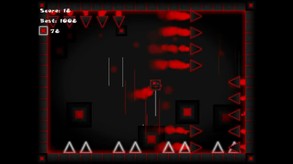
Spikit is a minimalist arcade survival game developed by Blastoid Entertainment and published by Back To Basics Gaming. Designed as a fast-paced reflex challenge rather than a traditional full-scale arcade shooter, the game focuses on a single core mechanic: dodging lethal spikes that relentlessly attack the player from every direction. Released on Steam in 2016, the title represents the kind of stripped-down indie experiment that prioritizes gameplay immediacy and challenge over narrative depth, complex systems, or elaborate visual presentation. The result is a compact but intense experience built around quick reactions, precision movement, and the constant pursuit of higher scores.
The premise of Spikit is intentionally simple and abstract. Players control a small square character trapped inside a confined arena while deadly spikes launch from the edges of the screen. There is no elaborate story or worldbuilding to guide the experience; instead, the game focuses entirely on the tension created by survival. The minimalist design places the player in a constant state of pressure where every movement must be carefully timed. One moment of hesitation or misjudgment is enough to end the run instantly, forcing players to restart and attempt to survive longer the next time.
Gameplay revolves around moving the square character across the arena while avoiding spikes that shoot inward from the top, bottom, and sides of the screen. The spikes appear rapidly and unpredictably, requiring players to react quickly and adjust their position within the limited space available. As time passes, the pace of the attacks gradually increases, creating a sense of escalating intensity that turns even a few seconds of survival into a meaningful accomplishment. Unlike many bullet-hell style games that feature intricate projectile patterns, Spikit relies on speed and unpredictability to create difficulty. The simplicity of its mechanics makes the rules immediately understandable, but mastering the game requires sharp reflexes and sustained focus.
An important part of the gameplay loop involves collectible items that appear during runs. Small boxes occasionally spawn within the arena, and players can attempt to collect them while dodging the incoming spikes. These boxes serve as a form of currency that can be spent in the game’s unlock system. Over time, players can use these collected resources to unlock cosmetic upgrades such as new character faces, color schemes, and visual themes for the arena. While these unlockables do not alter the gameplay mechanics, they provide small incentives that encourage repeated attempts and give players a sense of gradual progression.
Visually, Spikit embraces an extremely minimalist aesthetic built around simple geometric shapes and bright colors. The entire playfield consists of a single square arena surrounded by the boundaries from which the spikes emerge. The player character is represented by a small square that can display different expressions depending on the cosmetic skin selected. Although the visual design is very basic, it serves a practical purpose by keeping the screen clear and easy to read during intense moments. Because the game avoids visual clutter, players can quickly identify incoming threats and focus entirely on movement and positioning.
The audio design adds energy to the otherwise simple presentation. Electronic music tracks accompany the gameplay, helping create a rhythmic atmosphere that complements the fast-paced dodging mechanics. The soundtrack builds tension as players attempt to survive longer runs, while sound effects provide feedback for collecting items and encountering obstacles. Although the selection of music is somewhat limited, the audio still contributes to the overall arcade-like feel of the experience.
One of Spikit’s defining qualities is its focus on score-based competition. Rather than presenting a structured campaign or multiple stages, the game revolves entirely around achieving longer survival times and improving personal performance. Each attempt becomes a new opportunity to beat previous records, and players are encouraged to challenge themselves to survive just a few seconds longer than before. This design makes the game particularly well suited for short play sessions where players can jump in quickly, attempt a few runs, and gradually improve their reflexes.
However, the same simplicity that makes the game accessible also creates its most significant limitation. Because the gameplay loop never evolves beyond dodging spikes, the experience can begin to feel repetitive after extended play. There are no new mechanics, enemy types, or environments introduced over time, which means that the challenge remains largely the same regardless of how long the player continues playing. For some players, this lack of variety may reduce the long-term appeal of the game.
Another factor that affects the game’s longevity is the relatively limited amount of content. While cosmetic unlockables offer some incentive to keep playing, they do not fundamentally change the way the game is experienced. Players who enjoy score-chasing arcade challenges may still find satisfaction in refining their reflexes and climbing higher on the leaderboard, but others may wish for additional modes or gameplay variations to keep the experience fresh.
Despite these shortcomings, Spikit succeeds at delivering a focused and intense arcade challenge. Its straightforward mechanics make it easy to learn within seconds, while the escalating speed of incoming hazards ensures that the game remains demanding even for experienced players. The constant tension created by the one-hit-death rule means that every moment of survival feels earned, and even short runs can become exciting as the arena fills with incoming spikes.
Ultimately, Spikit stands as a small but effective example of minimalist game design. By stripping the bullet-hell concept down to its most essential elements, the game creates a challenging reflex test that rewards concentration and quick thinking. While it may lack the depth and variety found in larger arcade titles, it still manages to deliver bursts of excitement for players looking for a quick and challenging survival experience.
Rating: 6/10