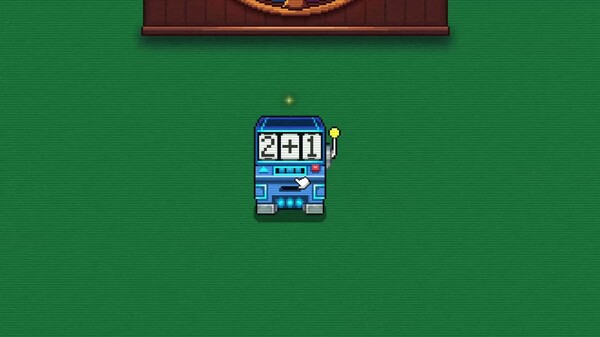
Slot Grind is a focused incremental and idle game that transforms the familiar concept of slot machines into a steadily expanding progression system. Developed and published by OneMoreSystem, it begins with an intentionally simple premise: operate a slot machine, collect the resulting income, and reinvest those earnings into improvements that make the entire operation more productive. Rather than attempting to reproduce the complexity of a casino simulation, the game concentrates on the satisfaction of growth. Every upgrade and newly acquired machine contributes toward building a larger and increasingly automated source of virtual wealth.
At the beginning, progression is deliberately hands-on. The player starts with a single machine and manually pulls its lever to generate money. This establishes the basic rhythm immediately and makes the earliest earnings feel directly connected to player interaction. Money does not simply function as a score, however, because it becomes the resource needed to improve the operation. The initial simplicity gradually develops into a broader optimization loop as accumulated earnings can be spent on upgrades, additional machines, and other improvements. The appeal comes from seeing something initially small and inefficient develop into a far more powerful system.
Machine upgrades form an important part of that transformation. Players can improve their slots so that they spin faster and provide better rewards, meaning that spending money becomes an investment in future productivity. This creates a straightforward but effective decision-making process. Saving currency may bring a more expensive improvement within reach, while purchasing an immediate upgrade can increase the rate at which subsequent money is generated. The numbers and machines consequently reinforce one another, creating the escalating feedback loop expected from a well-structured incremental game.
Automation represents one of the more meaningful stages of progression. Repeatedly pulling a lever may establish the concept, but Slot Grind does not expect manual interaction to remain the centerpiece forever. Machines can eventually operate automatically, turning what begins as an active clicking routine into a more passive management experience. This change is important because automation feels like an actual reward rather than merely another numerical increase. The player gradually progresses from directly operating individual machines to supervising an expanding collection that can continue generating income with less constant intervention.
A skill tree provides additional structure beyond purchasing conventional machine upgrades. Progressing through it can unlock new machines and useful perks, giving players longer-term objectives alongside the immediate pursuit of greater earnings. This helps prevent progression from becoming entirely dependent on one endlessly increasing currency value. Unlocking another machine or obtaining a valuable perk creates recognizable milestones and provides reasons to continue developing the operation. The skill tree also introduces an element of optimization, encouraging players to consider which improvements are most beneficial to their current setup.
New slot machines contribute to the sense that the player's operation is genuinely expanding rather than merely becoming statistically stronger. Incremental games are at their most satisfying when advancement can be observed as well as calculated, and adding machines accomplishes this effectively. Starting with one relatively ordinary source of income and eventually managing numerous automated machines provides a clear visual and mechanical representation of progress. The resulting experience revolves around transforming modest earnings into increasingly exaggerated amounts of money through better efficiency and continued reinvestment.
The game also gives this accumulation a humorous objective by framing debt repayment as the player's ultimate motivation. Instead of accumulating limitless money without explanation, the player is effectively attempting to grind through the slot-machine economy until the debt can finally be cleared. It is not presented as a complicated narrative, but it gives the progression an identifiable endpoint and adds some personality to an otherwise mechanically driven experience. The contrast between increasingly excessive money generation and the simple desire to escape debt fits the game's lighthearted approach.
Steam achievements provide another set of objectives for players who enjoy completing secondary challenges. With 26 achievements available, there are additional milestones beyond simply reaching the primary progression goal. Achievements are especially appropriate for an incremental title because they can recognize different stages of accumulation, unlocking, optimization, and continued play. They give completion-oriented players more reasons to explore the progression systems and can make intermediate accomplishments feel more meaningful while working toward larger objectives.
Visually, Slot Grind adopts a straightforward 2D presentation rather than attempting elaborate graphical spectacle. This approach fits the genre because readability and immediate feedback are more important than sophisticated visual effects. Players need to understand what their machines are doing, recognize improvements, and see their earnings increase without unnecessary complexity interfering with the central loop. The game's relatively modest system requirements similarly make sense for an idle experience designed around persistent progression rather than demanding graphical performance.
Accessibility is further supported by its lightweight technical requirements. The Windows version requires a 64-bit edition of Windows 10, a 2 GHz processor, 1 GB of memory, OpenGL 3.3 support, and approximately 200 MB of available storage at minimum. macOS support is also provided. Interface language support includes English, Simplified Chinese, and Russian. These modest requirements make the game suitable for a broad range of computers and complement the kind of experience that players may want to keep available without dedicating significant system resources to it.
The developer has also provided transparency concerning the use of generative AI during production. According to the Steam disclosure, no AI-generated material is presented to players during gameplay. AI assistance was used for programming purposes, with the resulting code reviewed and tested by the developer. The artwork, writing, music, and sound were created by humans. While this does not alter the gameplay itself, the disclosure clearly distinguishes development assistance from the content ultimately presented within the game.
Overall, Slot Grind succeeds most clearly as a compact game about accumulation, reinvestment, automation, and optimization. Its progression from one manually operated machine to a larger automated setup creates an understandable sense of advancement, while machine upgrades, unlockable slots, perks, a skill tree, achievements, and the debt objective provide multiple incentives to continue. It is intentionally narrow rather than ambitious, but that simplicity can work strongly in its favor for players who appreciate idle games built around watching a modest beginning evolve into an increasingly efficient economic engine. The repetitive foundation means it will appeal primarily to fans of incremental progression, yet within that niche it offers a coherent and appropriately streamlined concept.
Rating: 8/10