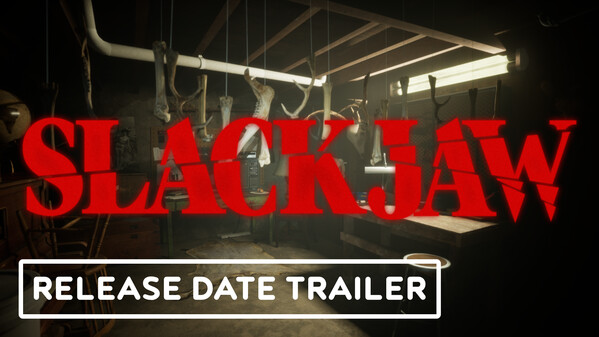
Slackjaw, developed and published by Nostromo Interactive, is a short but unnerving horror experience that demonstrates how atmosphere, pacing, and sound design can achieve more fear than elaborate mechanics or jump scares. Built in Unreal Engine 5, it throws the player into a confined nightmare that feels disturbingly real: you awaken trapped in the basement of a serial killer, with only your wits and a few scattered clues standing between you and an unthinkable fate. Rather than relying on gore or shock tactics, Slackjaw cultivates dread through realism and subtlety, turning the mundane—dim light, silence, creaking wood—into instruments of psychological terror. It’s an experiment in immersion, and though its length is brief, it leaves a haunting impression that lingers long after the credits roll.
From the first moments, Slackjaw makes it clear that the environment is the true antagonist. The basement is meticulously crafted to feel suffocating and grimy, with every object and texture reinforcing the sense of decay and captivity. The walls are damp and stained, the air thick with menace, and the lighting barely enough to make out the details of your surroundings. You can almost feel the grime under your fingertips as you search for an escape. The visual fidelity provided by Unreal Engine 5 enhances this realism—light reflects off concrete in a natural way, shadows move with unnerving accuracy, and subtle visual effects like flickering bulbs and dust particles create a sense of space that feels claustrophobically real. This level of attention to atmosphere is what anchors the experience; even in its simplicity, Slackjaw succeeds in immersing the player completely.
The gameplay structure follows the escape-room format but with the tension of a horror thriller. There are puzzles scattered throughout the basement, and each solved clue brings you closer to freedom. The mechanics are deliberately simple: explore, observe, interact, and piece together your path out. But the pressure is ever-present. You’re not alone, and every sound you make feels like an invitation for the killer to come closer. Unlike many horror games that bombard the player with enemies or chase sequences, Slackjaw keeps things understated. The real fear comes from anticipation—the uncertainty of when something might happen. The puzzles are logical enough to be solvable without frustration, yet never so easy as to lose engagement. They serve as pacing tools, keeping the tension steady while pushing the player deeper into the story.
Sound plays a critical role in Slackjaw’s success. The audio design is masterful in its restraint, layering environmental noises that keep you constantly on edge. The hum of electricity, the faint drip of water, the creak of floorboards above, and the distant movement of someone—or something—remind you that danger is omnipresent. There’s a quiet brilliance in how the game uses silence, letting the absence of sound become its own form of tension. Each step feels like a gamble, and every sudden noise jolts the nerves. It’s a horror experience that relies not on cheap scares but on psychological manipulation, drawing players into a state of sustained anxiety where they question every sound and shadow.
What sets Slackjaw apart is its commitment to immersion over spectacle. There are no cutscenes or dialogue trees, no exposition dumps or cinematic sequences. Everything is conveyed through the environment and the player’s sensory experience. This minimalist approach makes the horror feel personal—it’s not a story happening to someone else; it’s happening to you. The lack of guidance enhances the realism, as you’re forced to think, explore, and act on instinct. While the game’s brevity—it can be completed in about an hour—might disappoint those seeking a more extensive campaign, its concise runtime feels deliberate. The pacing ensures the tension never wanes, and the ending hits with the punch of a well-executed short film. It’s a tightly constructed slice of terror that respects the player’s time and attention.
Still, the game’s limitations are clear. Its short length, minimal narrative, and simple interaction system may leave some players wanting more depth or variety. A few rough edges in the interface—slightly finicky object detection or uneven lighting transitions—can break the illusion momentarily. The story, while effectively conveyed through atmosphere, doesn’t expand much beyond its initial setup, which could have been an opportunity for greater psychological exploration. Yet, these flaws are easy to forgive in light of what the game achieves with such a small scope. For an indie production from a single developer, Slackjaw’s craftsmanship and focus are commendable, proving that creativity and attention to tone can outweigh technical complexity or lengthy campaigns.
In the end, Slackjaw stands as a powerful example of minimalist horror done right. It captures the essence of fear—not through violence or spectacle, but through the primal dread of confinement, vulnerability, and the unknown. It’s an experience that understands the psychology of terror and wields it with precision, turning every flicker of light and every echoing sound into a threat. For players seeking an atmospheric, nerve-tightening horror experience that can be completed in one sitting, Slackjaw is a must-try. It may be short, but its execution is sharp, its world chillingly believable, and its impact undeniable—a grim reminder that sometimes the scariest monsters are the ones you never see.
Rating: 7/10