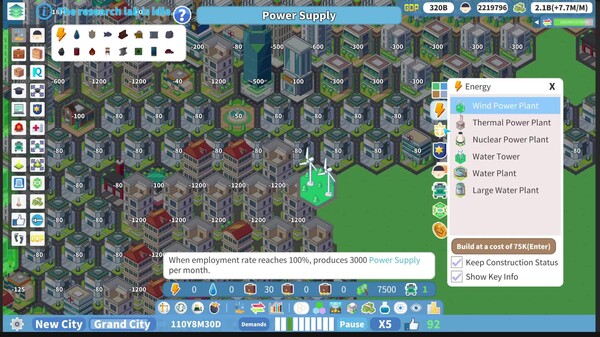
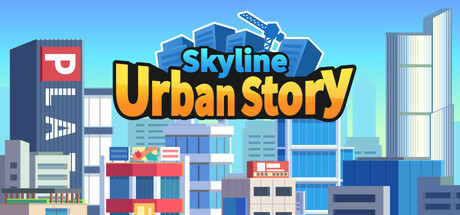
From barren land to towering metropolis, every decision you make shapes the destiny of your city. Industrial flow, global trade, surging land values, and growing wealth, offers deep management gameplay, perfect for players who love strategic city-building and economic simulation.
Modeled estimate, not a reported figure. How we estimate →
Prices
The United States storefront in every case, so this compares stores and not countries.
Discounts
Every price cut of more than 20% we have observed, in each market that quoted one, with this game's chart position on either side of it. These are episodes, not a model: a sale is one event, and one event cannot tell you what the next one will do.
Reviews, worldwide (the counter carries no country): 0/day in the week to Aug 30 → 0.14/day in the week after.
Reviews, worldwide (the counter carries no country): 0/day in the week to Jul 23 → 0/day in the week after.
For scale, across Steam · Top Sellers · Brazil over the last 30 days: the 26 chart moves that followed a price cut of more than 20% went a median of 7 places towards #1, and the 2,402 moves with no price cut behind them went 2 away. One store, one chart, one country — it is the only place we have enough observations to say even that.
Prices outside the United States have been collected since 6 August 2026 and chart positions since 19 July 2026, so a cut older than that has no market to compare and a market that joined later has no history yet. Nothing here is converted between currencies.
About
*Skyline Urban Story* is a city-building simulation game centered on macro-level planning. There’s no traditional “build roads, then place buildings” process—this is a true city management experience. As the mayor overseeing everything, the lifeblood of every industry, citizen, and economy flows under your command.
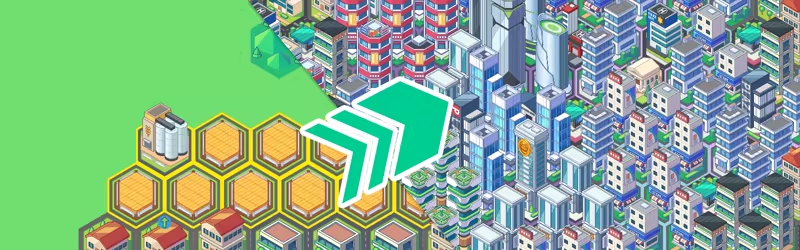
💠 Master Planning, Beyond the Ordinary
Say goodbye to old-school road-based layouts. On a grid-based map, you can freely design the entire city—from overall structure to industrial distribution—all under your control.
🏙 A Real Economy Driven by Demand Chains
Jobs bring people, people bring consumption, and consumption drives industry. As education improves, office demand rises, industries evolve, and tax revenue grows—all naturally following the laws of economics.
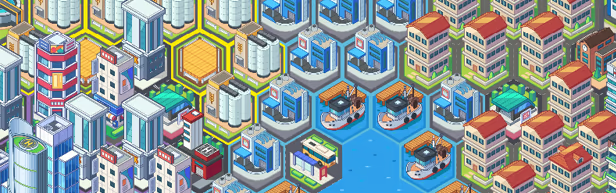
🏭 From Farmland to High-Tech Industries
Food, iron ore, chips, automobiles—every industry produces tangible resources. Supply and demand determine trade flow: surplus leads to exports, shortages to imports. Your city’s economy becomes a finely tuned machine.
📈 Sign Trade Contracts, Build an Export Powerhouse
Carefully choose what to export and import to maximize profit. With limited contract slots, every deal matters—each signature could shape your city’s destiny.
💰 The Pulse of Land Value and Wealth
High-value downtown districts attract wealthy residents and premium jobs, while the outskirts nurture everyday life. Manage land values wisely to watch skyscrapers rise and witness the evolution of your city’s social fabric.
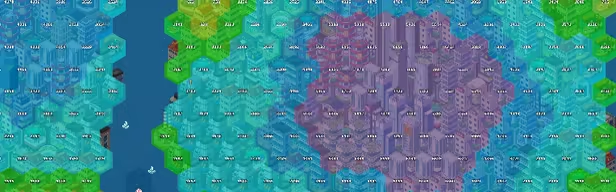
📊 GDP and Global Competition
Every tile contributes to your city’s GDP. Will you become an industrial powerhouse or a financial hub? The data will tell the story. Climb the global leaderboard and compete with mayors around the world!
🏘 Zoning System: Give Your City a Soul
From agricultural zones to creative districts, from shopping streets to towering CBDs—each zone type brings unique benefits and aesthetics, shaping your city’s identity and purpose.
🔬 Research and Civic Progress
Taxes aren’t just income—they’re fuel for innovation. Invest in research to unlock new technologies and push your city into higher stages of civilization.

⭐ Mayor Rating & Citizen Satisfaction
Your decisions will be judged by your citizens. Manage the city well, and they’ll reward you with prosperity. Fail them, and even taxes may stop coming in.
👔 Officer Assistant System
As your city grows, hire officers to help with administration. Let them handle the details while you focus on the big picture.
🕰 Time Machine Review System
From your first cottage to a skyline of skyscrapers, from a humble village to a megacity—relive your city’s entire journey and the pride of building a world with your own hands.

This isn’t just another city-builder about stacking and decorating—it’s a living experiment in economy, strategy, and humanity.
When you gaze upon your shining skyline, remember—every breath this city takes begins with your decision.
Sums Steam + Google Play
| Store | Price | Audience | Score | Chart | Est. revenue |
|---|---|---|---|---|---|
SteamYou are here | $6.99 | 106reviews | 91% | — | $19.8K |
| Free | — | — | — | $1.1K |
Matched by title — a reused name can pair the wrong games. * is a critic aggregate. Prices and positions are each store's United States storefront; Epic charts worldwide. Audience and Score too, except Steam's, which is worldwide.
Engagement
Reviews
Themes across 42 recent reviews and how positive each mention is. A keyword signal, not full sentiment analysis.
Reviews
好玩。只是重复可玩性略低。
太好玩了,期待大更新呀。美滋滋
很好玩,跟水多加面面多加水还不太一样,但是上手比较难,我无指引到10万人口已经借了三笔贷款了(妈的)。 比较恶心的是地价问题,还有物流中转站的卡手、极度高昂的交通维护费,本质就是市中心不断与郊区和郊外更换地格的发展过程,这点比较毒,因为随着市中心高地价地格的需求,势必要增加更多的交通成本,物流和公交缺一不可,导致你的钱永远紧巴巴的...再研究研究
Media

Related
Related
Price dynamics, follower growth, revenue and sales trajectories with interactive tooltips
This and every other Pro feature is free until October 20, 2026. A free account is all it takes.
Genres
Stats
All-time low is the lowest price we've recorded for this game since we started tracking it.
Languages: English, Simplified Chinese, Traditional Chinese, German, Japanese
Hours played at review time, across 42 reviews with recorded playtime.
positive critical· bar length = how often the theme comes up
交互有一定问题,我想点房子看下具体情况,或者移动屏幕看下其他同类情况,结果老是和建造、取消功能混在一起,建议优化一下,加一个鼠标边框移动屏幕功能
好玩的小游戏,更新很快
よくあるゲームだけど細部の出来が良い感じ
新手教程里建建筑都没办法一直卡着,点什么地块都没弹出来功能区。
挺不错的
中华一商和天际都市物语都非常有趣并耐玩,直戳模拟经营城市营造资本贸易类玩家的心,我本人非常喜欢这样大作的简洁操作版,希望开发商继续努力,多做些佳品!
Skyline Urban Story, developed and published by PandaUpStudio, is a city-building and economic simulation game that distinguishes itself through a strong emphasis on macroeconomic systems and industrial interconnectivity rather than purely aesthetic urban design. While many city builders focus heavily on road placement, traffic micromanagement, and decorative elements, Skyline Urban Story takes a broader strategic perspective. It challenges players to think like policymakers and industrial planners, constructing not only a functional city but a resilient and profitable economic ecosystem. From the outset, the game places players on a hex-based grid, offering a structured yet flexible foundation for development. Zoning forms the backbone of early progress, with residential, commercial, and industrial districts interacting in carefully balanced cycles. Residents require jobs, businesses require customers, and industries require both labor and raw materials. Unlike more streamlined city simulators, the economic feedback loops here are pronounced and consequential. An imbalance in supply chains or workforce distribution can quickly ripple across the entire city, affecting tax revenue, land value, and overall growth. This interconnected design encourages deliberate planning rather than impulsive expansion. Industrial development is where Skyline Urban Story truly shines. The game introduces layered production chains that require players to consider upstream and downstream effects. Basic resource extraction feeds into intermediate goods, which in turn support advanced manufacturing sectors. For example, raw materials may need to be processed before they can be transformed into consumer goods or high-value exports. Managing these chains demands foresight, particularly when balancing domestic consumption with external trade opportunities. The inclusion of import and export contracts adds a global dimension to the simulation, allowing players to shape their city’s role within a broader economic network. Trade mechanics provide both opportunity and risk. Entering into contracts can generate substantial revenue, but overreliance on external markets may expose the city to fluctuations in demand or supply shortages. This tension between local self-sufficiency and global integration mirrors real-world economic strategy. As cities grow, players must decide whether to diversify industries, specialize in certain sectors, or expand infrastructure to support higher production capacity. These choices create meaningful variation between playthroughs, as no two cities need to follow the same developmental path. Visually, Skyline Urban Story adopts a clean and functional art style that prioritizes clarity over spectacle. The hex-grid layout keeps zoning organized and readable, while overlays and data panels provide detailed insight into economic performance. Rather than relying on highly detailed 3D models or elaborate animations, the game emphasizes transparency in its systems. Watching districts evolve from modest beginnings into dense urban centers with rising skylines is satisfying not just because of visual growth, but because of the underlying economic logic driving that transformation. The simulation depth extends to macro indicators such as GDP and land value. Economic growth is not merely reflected in taller buildings but also in measurable metrics that influence bonuses and city performance. Citizens’ needs are communicated through interface cues, allowing players to adjust policies and development strategies accordingly. These layers encourage a holistic approach to governance, blending industrial management with social balance. Rapid industrial expansion may boost income, but neglecting residential satisfaction or public services can stall growth or reduce efficiency. However, the complexity that defines Skyline Urban Story can also serve as a barrier to entry. New players may find the interwoven systems overwhelming at first, particularly when trying to interpret economic data and optimize production flows. The learning curve demands patience and experimentation. Yet for fans of management-heavy simulations, this depth is precisely the attraction. Discovering how to stabilize a struggling supply chain or transform a deficit into sustained growth provides a sense of accomplishment rarely found in simpler city-building experiences. Ultimately, Skyline Urban Story stands as a thoughtful and system-driven entry in the city-building genre. It favors economic realism and strategic planning over decorative urban design, offering a sandbox where industrial logic and trade policy shape the skyline as much as aesthetic preference. For players who enjoy dissecting production chains, balancing imports and exports, and watching statistical indicators climb as a result of careful planning, the game delivers a rewarding and intellectually engaging experience. While it may not cater to those seeking casual creativity or visual spectacle alone, it offers a richly layered simulation that rewards analytical thinking and long-term strategy. Rating: 8/10
Selling now
See how fast this game is selling right now — estimated copies and revenue per day from recent review growth.
Players by region
Where this game's players are, estimated from review languages.
Related
| Game | Estimated lifetime revenue | Reviews | Review score | Price |
|---|---|---|---|---|
| $198.6K | 661 | 71% | $11.99 | |
| $90.5K | 260 | 73% | $11.99 | |
| $84.1K | 337 | 95% | $8.99 | |
| $80.2K | 352 | 83% | $8.99 | |
| $48.4K | 44 | 68% | $29.99 | |
| $2.1K | 8 | 38% | $9.99 |
Related
| Game | Estimated lifetime revenue | Reviews | Review score | Price |
|---|---|---|---|---|
| $19.8K | 58 | 79% | $9.99 | |
| $19.8K | 64 | 78% | $15.99 | |
| $19.8K | 326 | 68% | $2.99 | |
| $19.8K | 2.3K | 65% | $0.99 | |
| $19.8K | 191 | 94% | $4.99 | |
| $19.8K | 1.4K | 62% | $0.99 |