A chill idle-mining sim that lives on your desktop. Dig rocks, collect gems, buy upgrades, feed your greed, and uncover shiny surprises while you do other things.
Modeled estimate, not a reported figure. How we estimate →
Media

About
Sin Slayers: Meat & Greed is a cozy idle-mining simulator that quietly runs on your screen. Guide a lone dwarf miner as he digs through the cursed lands beneath the world of Sin Slayers—collecting gems and uncovering the darkness below.
Dig through cursed lands
Chip away at rock—gathering valuable gems buried deep beneath forgotten battlefields and haunted crypts.
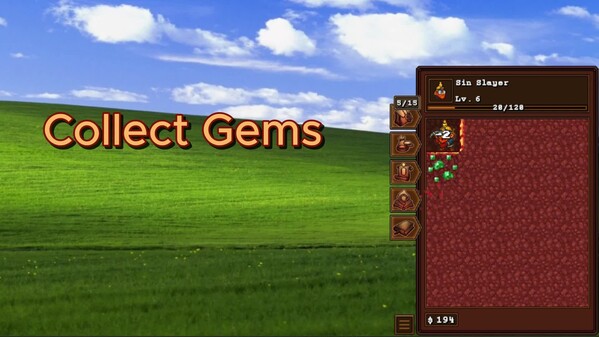
Collect gems
Each layer hides new surprises. Use your findings to unlock fresh mining zones, upgrade gear, and keep the dig going.
Upgrade your tools
Spend your hard-earned loot on stronger pickaxes, faster digging, and a bigger backpack. The deeper you go, the greater the rewards.
Idle-friendly
Sin Slayers: Meat & Greed runs quietly at the bottom of your screen while you go about your day. Whether you're working, studying, or slaying sins elsewhere, your miner keeps digging.
Disclaimer: Steam Deck is not supported by design. The game may launch, but performance and controls are not optimized for Steam Deck.
Genres
Stats
All-time low is the lowest price we've recorded for this game since we started tracking it.
Languages: English, Russian, French, Italian, German, Spanish - Spain, Bulgarian, Czech, Danish, Dutch, Finnish, Greek +15 more
Engagement
Hours played at review time, across 40 reviews with recorded playtime.
Reviews
Themes across 40 recent reviews and how positive each mention is. A keyword signal, not full sentiment analysis.
positive critical· bar length = how often the theme comes up
Reviews
A not-so-idle game that has nothing cozy going on with it. It doesn't work properly if you have multiple monitors connected, as the game will most likely run while in the void and you cannot do anything about it (well, you can go and edit the settings file and hope it works). Oh, and even then it has its own dimension, regardless of your monitor size. It won't really go to the corner since the game own dimensions aren't that far out. (In my case, it's about the middle of the screen) The UI scaling is also pretty bad. It doesn't seem to take in consideration higher resolutions, since it's either too small or too huge. It requires your action every so often since you need to sell your inventory, do upgrades, etc. It ain't so bad, it's just a bit limited so you need to check it a bit too often for what I think an idle game is. Besides that, there's nothing. That's about it. Something to leave running for at least 60 hours, if you manage to get everything else.
Норм айдл, но мало прокачки
I said yes, but this is a maybe. I read a lot of people disliked this because it required interacting too often. I kind of enjoyed that. It kind of bugged me at first, as it's very "need to interact to continue", but after awhile it gave me something to look forward too! Wish there was a lot more fleshed out with it, it could be something fun.
Sin Slayers: Meat & Greed is a solid idle game overall, striking a good balance between being mostly hands-off while still keeping you engaged with upgrades and progression decisions. Early on it feels very rewarding, as many of the 50 achievements or goals are unlocked quickly, which creates a strong sense of momentum. Unfortunately, that pace doesn’t last — progression slows down significantly in the mid-game, briefly improves, and then completely stalls in the endgame. After around 51 hours I had fully upgraded everything, leaving nothing left to do except wait to reach level 30 and the 60-hour mark to achieve 100% completion. The game clearly suffers from balance issues at the end, and would benefit from additional long-term achievements tied to stats like blocks destroyed or a general rebalance of progression to keep players engaged through to the finish.
As a huge idle game player, this game is meh at best. Another cornerpond clone but with mining. I thought it was going to be more than what it is, however it is not the case. My biggest issue with the game is stupid I'll admit but the name seriously bugs me. There is no sin, no slaying, and no meat. Who saw this name and thought "it's perfect!". Outside of the "greed", the name makes zero sense for this game. I do like the graphics, I'll give it that however you're not missing anything here as far as gameplay goes.
I am a dwarf and I'm digging a hole. Diggy diggy hole, diggy diggy hole. I am a dwarf and I'm digging a hole. Diggy diggy hole, digging a hole!
It is clear from the mixed reviews that many players are approaching this game with the wrong expectations. This is not a failure of the game's design; it is a failure to understand the distinct types of idle games. The idle genre is broad, and you simply cannot compare games designed for constant interaction to a truly passive experience. In reality, the game sits in the minimalist/passive idle category. The closest parallel is a game like Cornerpond, but even that comparison overstates the required interaction here. This game features the absolute bare minimum of upgrades and input by design. This game expertly executes its goal as a highly passive, aesthetically pleasing background idle experience. It is designed to be a slow, persistent reward system, and in that regard, it is a success. If you can accept its design philosophy, you will find a rewarding background companion. If you are worried about your inventory constantly getting full, you can easily implement an auto-clicker. Simply set it to click the "sell" button every 2-3 minutes. This maximizes passive income and removes the only real hands-on management requirement.
If you’re coming from the original Sin Slayers expecting an actual expansion or a meaningful evolution, save your money. This doesn't feel like a game; it feels like a chore designed by someone who heard what an RPG is but never actually played one. The "Gameplay" (or lack thereof): The core loop is mind-numbingly repetitive. It lacks the tactical depth that makes turn-based combat engaging. Instead of strategic choices, you’re just clicking through menus and watching health bars move in the least exciting way possible. There is no "soul" here—just a series of disconnected mechanics that don't respect the player's time. Where is the Greed? The irony of the title isn't lost on me. The "Meat" is non-existent, and the "Greed" seems to belong entirely to the release strategy. It feels like a stripped-down version of its predecessor, recycled and sold back to us with zero improvements to the UI, balance, or pacing. Verdict: It’s buggy, it’s shallow, and it feels unfinished. Calling this a sequel or even a standalone expansion is a stretch. It’s an exercise in boredom that fails to capture any of the dark atmosphere it promises. Do yourself a favor: skip the meat, save your greed, and play literally anything else.
Meh. It was bundeled with somthing else
Sin Slayers: Meat & Greed, developed and published by Goonswarm Games, is a lightweight incremental experience that takes the dark fantasy world of Sin Slayers and reinterprets it through a far more relaxed, almost passive gameplay loop. Instead of dungeon crawling or tactical combat, it shifts focus toward steady resource accumulation, gradual upgrades, and the quiet satisfaction of watching numbers climb over time. It’s a game designed less for immersion and more for coexistence—something that runs alongside your day rather than demanding your full attention. At its core, the game revolves around a simple but effective loop: mining, collecting resources, upgrading tools, and repeating the process to reach deeper layers. You guide a lone dwarf miner through increasingly lucrative underground zones, with each descent offering slightly better rewards and opportunities for efficiency. Progression feels consistent, even if it is incremental, and there is a certain appeal in seeing small improvements stack into meaningful gains. The game doesn’t rush the player or impose pressure, instead encouraging a steady, almost routine engagement with its systems. What sets Meat & Greed apart from more traditional idle games is its semi-active design. While it can function passively for stretches of time, it still asks for periodic input—clearing inventory, managing resources, and making upgrade decisions. This creates a middle ground between fully automated idle experiences and more interactive clicker-style games. For some players, this balance adds a sense of involvement that keeps the experience from feeling completely detached. For others, it may interrupt the relaxed flow they expect from an idle title, making it feel slightly more demanding than its presentation suggests. The upgrade system is straightforward and serves as the primary driver of engagement. Improvements to mining speed, carrying capacity, and efficiency are clearly communicated, making it easy to understand how each upgrade contributes to progress. This clarity is one of the game’s strengths, as it ensures that every decision feels purposeful, even within a simple framework. Unlocking new layers adds a sense of forward movement, though the underlying mechanics remain largely unchanged, reinforcing the game’s focus on consistency over evolution. Visually, the game adopts a modest pixel-art style that complements its low-intensity design. The environments are functional, providing just enough detail to convey progression without overwhelming the player. One of its most notable features is its ability to run as a desktop overlay, allowing it to occupy a small portion of the screen while you engage in other activities. This design choice defines much of the experience, positioning the game as something that fits into your routine rather than something you actively sit down to play for extended periods. However, the simplicity that makes the game accessible also limits its longevity. The core loop, while initially satisfying, offers little variation beyond incremental improvements. There are no major shifts in gameplay, narrative developments, or complex systems to deepen the experience over time. As a result, it can begin to feel repetitive, especially for players who prefer games with evolving mechanics or layered progression. Its connection to the broader Sin Slayers universe is also fairly loose, with little emphasis on lore or continuity, making it feel more like a thematic spin-off than an extension of the original concept. Despite these limitations, Sin Slayers: Meat & Greed succeeds in delivering exactly what it sets out to be: a low-commitment, background-friendly incremental game. It offers a steady and predictable loop that can be enjoyable in short bursts or as a secondary activity, particularly for players who appreciate the quiet satisfaction of gradual progression. It may not leave a lasting impression or stand out within the genre, but it fulfills its role with consistency and clarity. Rating: 6/10
Related
Related
Trends
Concurrent players on Steam, sampled daily since tracking started.
Audience
Estimated from the language of this game's reviews — a proxy for where players are, not official Steam demographics.
Related
| Mr. Maze | $1.7K | 62 | 84% | $1.99 |
| Spring Bonus | $1.7K | 69 | 81% | $1.74 |
| Secret in Story | $1.7K | 114 | 69% | $0.99 |
| Hope | $1.7K | 66 | 94% | $2.99 |
| Escape the City | $1.7K | 51 | 67% | $0.49 |
| Succubus Throne | $1.7K | 68 | 85% | $1.11 |