Shards of Infinity is a digital deck-building strategy game developed and published by Temple Gates Games that translates the essence of modern tabletop deck builders into a sleek and highly competitive video game experience. It sits comfortably alongside genre peers while carving out its own identity through a strong emphasis on direct combat, escalating power, and constant player interaction. Rather than focusing on abstract victory points or long-term engine building alone, the game frames every match as a race toward dominance, where aggressive decisions and sharp timing often matter just as much as careful planning.
At the heart of the experience is a fast-paced head-to-head structure in which players build their decks on the fly from a shared central market. Each player begins with a small, basic deck and gradually improves it by acquiring stronger cards that generate resources, deal damage, or provide defensive effects. The objective is simple and immediately understandable: reduce your opponent’s health to zero or achieve an alternate victory condition before they do the same to you. This clarity makes the game approachable, but beneath the surface lies a surprising amount of strategic depth.
One of the game’s defining mechanics is the Mastery system, which adds a unique layer of progression and tension to every match. By spending gems, players increase their Mastery level, which in turn unlocks enhanced effects on many cards. As Mastery rises, even modest cards can become devastatingly powerful, dramatically shifting the balance of a match. Reaching a high enough Mastery level also enables an instant-win condition, forcing opponents to constantly weigh whether they should focus on dealing damage, building defenses, or racing to increase their own Mastery. This creates a dynamic push-and-pull that keeps games from becoming predictable or stagnant.
Another standout feature is the use of Mercenary cards, which can be either purchased into a player’s deck or used immediately for a one-time effect straight from the market. This mechanic injects a strong tactical element into each turn, as players must remain alert to opportunities their opponents might exploit. A well-timed mercenary play can swing momentum in an instant, punishing careless turns and rewarding players who can read the board state effectively. The shared market ensures that every decision is interactive, with players constantly influencing each other’s options.
The pacing of Shards of Infinity is one of its strongest qualities. Matches tend to be relatively short, often finishing in under half an hour, yet they rarely feel rushed or shallow. Each turn presents meaningful choices, and the escalating power curve ensures that tension builds steadily toward a decisive conclusion. This makes the game ideal for repeated play sessions, whether against AI opponents or human players online. It also means that losses rarely feel exhausting, as it’s easy to jump straight into another match with a fresh strategy.
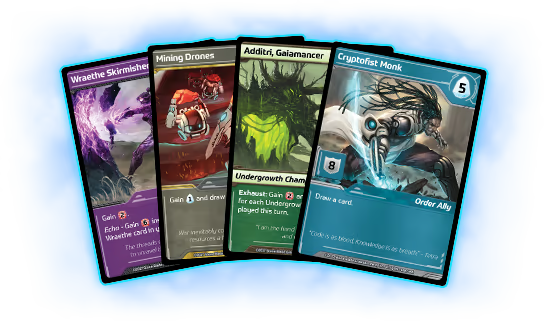
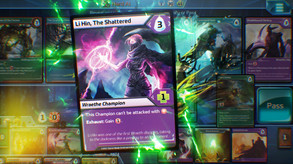
Visually, the game opts for a clean and functional presentation that prioritizes clarity over spectacle. Card art is readable, interfaces are well organized, and important information such as health totals and Mastery levels is always visible at a glance. While the aesthetic may not be as flashy or thematic as some larger card games, this restraint works in its favor by keeping attention focused on decision-making. The digital adaptation runs smoothly and feels well suited to both mouse and touch-based inputs.
Shards of Infinity offers a range of modes that support different playstyles. Solo players can face AI opponents to learn the mechanics or refine strategies, while online multiplayer provides the real test of skill, where mind games and timing become crucial. The game’s systems are easy to grasp, but mastering them requires experience, particularly when it comes to recognizing when to pivot between aggressive pressure and long-term Mastery investment.
Despite its strengths, the game is not without limitations. Because it relies on a shared market and a relatively compact card pool, some matches can feel structurally similar over time, especially for experienced players. There is also little in the way of narrative framing or thematic immersion, which may disappoint players looking for story-driven card games. However, these omissions are largely a result of the game’s focus on pure mechanics and competitive balance rather than world-building.
Ultimately, Shards of Infinity succeeds because it delivers a tightly designed, highly replayable deck-building experience that values interaction and momentum. Its combination of direct combat, the Mastery system, and tactical card usage creates a satisfying blend of strategy and immediacy that keeps players engaged from the opening draw to the final blow. For fans of competitive card games and deck builders who enjoy fast matches with meaningful choices and constant pressure, it stands as a strong and confident entry in the genre.
Rating: 7/10