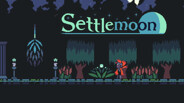
After the moon vanished, the fantasy world of Settlemoon lays abandoned in darkness. Re-light the skies, and provide a rest stop for adventurers in a town that updates in real time. Grow your town to attract strange visitors, and discover happened to this world.
Modeled estimate, not a reported figure. How we estimate →
Media
About
Genres
Stats
All-time low is the lowest price we've recorded for this game since we started tracking it.
Languages: English
Engagement
Hours played at review time, across 40 reviews with recorded playtime.
Reviews
Themes across 40 recent reviews and how positive each mention is. A keyword signal, not full sentiment analysis.
positive critical· bar length = how often the theme comes up
Reviews
I love my little guys.
h
Genuinely interesting and fairly unique game that encourages you to engage with its systems and mechanics blindly to discover just what they are and how they function. At its roughest, it can be hard to decipher exactly what's going on, but eventually, everything sort of settles into place. Settlemoon doesn't demand a lot of your time, and even encourages you to hop off the game rather than leave it open. It becomes an interesting mix of resource management, strategy, and planning to overcome obstacles and discover secrets without, in my opinion, forcing you into any one corner or specifically stating what it is you need to do. I really like that, as it feels like digging into a strange world. It's honestly worth the pricetag.
Part of this game's charm is figuring it out; if you don't like these kinds of puzzles, this game isn't for you. Other than that, it is an idler where you are meant to check in, get a few things set up, and then close it again. You need to be able to analyze what you are doing, what you are planning, and what are the results you want to achieve; but even by winging it, eventually, you'll probably get through it all. Most of the difficulty is just in figuring it out. The game itself is pretty casual. It has a really charming style, lots of customization options, and just great soundtrack as a whole.
Settlemoon, developed and published by Lepioid LLC, is a tranquil and imaginative town-building experience that blends idle mechanics with a cozy, reflective atmosphere. Set in a world where the moon has mysteriously vanished and plunged the land into darkness, the game invites players to rebuild light and life from the remnants of a fading world. Rather than following a traditional narrative or gameplay loop, Settlemoon takes a minimalist and meditative approach. It allows players to nurture a settlement over time, attract wandering adventurers, and restore a sense of balance to the world one small action at a time. This isn’t a game about conquest, competition, or constant management—it’s about watching a community slowly take shape under your quiet guidance. At its heart, Settlemoon operates as a hybrid between an idle game and a town simulator. Players begin with little more than a barren plot of land and the tools to place a few basic structures. As time passes, the town begins to grow, adventurers arrive, and the world slowly starts to feel alive again. Progress is designed to unfold gradually, with the game continuing to evolve even when you are not actively playing. This sense of persistence is one of Settlemoon’s defining traits. The world doesn’t demand your constant attention; instead, it rewards patience and small moments of interaction. You might log in to see new visitors, completed quests, or buildings under construction, each change adding subtle satisfaction to your ongoing creation. Despite being labeled an idle game, Settlemoon strikes an interesting balance between automation and engagement—while some systems progress on their own, meaningful growth still relies on the player’s input and attention, which can occasionally make the “idle” description feel a bit generous. Visually, Settlemoon captures an otherworldly serenity through its distinctive pixel art and subdued color palette. The muted tones and minimal lighting evoke the sense of a world wrapped in twilight, perfectly matching the theme of a land without a moon. The animations are simple but expressive, and small touches—such as flickering lanterns, drifting clouds, and the soft glow of rebuilt lights—lend the game a calm, almost hypnotic rhythm. The visual design is both functional and evocative, ensuring clarity while establishing mood. The aesthetic carries the game’s emotional weight; there is a quiet melancholy to the landscapes, yet an underlying sense of hope as your town slowly becomes a beacon in the darkness. The soundtrack complements this beautifully with gentle, ambient melodies that flow naturally with the pace of the game, inviting players to relax and linger rather than rush. The mechanics of Settlemoon emphasize creation and observation over direct control. Players construct and upgrade various buildings, post quests for adventurers, and supply the resources needed to sustain the settlement. Adventurers serve as the active agents in your world—they come to shop, rest, or undertake quests that help expand the town’s influence. These NPCs are autonomous, giving the sense that your village is truly alive, functioning even when you’re not watching every move. Managing these interactions becomes a satisfying balancing act between providing enough infrastructure for your citizens and leaving room for natural growth. There’s also a light customization system that lets you decorate and organize the layout of your town, which adds personality and creativity to the process. Although not as intricate as larger city builders, this freedom allows each player’s version of Settlemoon to feel distinct and personal. However, the game’s tranquil pacing can sometimes blur the line between relaxing and uneventful. While it is refreshing to play a game that doesn’t pressure the player with constant tasks, the lack of urgency also means that certain stretches can feel slow or repetitive. Some players may find the progress curve uneven, as key milestones or upgrades require long periods of waiting or frequent check-ins to advance. The quest system, while charming at first, eventually begins to loop with familiar objectives and interactions, which can make extended play sessions feel repetitive. The idle mechanics, too, are imperfect—progress often halts entirely when the game is closed, which undercuts the promise of true background progression. This may frustrate players who expect a more automated system, especially those drawn in by the “idle” label. Despite this, the game maintains an appealing rhythm once expectations adjust, rewarding consistency and curiosity rather than optimization. Thematically, Settlemoon carries an understated emotional resonance. The premise of restoring light to a moonless world serves as a quiet metaphor for renewal and persistence. There’s a sense of loneliness at first, but as the town grows and more adventurers arrive, that loneliness transforms into comfort and connection. The game doesn’t rely on heavy dialogue or scripted storytelling; instead, it builds atmosphere through small discoveries and evolving details. Each new structure or visitor feels meaningful, not because it grants power or progress, but because it symbolizes hope returning to a darkened land. It’s the kind of game that speaks softly, offering moments of contemplation rather than adrenaline. In terms of performance and accessibility, Settlemoon is lightweight and polished, running smoothly on most systems without technical hiccups. The interface is intuitive, the controls are minimal, and the overall experience is designed to be approachable for players of all skill levels. There are no high-stakes challenges or complex management systems to master—just a steady loop of creation, observation, and gentle progression. This simplicity is both its strength and its limitation. It’s ideal for players seeking relaxation or creative expression, but those craving strategic depth or dynamic storytelling may find its minimalist design too subdued. Still, its clarity of vision and consistent tone make it a commendable example of how small-scale design can achieve emotional depth through restraint. Ultimately, Settlemoon is less a game about achievement and more a meditation on time, patience, and quiet creation. It invites you to slow down, to build something at your own pace, and to find satisfaction in watching a world grow from silence into life. Its modest scope and soft aesthetic make it a soothing antidote to the frantic pace of most modern games. While it has its shortcomings—limited automation, repetitive quests, and shallow mechanics—its charm lies in its atmosphere and intent. It offers players not just a simulation of settlement building, but a moment of stillness in a digital world often obsessed with speed and productivity. For those who appreciate games that let you breathe, reflect, and build a little light in the dark, Settlemoon is a quietly memorable experience that stays with you long after you stop playing. Rating: 8/10
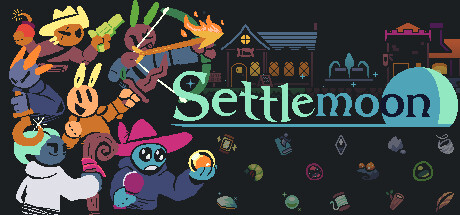
If you enjoy the decoration and art-style of Stardew Valley, but want something more idle and cozy, then this is the game for you! It's very easy to get into and I like collecting the villagers, they are so cute :3
Settlemoon is an interesting take on the idler genre. Rather than progressively getting better and upgrading yourself to get bigger numbers, you just come back every so often to check in on the villagers of your town. It has a pretty simple gameplay loop that can go on for a really long time, especially because it doesn’t run 24/7. You need to activate moon phases which have a limited time for your town to make progress. That means you can’t just leave it running for a week, come back, and powerlevel a bunch and repeat the process. This makes it different from other idlers because it really wants you to idle by leaving it entirely and checking on it hours later. Playtime will probably be anywhere from 5 minutes to an hour or so, depending on how much you plan on doing. First and foremost the biggest problem this game has is definitely it’s lack of information. There’s basically no words at all in this game and so everything is basically just vaguely given to the player in the form of short little picture books that give you the jist of what is going on. Other than that you’re given nothing. You don’t get names for the monsters, the quests, the materials, the items you’re selling or their effects, the buildings you’re making or what those buildings do, the effects of- You get the idea. The game gives you literally nothing because it’s purely visual. On one hand it doesn’t need words, but on the other hand it does make me hate the game more than I probably would otherwise. I'm just constantly asking "what is that?" and "what does that even do?" with no answer other than to figure it out or ignore it. While this game doesn’t need words to spell out the story flat out to the player and pad its already padded playtime with dialogue boxes, it is really annoying trying to figure things out with literally no feedback whatsoever. Unless you look up guides and you play this game blind, you’re gonna spend a lot of time looking at everything and not know what the heck anything means. You might eventually notice that certain buildings have certain tags but not know what any of them mean. You might take a while figuring out how the leveling system works, or how to start selling merch, etc. You’re bound to figure it out eventually, but it might be frustrating to be dealing with the pure vagueness that is the entirety of this game. Still, without any information the base gameplay loop is there and easy to grasp if you give it a chance. It might take a bit to get a feel for it but you’ll eventually get it. Set a moon cycle if there isn’t one, collect your silvers, redeem quests for materials, deliver materials to shops for various items to sell, and that’s basically it. Expand your town over time, build new buildings for either utility purposes or to be cosmetic, grow your town’s level and slowly take on harder bosses to progress further. The town does everything, you just need to come back and check on it from time to time. Other than that it's a cute and simple little time killer every so often. Settlemoon is designed to be played every couple hours or so, or whenever you feel like it honestly, and isn’t really designed to be opened constantly like other idlers. Although, while it's a nice game to play between games, I find that it’s price point is a bit steep for what it offers. On a sale, perhaps, but with how little there is to do combined with how little information is given to the player, I personally found the game to slowly grow more boring over time as I make my way deeper into the game but still be given close to nothing to really work with. I would really like it more if it wasn’t so vague and clunky by design. There’s just nothing for me to personally latch onto after a certain point of doing the same thing over and over again until I find the next piece of the puzzle.
Funny little game about toying with toys to figure out what they do and how to progress. It's something you can either leave open or just come back every day or so and get a little further. I didn't really understand much of the story though lol.
it's nice and relaxing
Dowalona giera,minimalistyczny citybuilder z questami.
Related
Related
Trends
Concurrent players on Steam, sampled daily since tracking started.
Momentum
Pace estimated from the game's recent review growth (our daily snapshots) at its own sales-per-review ratio — a momentum signal, not booked sales.
Audience
Estimated from the language of this game's reviews — a proxy for where players are, not official Steam demographics.
Related
| Marmoset Hexels 3 | $124.9K | 332 | 91% | $19.00 |
| Forsaken Remastered | $124.9K | 296 | 87% | $19.99 |
| GeoDepths | $124.9K | 304 | 87% | $16.99 |
| Vampire: The Masquerade - Redemption | $125K | 988 | 88% | $5.99 |
| Secrets of Rætikon | $125K | 495 | 60% | $9.99 |
| Whimsy Bake&Craft | $124.8K | 405 | 65% | $7.99 |