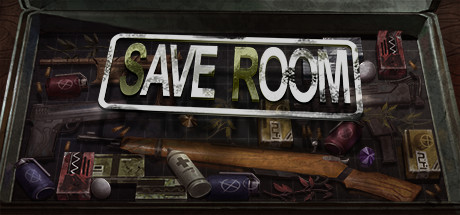
Save Room – Organization Puzzle, developed and published by Fractal Projects, is a clever and unexpectedly addictive puzzle game that takes one of the most memorable mechanics from classic survival horror games and transforms it into an entire experience built around strategy, organization, and spatial problem-solving. Inspired heavily by the inventory management system popularized by games like Resident Evil 4, the title revolves entirely around arranging weapons, ammunition, healing items, and supplies inside a limited inventory grid. While the concept initially sounds extremely simple, the game quickly proves how satisfying and engaging inventory organization can become when treated as the core mechanic rather than a secondary feature.
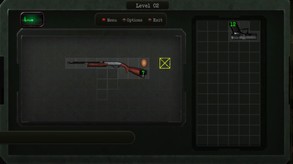
The gameplay loop is straightforward but remarkably effective. Each stage presents players with a cluttered inventory filled with firearms, grenades, herbs, ammunition boxes, knives, and healing sprays that must all fit neatly inside a restricted storage case. The challenge comes from figuring out how to rotate, combine, reload, and arrange these items as efficiently as possible. Early puzzles are relatively forgiving, introducing players to the core mechanics gradually, but later levels become increasingly demanding and require careful planning several steps ahead.
One of the strongest aspects of Save Room is how naturally it evolves its puzzles over time. At first, players simply rotate and reposition items to maximize space, but new mechanics are introduced steadily enough to keep the gameplay fresh. Weapons can be reloaded to free inventory slots, herbs can be combined into stronger healing items, and ammunition must often be distributed carefully to create enough room for larger objects. These additions transform the puzzles into much more strategic challenges than simple object placement exercises.
The game succeeds because it understands exactly why inventory management became so memorable in survival horror games. There is an oddly satisfying feeling that comes from perfectly fitting a shotgun into a narrow gap or reorganizing supplies so every item fits neatly within the case. Save Room builds its entire identity around that small but rewarding sensation. Every completed puzzle delivers a strong sense of accomplishment because players can visibly see the efficiency of their solutions.
Another major strength is the game’s pacing. The campaign steadily increases in difficulty without becoming overwhelming too quickly. New mechanics and larger item combinations appear often enough to maintain variety, ensuring the gameplay rarely feels stagnant despite the narrow focus. The puzzles remain engaging because each level introduces different inventory layouts and strategic possibilities rather than simply increasing the number of objects on screen.
Atmosphere and presentation also play an important role in the experience. Although Save Room is technically a puzzle game rather than a horror title, it strongly recreates the mood of classic survival horror inventory screens. The interface design, sound effects, and ambient music all evoke the feeling of organizing supplies inside a quiet save room before heading back into danger. Weapon reload sounds feel satisfyingly mechanical, item interactions are accompanied by familiar audio cues, and the overall presentation taps directly into nostalgia for older survival horror games.
Visually, the game keeps things clean and functional. Items are detailed enough to remain instantly recognizable while still maintaining readability during more crowded stages. The minimalist design works extremely well because it allows players to focus entirely on solving the puzzles without unnecessary visual clutter. Rotating and moving items feels smooth and responsive, which is important in a game where precision and experimentation form the foundation of the experience.
The accessibility of the mechanics is another reason the game works so well. Players can understand the core concept almost immediately, making it easy to begin solving puzzles within minutes. At the same time, later stages become surprisingly challenging and require careful thinking to solve efficiently. This balance allows the game to appeal both to casual puzzle fans and to players who enjoy optimization-heavy gameplay systems.
One particularly enjoyable element is how experimentation is constantly encouraged. Many puzzles initially appear impossible until players discover small tricks involving item combinations, ammunition management, or unconventional positioning. The game rarely hands solutions directly to the player, instead rewarding patience and observation. This makes progression feel genuinely satisfying because solutions feel earned through problem-solving rather than luck.
However, the game’s tightly focused design can also become its biggest limitation. Since every stage revolves around the same inventory management mechanic, the gameplay may eventually feel repetitive during extended sessions. Players looking for narrative depth, exploration, or major gameplay variations may find the overall structure too narrow in scope. Save Room fully commits to its concept, but that also means there is little variety outside of the organization puzzles themselves.
The overall runtime is also fairly short. Most players can complete the game within a few hours, especially once they become familiar with the logic behind the inventory systems. While the shorter length helps prevent the concept from overstaying its welcome, some players may wish for additional challenge modes, randomized puzzles, or expanded content once the main stages are completed.
A few later puzzles also lean heavily into trial-and-error problem solving, occasionally creating moments where progress stalls until the correct arrangement finally becomes clear. While these moments rarely become frustrating enough to ruin the experience, they can interrupt the otherwise smooth pacing of the game.
Despite these minor shortcomings, Save Room – Organization Puzzle succeeds because it fully understands the appeal of its central mechanic and executes it extremely well. It transforms a beloved inventory system into a complete puzzle experience that feels both nostalgic and surprisingly strategic. The game never overcomplicates its formula, instead focusing on delivering polished and consistently satisfying organization challenges from beginning to end.
For fans of puzzle games, inventory management mechanics, or classic survival horror nostalgia, Save Room offers a highly entertaining and refreshingly creative experience. Its clever puzzle design, satisfying progression, and atmospheric presentation turn a simple idea into one of the more memorable indie puzzle games in recent years.
Rating: 9/10