You think Tower Defense games are all about building? You thought wrong. Sanctum is not your average Tower Defense title. When the havoc starts, you get to join the fray! As one of the world’s first First Person Shooter - Tower Defense games, Sanctum has taken the best of both worlds to deliver an epic, one-of-a-kind experience.
Modeled estimate, not a reported figure. How we estimate →
Media

About
Genres
Stats
All-time low is the lowest price we've recorded for this game since we started tracking it.
Languages: English, Danish, French, German, Spanish - Spain, Swedish, Japanese, Polish, Dutch, Italian, Russian, Turkish
Engagement
Hours played at review time, across 41 reviews with recorded playtime.
Reviews
Themes across 41 recent reviews and how positive each mention is. A keyword signal, not full sentiment analysis.
positive critical· bar length = how often the theme comes up
Reviews
Sanctum 2 jest o wiele lepszy
protect [b]the Core[/b] at all cost ! [i]alien invasion just beginS[/i] ! tower defence with [b]You[/b] inside ... :o)
Franchement, je n’ai pas du tout accroché. J’espère l’avoir acheté en promo, parce que les graphismes ont pris un sacré coup de vieux et la prise en main est assez pénible en solo.
davvero molto bello e carino vorrei il remastered
Все
Je l'avais trouvé sympa à sa sortie, je ne me rappellais pas à quel point le gameplay était complexe à prendre en main... Le principe du jeu est sympa mais galérer plusieurs minutes pour arriver à maîtriser le fait de poser des tours suffisamment rapidement pour pas se faire submerger... ça me gave !
タワーディフェンスゲーム かと思ったら自分がマップの中に入って戦うことができる変態仕様で、 タワーにも中を通った弾が強化される透過式タワーなどがある。 自分の装備強化とタワー強化のさじ加減が重要になってくる。 次回作が出ているが、あっちはがんばってつくったルートを破壊してくる敵が居るので正直初代の方が面白い 癖のあるチャットの読み上げやところどころに仕込まれた小ネタなど、 この頃からすでにコーヒーステインの光るセンスが垣間見える。
Ciekawy koncept
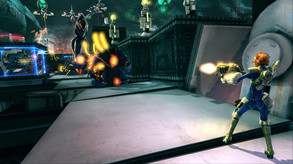
Sanctum by Coffee Stain Studios is a fascinating experiment that bridges two genres rarely combined successfully: first-person shooting and tower defense strategy. Rather than placing the player solely in the role of an overseer who watches turrets and traps do all the work, it places you directly on the battlefield. As Skye, an elite operative defending the futuristic city of Elysion One from waves of alien invaders, you are both architect and soldier. Each mission alternates between two phases—one for building, one for fighting—and this seamless cycle gives the game a rhythm all its own. What begins as a simple idea quickly becomes a compelling challenge that demands foresight, efficiency, and quick reflexes, resulting in one of the most memorable indie strategy titles of its time. At the heart of Sanctum is its blend of strategic planning and kinetic action. During the build phase, you spend resources to construct and upgrade towers that serve as your main line of defense. Each level starts as a bare grid of pathways, and it’s up to you to shape the route that enemies will take, forcing them into deadly chokepoints or long, winding corridors filled with turrets. This planning stage rewards creativity—different tower types excel against different threats, and the ability to stack and upgrade them adds tactical depth. Once the attack phase begins, you shift into first-person mode, actively fighting alongside your defenses with an arsenal of futuristic weapons. You’re not just observing the battle from above; you’re part of it, running between towers, managing angles, and picking off enemies that slip through your defenses. This constant movement and dual focus transform what might have been a passive experience into an energetic, hands-on encounter. The cooperative multiplayer mode amplifies this design even further. With up to four players coordinating in real time, Sanctum becomes an exercise in teamwork and adaptability. One player might focus on managing tower placements while another provides frontline support, and others cover weak points or repair structures between waves. Communication and coordination make the difference between survival and collapse, and this shared tension gives the game an exhilarating sense of camaraderie. While it can be enjoyed solo, it’s in multiplayer that Sanctum truly shines—turning each level into a test of group strategy and reactive improvisation. Few tower defense games manage to make cooperation feel this immediate or tactile. Visually, Sanctum still carries the charm of early Unreal Engine 3 titles. Its clean, futuristic aesthetic suits its sci-fi setting, emphasizing function and clarity over spectacle. The environments, while not overly detailed, are structured in a way that supports the game’s tactical demands—open spaces, elevated vantage points, and distinct enemy designs make it easy to read the battlefield at a glance. The aliens, rendered in glowing blues and greens, stand out clearly against metallic backdrops, and the visual feedback from weapons and towers is satisfying without being overwhelming. The sound design complements this tone perfectly, mixing energetic electronic music with crisp audio cues that keep the player alert without breaking immersion. It’s not a flashy presentation, but it’s cohesive and effective, built to serve gameplay rather than distract from it. Despite its innovative foundation, Sanctum isn’t without shortcomings. The shooter component, while functional, lacks the precision and polish of dedicated FPS games. Weapons feel solid but limited in variety, and enemy encounters sometimes devolve into repetitive point-and-shoot sequences. Similarly, the tower defense side can feel somewhat shallow over extended play; once you’ve mastered tower placement strategies, there’s little mechanical progression beyond incremental upgrades. The limited number of maps at launch also contributes to repetition, and players looking for extensive campaign content may find the experience brief. However, these issues don’t undermine the core loop that makes the game so engaging. Even after several runs, the tension of balancing your resources, designing a smart defense, and switching to real-time combat remains gratifying. Sanctum’s greatest achievement lies in how naturally its two halves complement each other. The tower defense mechanics feed directly into the shooter experience—every decision made in the build phase has tangible consequences once the battle begins. Likewise, your performance in combat directly impacts how effectively you can manage resources for future upgrades. This interplay between macro and micro-level thinking keeps the player constantly involved and invested. The satisfaction of watching your carefully constructed maze channel enemies straight into a field of laser fire, while you mop up stragglers with your rifle, creates a unique sense of control that most strategy games can’t replicate. It’s a system that rewards both intellect and reflex, seamlessly merging planning and action into a unified experience. Looking back, Sanctum stands as one of the early examples of Coffee Stain Studios’ knack for experimentation—a trait they would later refine in games like Sanctum 2 and Goat Simulator. It may not boast the production values of larger shooters or the complexity of pure tower defense titles, but it remains an important milestone for blending the two genres in a way that feels cohesive and enjoyable. For players who enjoy strategic problem-solving but crave the immediacy of combat, Sanctum offers a rare balance that still feels fresh even years after its release. It’s the kind of game that proves innovation doesn’t always require massive scale—sometimes it just takes the courage to mix ideas that others assume don’t belong together. Rating: 8/10
Joguei por 9 horas ininterruptas desde o momento que instalei e jogando no insano passei só da primeira fase, 10/10 peak game
Related
Related
Trends
Modeled estimate over time, reconstructed from Steam's monthly review histogram.
Momentum
Pace estimated from the game's recent review growth (our daily snapshots) at its own sales-per-review ratio — a momentum signal, not booked sales.
Audience
Estimated from the language of this game's reviews — a proxy for where players are, not official Steam demographics.
Related
| Silent Hunter® III | $1M | 2.6K | 88% | $9.99 |
| Ruinarch | $1M | 1.4K | 63% | $24.99 |
| DRAGON QUEST MONSTERS: The Dark Prince | $1M | 1.3K | 74% | $39.99 |
| Street Legal Racing: Redline v2.3.1 | $1M | 4.1K | 89% | $6.99 |
| Digimon Survive | $1M | 3.7K | 79% | $9.59 |
| Ghostbusters: The Video Game Remastered | $1M | 2K | 91% | $24.99 |