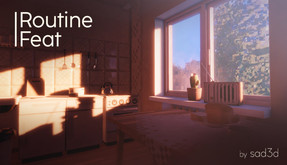
Summer days and no one around. Routine feat. The agony of isolation and abandonment. No violence, no haste, no conflict, except fighting your doubts. Swifts, butterflies, sunset rays on the leaves of trees; radio, notebook and pencil; typewriter; bus; overwhelming loneliness.
Modeled estimate, not a reported figure. How we estimate →
Media

About
Genres
Stats
All-time low is the lowest price we've recorded for this game since we started tracking it.
Languages: English*, Russian**languages with full audio support
Engagement
Hours played at review time, across 40 reviews with recorded playtime.
Reviews
Themes across 40 recent reviews and how positive each mention is. A keyword signal, not full sentiment analysis.
positive critical· bar length = how often the theme comes up
Reviews
Это цифровая поэзия, а не просто рандомная инди игрушка. Мы все там были, ребята.
можно жарить бумагу в духовке, 10/10
Routine feat - это когда простые вещи вдруг становятся пронзительными. Атмосфера затягивает, стихи цепляют, и ты уже не просто играешь, а чувствуешь
Routine Feat is an unconventional first-person exploration experience that quietly resists most of the expectations players typically bring to games. Developed by sad3d, it is less concerned with objectives, progression systems, or structured storytelling and instead focuses on atmosphere, repetition, and the emotional texture of everyday life. At a glance, it resembles a minimal walking simulator set within a modest apartment and its surrounding spaces, but that description only captures its surface. The longer you spend with it, the more it becomes clear that the game is not about doing, but about being—occupying a space, repeating small actions, and observing how those actions begin to take on meaning. The environment is intentionally ordinary. You move through a small living space, interact with objects, step into shared areas, and engage in simple routines that mirror real-life habits. There is no explicit goal guiding your actions, no checklist of tasks to complete, and no narrative urgency pushing you forward. Instead, the game places you inside a loop of familiar behaviors, encouraging you to explore not for reward, but for presence. This design can feel disorienting at first, especially for players accustomed to clear direction, but it gradually reveals a different kind of engagement—one that relies on curiosity and reflection rather than progression. What gives Routine Feat its identity is its atmosphere. The world feels quietly alive, shaped as much by sound as by visuals. Distant voices drift through unseen spaces, ambient noise fills the silence, and fragments of music appear and fade without clear origin. These elements create a sense of connection to something beyond the immediate environment, even as the space itself remains small and contained. Visually, the game adopts a low-poly style with soft lighting and muted tones, giving everything a slightly unreal, almost memory-like quality. The result is a space that feels both familiar and detached, as if you are navigating a recollection rather than a physical location. Interaction is deliberately simple but surprisingly expressive. Most objects in the environment can be manipulated—picked up, moved, thrown, or rearranged—and these actions are governed by physics that often behave in exaggerated or unpredictable ways. There is no practical purpose to these interactions, but they create a sense of tactile engagement that reinforces your presence in the world. Over time, these small actions become part of the rhythm of the experience, turning routine behavior into a form of quiet exploration. At the same time, the limitations of the environment occasionally become apparent, with invisible boundaries or incomplete areas reminding you of the game’s underlying structure. Narratively, the game is abstract and open-ended. It does not present a clear story or explicit themes, but instead offers fragments—moments, sounds, and subtle environmental cues—that suggest deeper emotional undercurrents. There are hints of isolation, repetition, and perhaps even longing, but these ideas are never fully articulated. Instead, the game invites interpretation, allowing players to project their own thoughts and feelings onto the experience. This ambiguity can be one of its most compelling qualities, but it can also make the game feel directionless for those who prefer more defined storytelling. Pacing is slow and intentionally uneventful, which will likely be the most divisive aspect of the game. Nothing pushes you forward, and there is no sense of escalation or climax. The experience unfolds at whatever pace you choose, encouraging you to linger, observe, and repeat actions without expectation of change. For some players, this creates a meditative quality, offering a rare opportunity to engage with a game that does not demand constant attention or achievement. For others, the lack of structure may feel monotonous, as the repetition that defines the experience can also limit its sense of variety. Technically, Routine Feat reflects its indie origins. The physics-based interactions, while engaging, can sometimes behave inconsistently, and the environment occasionally reveals rough edges in its design. These imperfections do not necessarily detract from the experience, but they do reinforce its experimental nature. The interface is minimal to the point of near absence, providing little guidance or feedback, which aligns with the game’s philosophy but can also leave players feeling uncertain about what to do next. Despite these limitations, the game succeeds in creating something distinct. It does not aim to entertain in the traditional sense, nor does it attempt to provide a clear narrative or challenge. Instead, it offers a space to inhabit, a mood to experience, and a set of small interactions that gradually take on personal significance. Its impact depends heavily on the player’s mindset; approached with patience and openness, it can feel reflective and even calming, but approached with expectations of structure or progression, it may feel empty. In the end, Routine Feat is less a game about achievement and more an exploration of presence and routine. It asks the player to slow down, to engage with small details, and to find meaning in repetition rather than reward. It is a niche experience, one that will not resonate with everyone, but for those who connect with its tone, it offers something quietly memorable. Rating: 7/10
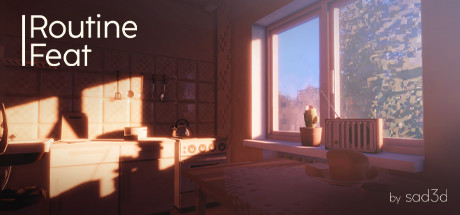
мне не зашло. на мой взгляд сюжет слишком прост, ничего особенного или неожиданного. так же есть неприятные баги, вроде возможности провалиться. еще мир слишком маленький, ни большего количества домов, магазинов, или хотя бы возможности полазить по гаражам. да, приятно, что можно почитать книги, повзаимодейстовать с объектами в квартире, и что в текстах главного героя поднимается проблема одиночества, но так или иначе эта игра где-то на час, пройти и забыть
Before Neyasnoe there was Routine Feat: a brief (as brief as you make it, in fact) game about loneliness, despair, and the uneasy feeling that there has to be more to life than this. A desperate search for meaning. The game plays to this by making only two actions - working and sleeping - progress the clock. You can wander the sprawling hills around your apartment complex; cook eggs directly on the hob; gaze at the skies; read books and helpline ads; flush your worldly possessions down the toilet...none of it makes the blindest bit of difference. Meanwhile, there's mindless data entry to be done, and strange dreams to experience. Time marches on relentlessly, endlessly. The only way to break the cycle...is to quit. I'm genuinely excited by sad3d's work, and can't wait to see what they come up with next.
The game is put together in a very sloppy technical way — there are no settings at all, and I had to enable vertical sync through the graphics card control panel. But the game itself is a dream. A dream of an empty summer city, where you live in a sun-flooded Soviet panel apartment building, ride a PAZ minibus to work, and in your free time write a book to send to a publisher, hoping to become famous and make people feel something. The game has strange jokes. For example, I walked into a neighboring courtyard and fell through the textures. The game ended with the message: "you completely fell through." One day I decided to walk to work instead, and discovered that the minibus simply disappears in the middle of the road, and I run into an invisible wall. Technically, the game is a complete mess. But it gave me an hour of summer in January, and for that alone I'm grateful to its developers.
a soothing game about loneliness. you are given the option to quit your day to day life, or to hold onto a little glimmer of hope and see what the next morning has in store for you. and eventually, it pays off - a reminder that even amongst your darkest of times, there's always room for change if you just hold on. beautiful game, lovely developer.
Очень ламповая игра, отправившая меня в детство и школьные годы. Ловил флешбеки своей рутины и приятные моменты свободы. Тот момент, когда можешь почувствовать запах времени через экран.
Игра Бытовой подвиг очень своеобразный продукт про постоянный день сурка и бессмысленную одинаковую работу. Фраза "Еду на работу. Сегодня будет прекрасный продуктивный день как всегда (нет). Пора работать!" Респект разработчикам. Отдельное спасибо за лозунг на работе главного героя "Посткоммунизм к 2100 году!" Намек на вечную стройку непонятно чего и с неясным результатом. Сюрреализм снов это что-то с чем то! Фраза в конце одного из снов в бумажке- Такое чувство, что ты хочешь оставить след в истории. Игра хороша, но немного пустовата. Посыл разработчиков понятен- каждый одинаковый монотонный рабочий день у нас, по сути это подвиг- бытовой подвиг. Суть этого подвига в том, что человек тратит свое невосполнимое время во многом на одинаковую и одномерную бессмыслицу, ради денег ( недаром на остановке, где главный герой ждет автобус, появляется надпись "Деньги не главное"). На рабочем месте бумаги о работе -пустые листы. Ежедневник лежащий на столе при открытии выдает пустой лист. Этот пустой лист показывает невысокий смысл работы главного героя. Других людей в игре нет- все сосредоточено на микромире главного героя - пустой жизни - его бытовом подвиге. Хотя опосредованно посторонние люди наблюдаются, через звуки и бычки с мусором в подъезде. В целом игру рекомендую к покупке и желаю разработчикам и дальше совершенствоваться и выпускать новые проекты.
Related
Related
Trends
Modeled estimate over time, reconstructed from Steam's monthly review histogram.
Momentum
Pace estimated from the game's recent review growth (our daily snapshots) at its own sales-per-review ratio — a momentum signal, not booked sales.
Audience
Estimated from the language of this game's reviews — a proxy for where players are, not official Steam demographics.
Related
| The Wind and Wilting Blossom | $41K | 188 | 95% | $9.99 |
| The Lustful Inn of Female Adventurers | $41K | 108 | 84% | $9.99 |
| Blacksmith: Ignite the Forge | $41K | 108 | 74% | $9.99 |
| MILF's So Juicy 🍑💦 | $41K | 108 | 76% | $9.99 |
| Vampire: The Masquerade — Sins of the Sires | $41K | 139 | 40% | $11.99 |
| Piggy Poggy Pog | $41K | 723 | 82% | $1.99 |