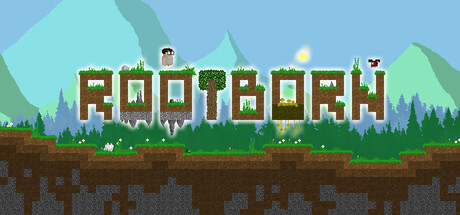
A cozy action-platformer with an open world that, of course, 99% of players will pirate. And in the end, all the nonlinear story, filled with battles, building, entertainment, and much more... the developer did it all for free.
Modeled estimate, not a reported figure. How we estimate →
Media

About
Rootborn is a quirky action-platformer—basically, a sandbox adventure.
It’s like the lovechild of Terraria and schizophrenia. Brother to Starbound and the dirt on your sneakers, inspired by squares.
Imagine mixing weird art style, a random story, four cans of booze, and a unhealthy obsession with stacking game blocks. That’s what you get.
Game that scares clowns, spiders, and heights (probably).
(Okay, maybe not completely, but you get the idea.)
Game that took 17,000 years and 96 trillions of neurons to make this game.
Game that cost about the same as 3 slices of pizzas and a free water cup.
Game that is the reason its developer is now unemployed and lonely.
Meet Rootborn.
Genres
Stats
All-time low is the lowest price we've recorded for this game since we started tracking it.
Languages: English*, Russian*, Spanish - Spain**languages with full audio support
Reviews
купил чтоб разработчик не помер от депрессии и голода
Rootborn by Goloblia Konstantin is an experimental sandbox action-platformer that leans heavily into freedom, unpredictability, and player-driven exploration. Rather than guiding players through a clearly structured progression, it drops them into a 2D world filled with resources, enemies, and environmental systems, leaving much of the direction up to personal curiosity. This design gives the game a distinct identity, one that prioritizes discovery and experimentation over traditional pacing or tightly controlled objectives. The core gameplay revolves around movement and interaction with the environment. Players traverse a variety of landscapes using jumping and platforming mechanics, gradually learning how to navigate the terrain while avoiding hazards and encountering enemies. Movement feels functional, though not always precise, which can lead to moments of unpredictability. This unpredictability extends into combat as well, where encounters can feel chaotic rather than methodical. Fighting enemies is less about refined mechanics and more about reacting quickly and adapting to situations as they unfold. Exploration is where the game finds much of its appeal. The open-ended structure encourages players to wander freely, uncovering new areas, gathering materials, and experimenting with different interactions. There is no strict path to follow, which creates a sense of independence that can be rewarding for players who enjoy figuring things out on their own. However, this lack of direction can also make the experience feel aimless at times, especially for those who prefer clearer goals or a stronger sense of progression. Crafting and resource collection are integrated into this exploration loop, giving players tools to shape their experience. Materials found in the environment can be used to create items or build simple structures, adding a layer of customization to how the game is approached. These systems are relatively basic but provide enough functionality to support the sandbox design. They encourage experimentation, even if they do not offer the depth seen in more polished crafting-focused games. The narrative is loosely woven into the experience, appearing more as a background element than a driving force. Instead of a clear storyline, the game presents fragments of ideas and themes that players can interpret as they explore. The tone is unusual, mixing abstract concepts with moments of humor and unpredictability. This approach gives the game a unique personality, though it may feel disjointed or difficult to follow for players expecting a more cohesive narrative. Visually, Rootborn adopts a pixel-based style that reflects its indie origins. The environments vary in design, with some areas showing more detail than others, resulting in a somewhat uneven presentation. While the art style has a certain charm, it lacks consistency and polish, which can affect immersion. Animations and visual feedback are serviceable but not refined, reinforcing the sense that the game is more focused on ideas than execution. Sound design follows a similar pattern, providing basic feedback without significantly enhancing the atmosphere. Audio elements are present and functional, but they do not play a major role in shaping the overall experience. The game relies more on its systems and exploration to engage the player than on audiovisual presentation. One of the most noticeable aspects of Rootborn is its roughness. Controls can feel inconsistent, and some mechanics lack clarity, which can lead to confusion or frustration. Progression is not always intuitive, and the absence of guidance means that players must rely on trial and error to understand how systems work. While this can be appealing for those who enjoy experimentation, it may be discouraging for players who prefer a more structured and polished experience. The pacing is entirely dependent on how the player engages with the game. Without a defined progression path, the experience can feel slow or uneven, with moments of discovery followed by periods where it is unclear what to do next. This open-ended nature is both a strength and a weakness, offering freedom while also risking a lack of momentum. Despite its limitations, Rootborn stands out as a creative and personal project. It does not attempt to compete with larger, more refined titles, but instead offers a unique space for players to explore and experiment. Its unconventional design and willingness to embrace imperfection give it a character that is distinct, even if not always cohesive. In the end, Rootborn is best suited for players who enjoy sandbox experiences and are willing to work through rough edges in exchange for freedom and creativity. It provides moments of genuine discovery and experimentation, but it requires patience and an open mindset to fully appreciate. While it may not deliver a polished or deeply structured experience, it offers something different for those willing to engage with its design. Rating: 6/10
купил чтоб разработчик не помер от депрессии и голода
После боссов - смотритель болот, ошметок, первый абориген - непонятно как добраться до следующих. Мастер БО с необходимыми предметами не спаунится в мирах с пройденными тремя перечисленными боссами. Если долго играть в rootborn, то rootborn начинает играть в тебя)) 100 часов прошло, нужно ещё) Глубина в 140 часов пройдена, ещё мало)
Related
Related
Trends
Concurrent players on Steam, sampled daily since tracking started.
Related
| Grass Toucher | $1K | 65 | 91% | $0.49 |
| The Dark Pursuer | $1K | 59 | 75% | $0.99 |
| Rustled Pete | $1K | 74 | 97% | $2.99 |
| Ashes of Immortality II | $1K | 57 | 47% | $0.79 |
| Futanari of the Amazon | $1K | 55 | 73% | $0.99 |
| Jade's Journey 2 | $1K | 55 | 62% | $0.79 |