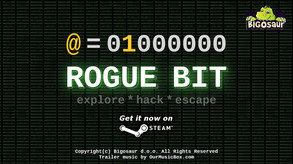
A single bit of computer memory became sentient and decided to escape from digital into the real world. Explore RAM, modify bytes and hack machine code and CPU registers to set it free.
Modeled estimate, not a reported figure. How we estimate →
Media

About


Genres
Stats
All-time low is the lowest price we've recorded for this game since we started tracking it.
Engagement
Reviews
Themes across 40 recent reviews and how positive each mention is. A keyword signal, not full sentiment analysis.
Reviews
Gift it to someone you don't like to make them feel stupid.
<SYSTEM> 경고 메시지가 출력되었습니다. 프로그래밍 덕후, 그 중에서도 어셈블리어 덕후가 아닌 이상 쳐다보지도 말것. 호기심에 시작했다가는 30분 안에 흥미를 잃게 될 것이다.
[h1][b] Reseña de Rogue Bit[/b][/h1] [h2]Resumen del Juego[/h2] Rogue Bit es ese híbrido indie de simulación donde “programar” y “hackear” no es una skin estética para sentirse Mr. Robot, sino el centro del rompecabezas: lógica, pasos calculados y esa satisfacción rara de que algo funcione… después de fallar 17 veces por tu culpa (y un poquito por la del juego). La primera impresión es clara: esto no viene a contarte una epopeya, viene a ponerte a pensar. Es corto, difícil y con vibra educativa, como si alguien hubiera dicho: “¿Y si hacemos un simulador de romperte el ego con puzzles de programación?” Y luego le metieron una banda sonora tan buena que casi te perdona el sufrimiento. [h2]Lo Compila y lo Crashea[/h2] Lo Bueno: Puzzles de lógica/programación que sí exigen cerebro (no solo “mueve cajas y finge que hackeas”). Compatibilidad total con mando y opción solo teclado: cómodo para jugar como te dé la gana. Guardar en cualquier momento: ideal para cuando tu dignidad necesita un descanso inmediato. Incluye editor de niveles: contenido potencialmente infinito si la comunidad se pone las pilas. Gran banda sonora: te acompaña mientras dudas de tus decisiones de vida. Lo No Tan Bueno: Un jugador y ya: si querías presumir tus hacks con amigos, toca hacerlo por fuera. Jugadores actuales: 0. Sí, estás solo. Es una experiencia inmersiva en “simulador de desierto social”. Difícil + corto: combinación peligrosa; si no conectas rápido, se acaba antes de que le agarres cariño. Solo 9 logros: los cazadores de dopamina van a sentir que les dieron una galleta… sin chispas. [h2]Tabla de Evaluación[/h2] [table] [tr][th]Aspecto[/th][th]Puntuación (0-10)[/th][th]Comentario[/th][/tr] [tr][td]Jugabilidad[/td][td]7[/td][td]Puzzles bien planteados, te obliga a pensar de verdad.[/td][/tr] [tr][td]Dificultad / IA[/td][td]7[/td][td]Difícil por diseño; no te lleva de la manita.[/td][/tr] [tr][td]Contenido[/td][td]6[/td][td]Es corto, pero el editor de niveles puede salvarlo.[/td][/tr] [tr][td]Gráficos / Video[/td][td]6[/td][td]Funcional en clave indie/simulador, sin fuegos artificiales.[/td][/tr] [tr][td]Historia[/td][td]5[/td][td]No es el enfoque; cumple como excusa para los retos.[/td][/tr] [tr][td]Ambientación[/td][td]6[/td][td]Vibra de hackeo/logic-puzzle coherente y agradable.[/td][/tr] [tr][td]Efectos (VFX)[/td][td]5[/td][td]Correctos, sin destacar demasiado.[/td][/tr] [tr][td]Música[/td][td]8[/td][td]Sorprendentemente fuerte; eleva la experiencia.[/td][/tr] [tr][td]Voces[/td][td]4[/td][td]No se perciben como un componente relevante aquí.[/td][/tr] [tr][td]Diversidad[/td][td]5[/td][td]Opciones de accesibilidad útiles, pero el contenido es muy específico.[/td][/tr] [tr][td]Rendimiento[/td][td]7[/td][td]Al ser un indie de rompecabezas, debería ir estable en general.[/td][/tr] [tr][td]Rejugabilidad[/td][td]6[/td][td]Depende de si el editor y la comunidad te enganchan.[/td][/tr] [tr][td][b]Total Puntuaciones (Bueno)[/b][/td][td][b]6.0[/b][/td][td]Sólido, inteligente y exigente, pero con nicho y poca vida alrededor.[/td][/tr] [/table] [h2]Conclusión (Bueno)[/h2] Rogue Bit es un buen indie de simulación con rompecabezas de lógica/programación que no te trata como si te distrajeras con una luz LED. Si te gustan los juegos que te hacen sentir brillante cuando lo logras y un fraude cuando no, aquí hay material. Y el guardado en cualquier momento es básicamente un “botón de seguridad emocional”. Ahora, lo controversial: con 0 jugadores activos, esto se siente como entrar a una fiesta donde solo está el DJ (y el DJ sí es buenísimo, porque la música está genial), pero nadie baila. Aun así, 118 recomendaciones totales sugieren que, cuando alguien lo juega, normalmente sale satisfecho… o al menos derrotado con dignidad. [h3]Recomendación de Compra (Recomendado con reservas)[/h3] Puntuación Total: 6.0/10 Número de jugadores activos al momento de hacer esta review: 0 Descuento máximo registrado: N/A Veredicto: [i]Un rompecabezas exigente y bien hecho, pero de nicho y con comunidad fantasma.[/i] Si buscas un juego corto, difícil y cerebral con vibra de hackeo/programación y buena música, vale la pena. Si necesitas una comunidad activa, conversación constante o una experiencia larga que te acompañe semanas, mejor mira alrededor… porque aquí, por ahora, estás jugando en modo “solo en el servidor”.
Related
Related
Trends
Concurrent players on Steam, sampled daily since tracking started.
Languages: English**languages with full audio support
Hours played at review time, across 40 reviews with recorded playtime.
positive critical· bar length = how often the theme comes up
ニーモニックくらい知ってますよ(本当に知っていると言えるだろうか?(とりあえず書いてある番地のところに行ってみましょ(´ー`)))
Impressive game. Fun to play and learn. If you're learning any assembly language, that't the game for you.
年轻人的第一款逆向入门游戏。 游戏较短,感觉渐入佳境的时候忽然就结束了,感觉挺意犹未尽的,最后的机制可以出很难很有趣的题目,但是感觉利用不足,还没发挥就结束了。也因此游戏确实价格偏高,打折也难以下决心入手。 你是一个比特,在一个字节中位于第二位,你只能进入相邻第二位为0的字节。你需要通过层层考验,[spoiler] 比如通过修改运行中的程序 [/spoiler],来想办法逃出内存。 legacy那关的程序挺惊艳(唬人)的(对于没有相关知识的人来说),跑到某个位置下然后整个程序直接完全大变,不知道为什么程序变着变着就过了……
Fun game with brilliant way of how implement the computer science(register, memories, ..) in a game
I like concept
Awesome game! I consider making a player level for it, but I am not quite sure what I want to make... But I am certain this baby can run Doom at about 1 fph (frame per hour)
I picked this game up on sale for $2, and for that price I did enjoy my first playthrough a fair bit and really love the idea. But on the whole I think the game falls quite short of what it could be and ends up just feeling unfinished. I think the "maze" aspect at the core of this game can overshadow the programming logic side of things. Especially in the first half of the game, the puzzles are just "be in the right spot at the right time to be teleported." You're intended to find those solutions by reading the assembly code, but it's very possible to "brute force" a lot of the game without any real understanding. Even if you aren't deliberately cheesing the game, I solved a number of the puzzles completely on accident. The sections where you "hack" the assembly are quite narrow due to the XOR movement mechanic. You can only "fit" into certain lines of code, making it fairly obvious where the solution is. It's a great mechanic, I just wish it were more open ended. At the end of the game, memory pages are introduced which have a lot of exciting potential! Weaving two assembly programs together increases the complexity a good bit, as does unlocking the ability to move between CPU registers. Unfortunately after only one puzzle with this mechanic, the game comes to an abrupt end. It really feels like the dev gave up halfway through and published what was done. Thank goodness for custom levels, I foolishly thought. As far as I can tell, nobody has ever created any. Furthermore, the memory page mechanic is NOT available in the custom level creator!! The entire game feels like a tutorial leading up to this mechanic, it's unbelievable that there's nothing further. I finished the game in just 100 minutes. My current playtime includes a second playthrough to replay the puzzles I solved by accident in my first, as well as to earn all achievements. [hr][/hr] My final two criticisms are pretty minor nitpicks stemming from my prior experience in memory hacking: 1. Memory addresses are basically written backwards, being labeled as XXYY. This makes a certain amount of sense in translating the idea of memory addresses to an (X,Y) coordinate grid for a layperson. But it is reverse of what an actual 256x256 memory dump would look like, which would start at 0000 and end the first "line" at 00FF, starting the "next line" at 0100. The game instead goes from 0000 to FF00 to 0001. That's just not how hexadecimal works, nor numbers in general. This made it difficult for me to make intuitive sense of where key addresses were in the maze. The B hotkey to highlight addresses referenced in the assembly would be more helpful if the blue boxes were labeled with their addresses. 2. Five bytes wide is such a strange number for the binary display. A power of 2 would have been more "traditional." I found it to be frustratingly narrow when using it to navigate, especially when page flipping to find hidden paths at the end of the game. I would have preferred hexadecimal instead for its 4x information density. I do understand that a layperson would probably have more trouble interpreting whether The Bit is on or off for a given byte when represented in hexadecimal. However, I think the "blue = wall" color coding already communicates the idea sufficiently.
Audience
Estimated from the language of this game's reviews — a proxy for where players are, not official Steam demographics.
Related
| Auralux: Constellations | $49.3K | 178 | 81% | $9.99 |
| Classic Sudoku | $49.3K | 490 | 93% | $4.99 |
| Dark Hero Party | $49.3K | 374 | 64% | $7.49 |
| Knock'Em Out | $49.3K | 259 | 88% | $7.99 |
| Chess of Blades | $49.3K | 117 | 91% | $24.99 |
| Surviving Ceres | $49.3K | 138 | 87% | $9.99 |
Related
| 7 Days to Die | $425.3M | 403.5K | 87% | $44.99 |
| Euro Truck Simulator 2 | $421.6M | 932.1K | 97% | $19.99 |
| Mount & Blade II: Bannerlord | $309.8M | 293.9K | 88% | $49.99 |
| The Forest | $254.8M | 678.5K | 96% | $19.99 |
| Stardew Valley | $243.2M | 1M | 98% | $14.99 |
| Project Zomboid | $239.1M | 460.8K | 94% | $19.99 |