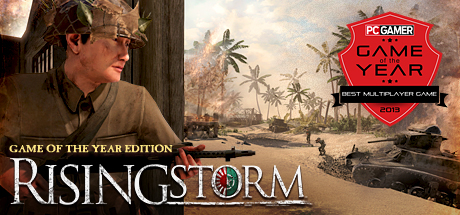
Rising Storm is a remarkable entry in the realm of tactical World War II shooters, standing apart from mainstream titles through its commitment to authenticity, teamwork, and asymmetrical warfare. Developed by Tripwire Interactive and Anti Matter Games, and published by Tripwire itself, it serves as both an expansion and evolution of Red Orchestra 2: Heroes of Stalingrad, shifting the focus from the frozen battlefields of Europe to the brutal, sun-scorched islands of the Pacific. What emerges is an experience that is less about individual heroism and more about survival, communication, and the chaos of warfare in one of history’s most unforgiving theaters. The Pacific setting breathes new life into the Red Orchestra formula, introducing new factions, weapons, and tactical philosophies that clash in some of the most tense and grueling multiplayer battles ever realized in a first-person shooter.
At its core, Rising Storm’s brilliance lies in its asymmetrical design. The American and Japanese forces could not be more different in both equipment and doctrine, and the game embraces those differences fully. The U.S. military brings superior firepower to the field—semi-automatic Garands, flamethrowers, machine guns, and plentiful artillery support—while the Japanese rely on cunning, patience, and ferocity. Their arsenal includes bolt-action rifles, knee mortars, and improvised traps, but what truly defines them is the infamous Banzai charge. This feature transforms what would otherwise be a desperate melee rush into a chillingly effective psychological weapon, capable of disrupting American coordination and morale. The dynamic between the two factions feels authentic, with each side embodying its historical strengths and limitations. It’s a delicate balancing act that demands adaptability: Americans must leverage range and firepower, while the Japanese excel through stealth, ambush, and timing. Few multiplayer games capture the strategic nuances of asymmetry as convincingly as Rising Storm does.
Combat in Rising Storm is deliberately harsh and grounded, stripping away the conveniences that define most modern shooters. There are no crosshairs, no regenerating health, and no instant gratification. A single bullet can end a life, and suppressive fire is a genuine tool of dominance rather than a background effect. Movement feels heavy, reloads are slow, and visibility is limited by realistic smoke and foliage. Every firefight is a contest of nerves and awareness rather than reflexes. The result is an experience that feels visceral and unpredictable; victory is rarely achieved through lone-wolf heroics, but through coordination, cover, and communication. Squad leaders call in airstrikes or smoke screens, riflemen hold angles, and machine gunners provide overwatch in positions that feel painstakingly earned. The game’s slower pacing forces players to value every step forward, every well-timed grenade, and every precious second of cover. When an objective is captured or a line held, it carries genuine emotional weight because it feels like it cost something to achieve.
The maps in Rising Storm are among the most evocative and well-designed of any multiplayer war game. Each battlefield—from the jungles of Guadalcanal to the beaches of Iwo Jima—tells its own story through topography and tension. Terrain plays an enormous role in determining the rhythm of each encounter. Dense vegetation provides cover for ambushes but restricts visibility, while open beach assaults evoke a terrifying sense of exposure reminiscent of historical landings. The map design promotes constant adaptation, with teams pushing and pulling over contested ground in drawn-out struggles that can last nearly an hour. Every meter gained feels hard-fought, and the flow of battle often shifts on the coordination of a single squad or the timely use of artillery. The visual presentation, though modest by modern standards, captures the grit and atmosphere of war with remarkable authenticity. Lighting, smoke, and environmental details immerse the player not through spectacle but through plausibility. Rising Storm’s maps feel lived-in, and they enhance the game’s tension far more than graphical polish ever could.
Rising Storm’s realism extends beyond its mechanics into its philosophy. It is not designed for casual pick-up-and-play enjoyment; it demands patience, discipline, and teamwork. New players often struggle at first, as deaths come swiftly and seemingly without warning, but those who persevere find a deeply rewarding experience. Learning to read the battlefield, to distinguish between friendly and enemy silhouettes, and to anticipate enemy maneuvers becomes second nature over time. The game’s steep learning curve acts as a filter, ensuring that those who remain develop a sense of respect for its systems and for their teammates. Few shooters inspire the same level of camaraderie among players—communication and coordination aren’t just helpful, they are essential for survival. When a squad of coordinated players executes a flawless defense or overwhelms a fortified objective, it feels like a triumph of shared skill and trust rather than personal glory.
The audio design amplifies the immersion to an extraordinary degree. The whine of incoming artillery, the crack of a sniper rifle, or the blood-curdling roar of a Banzai charge all serve to unsettle and immerse. Every sound is purposeful, every echo a clue. Combined with the limited HUD and lack of superfluous indicators, the soundscape becomes a navigational tool as much as an atmospheric one. The same attention to authenticity carries through to the weapons themselves, each rendered with distinct handling characteristics and weight. Firing a Garand or Arisaka rifle feels meaningful because of the time and precision required to use them effectively. There’s no power fantasy here—just the grim satisfaction of surviving and contributing to a larger cause.
Yet Rising Storm is not without its challenges. Its realism can alienate players accustomed to faster-paced shooters, and the unpolished interface, clunky animations, and sometimes dated visuals betray its age. Matches can be long and unforgiving, with new players feeling overwhelmed by both mechanics and community expectations. However, these same traits are also what give Rising Storm its unique identity. It is a game unafraid to demand patience, where tension and realism are the reward rather than high scores or flashy unlocks. For those who embrace its deliberate pacing and brutal authenticity, it offers some of the most memorable and nerve-wracking moments in multiplayer gaming.
Ultimately, Rising Storm remains one of the finest examples of tactical multiplayer design. It captures not only the physical but also the psychological dimensions of warfare, emphasizing communication, caution, and courage in the face of overwhelming odds. Its asymmetrical gameplay, grounded combat mechanics, and masterful map design create a battlefield experience that feels raw and unfiltered. It is not an easy game to love at first, but for those who stay, it becomes an experience that few others can match. In an industry dominated by arcade-like shooters and power fantasies, Rising Storm stands as a rare achievement—an honest, unflinching portrayal of the chaos and intensity of war, where victory is earned inch by inch and survival itself feels like a triumph.
Rating: 8/10