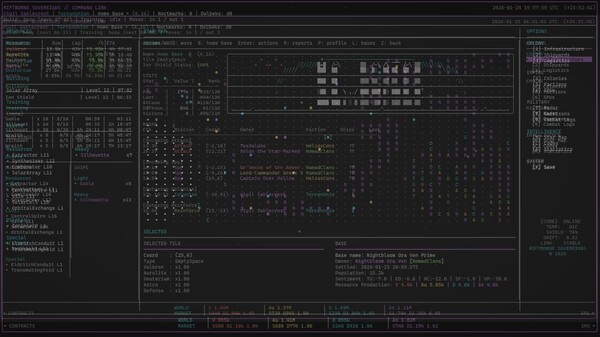
Riftborne is a classic terminal based, real time, grand strategy game. Construct space ships. Take part in factional warfare. Hire galactic hit-men on your rivals. Raid neighbors for rare resources. Train spies to infiltrate enemy bases for key intel. Grow your empire to dominate the galaxy.
Modeled estimate, not a reported figure. How we estimate →
Discounts
Every price cut of more than 20% we have observed, in each market that quoted one, with this game's chart position on either side of it. These are episodes, not a model: a sale is one event, and one event cannot tell you what the next one will do.
Reviews, worldwide (the counter carries no country): 0.14/day in the week to Sep 7 → 1.14/day in the week after.
Reviews, worldwide (the counter carries no country): 0.57/day in the week to Jul 30 → 2.14/day in the week after.
For scale, across Steam · Top Sellers · Brazil over the last 30 days: the 26 chart moves that followed a price cut of more than 20% went a median of 7 places towards #1, and the 2,400 moves with no price cut behind them went 2 away. One store, one chart, one country — it is the only place we have enough observations to say even that.
Prices outside the United States have been collected since 6 August 2026 and chart positions since 19 July 2026, so a cut older than that has no market to compare and a market that joined later has no history yet. Nothing here is converted between currencies.
About
Begin with a single base and gradually transform it into an interstellar power.
Colonize new worlds, construct fleets, organize supply lines, manipulate markets, train spies, raid rivals and build influence across a galaxy that continues developing in real time.
Riftborne is a slow-burn sci-fi grand strategy game built around long term planning. Campaigns can unfold over days, weeks or even months. Small decisions compound over time, supply problems become military crises, minor rivals become major powers, and carefully prepared plans can reshape the galaxy.
A successful empire depends on more than military strength.
Manage production, storage and logistics across multiple colonies. Establish trade routes and resource shipments. Develop specialized worlds, maintain defensive networks and prepare your economy to survive prolonged wars.
Send spies to gather intelligence, sabotage rivals and expose enemy weaknesses. Hire galactic operatives, negotiate with other powers and use economic pressure when direct conflict would be too costly.
The galaxy remembers what happens within it through campaign histories, rankings, medals and long term progression.
Enemy powers adapt to your behavior, including patterns established across previous saves.
Procedural galaxies create different strategic geography each campaign, while long running systems allow alliances, rivalries and economic dependencies to develop naturally over time.
Play a solo campaign at your own pace.
Host a private server locally, online or through SSH.
Join regularly scheduled official multiplayer galaxies with factions and up to 120 commanders competing inside the same persistent universe.
Riftborne is deliberately dense, patient and information driven.
It is made for players who enjoy learning interconnected systems, gradually building momentum and watching early decisions produce consequences much later.
• Persistent real time campaigns lasting days, weeks or months
• A distinctive terminal interface built for dense strategic information
• Solo play, private servers and official multiplayer galaxies
• Official multiplayer supporting up to 120 commanders
• Colonies, fleets, logistics, production and storage management
• Espionage, sabotage, raids and political influence
• Markets, contracts and multiple economic playstyles
• Procedural galaxies with strategically meaningful geography
• Adaptive enemies that respond to your behavior
• Campaign histories, rankings, medals and progression

Engagement
Reviews
Themes across 78 recent reviews and how positive each mention is. A keyword signal, not full sentiment analysis.
Reviews
I'm really enjoying it, the Discord is super active, devs are clearly passionate, and it's got a lot of complexity and depth. Only thing holding me back from playing it all the time is that the advance time feature feels a bit slow, feels like I'm spending most of my time playing just waiting for the simulation to advance, but the devs have already talked about optimising that in the future, and I've got faith in them.
It's a bit challenging to approach because of the unspectacular appearance, the retro control scheme and the many different tables and values. But behind that, there is a really straight forward game concept which greatly stimulates one's own imagination. And it really shines in the real-time multiplayer matches.
Media

Related
Related
Price dynamics, follower growth, revenue and sales trajectories with interactive tooltips
This and every other Pro feature is free until October 20, 2026. A free account is all it takes.
Genres
Stats
All-time low is the lowest price we've recorded for this game since we started tracking it.
Languages: English
Hours played at review time, across 78 reviews with recorded playtime.
positive critical· bar length = how often the theme comes up
..... . ........ .... ..... ..... ... .. ... .. . ...... .... . .. .... ..... ........ ... ....... ..... .... .. ..... ... ... .... ... ...... ... . .... ... .... ... .... .. ....... ... .. ...... ...... ...... .. ... ...... .... ...
Great game
Is a cheap little cookie clicker/stellaris/arena game. No weird stuff that detracts from gameplay.
Pretty fun strategic game, very early but I really enjoy the direction it is heading. The Dev is very responsive on discord and willing to take any ideas into account.
Good game with an active and responsive dev. Hopefully will continue to be improved and refined.
Probably great, but not for me. As previously discussed with the dev on reddit, you can't feel attached to it. UI feels sterile, No soul behind the numbers. Naming of things is awkward. Ships are weird. You can't visualize ship movement on the map. UX: I just realised that I did not want to log back in. Refunded.
Excellent game. Well done.
Riftborne approaches galactic strategy from a direction that immediately separates it from more visually elaborate space games. Instead of surrounding empire management with cinematic battles and detailed planetary scenes, it presents much of its universe through a terminal-inspired interface where information, commands, statistics, and long-term planning take priority. Developed and published by Pitio Productions, it begins with the player controlling a relatively small foothold in space and gradually expands the scope toward colonies, fleets, economic networks, diplomacy, intelligence operations, and conflicts between increasingly powerful factions. The interface is more than a stylistic gimmick because it directly shapes how the game is played. Success depends heavily on reading information, understanding interconnected systems, and issuing sensible orders rather than reacting to constant visual activity. There is an intentionally old-fashioned computer simulation quality to the presentation that suits the subject remarkably well. It can initially feel intimidating because a considerable amount of information must be absorbed, but players who enjoy statistics-heavy management games may find that the stripped-down presentation allows them to concentrate on strategy without unnecessary distractions. Building an interstellar economy forms a major part of the experience. Colonies are not isolated sources of income that can simply be forgotten after construction. Resources need to be produced, stored, transported, and directed toward whatever part of the empire requires them. Trade and logistics consequently become meaningful strategic concerns. A specialized colony might be extremely productive while simultaneously depending on other territories for supplies or protection. Expansion therefore creates both opportunities and vulnerabilities, forcing players to consider whether their infrastructure can support their ambitions. Military development provides another layer of depth, with a large selection of ships available as an empire becomes more capable. Fleets can defend important territory, attack rival installations, contest valuable locations, and participate in wider factional wars. Raw military strength is not the only path to success, however. Espionage introduces agents capable of gathering intelligence and interfering with opponents, allowing a careful commander to undermine rivals before committing expensive military assets. Diplomacy and economic influence further broaden the available strategies, making it possible to pursue objectives through negotiation, trade, contracts, or indirect pressure. One of Riftborne's most interesting qualities is its emphasis on persistence. The galaxy is designed to continue developing over extended periods, giving decisions a different weight from those made in short strategy matches. Establishing an efficient economy early can provide substantial advantages later, while ignoring a seemingly minor rival may allow that faction to grow into a serious problem. Procedurally generated galaxies also help prevent campaigns from following exactly the same pattern, since valuable regions, strategic positions, and opportunities can shift between playthroughs. Multiplayer expands this concept considerably. Persistent galaxies can accommodate numerous commanders divided among competing factions, creating an environment where diplomacy and economic relationships can become as important as fleet strength. Players can cooperate, trade resources, accept contracts, compete over valuable systems, or participate in broader struggles between factions. Smaller powers are not necessarily forced into immediate direct competition with stronger ones because contracts and cooperation can provide alternative ways to establish themselves. This social dimension has the potential to create memorable situations that would be difficult for a completely scripted campaign to reproduce. The economic and political systems work particularly well with the procedural nature of the galaxy. Mining regions and other strategically valuable areas can naturally become centers of competition. A territory that initially appears unimportant may become crucial once transportation routes and resource demands develop around it. Likewise, two factions that would normally be competitors might temporarily cooperate because their economies benefit from one another. These emergent situations give the game much of its personality and make successful empire building feel like the result of accumulated decisions rather than following a predetermined path. The main obstacle is accessibility. The terminal-focused presentation demands patience, and players expecting conventional menus, elaborate animations, or instantly readable visual feedback may need time to become comfortable with it. Riftborne is also an Early Access title, so balancing, onboarding, interface refinement, solo progression, multiplayer systems, and general polish remain areas where further development can make a noticeable difference. Its minimalist graphics should therefore be understood as an intentional design choice rather than an indication that the underlying simulation is equally simple. Steam Deck compatibility is officially listed as Unsupported. Players primarily interested in experiencing it on Valve's handheld should keep this limitation in mind rather than assuming that the simple controls automatically guarantee full compatibility. Its design may appear ideal for portable play, but the official Deck classification does not currently provide that assurance. Riftborne ultimately offers an unusual mixture of 4X strategy, economic simulation, logistics, warfare, espionage, diplomacy, and persistent multiplayer within an intentionally minimalist shell. Its greatest appeal comes from the feeling that every colony, shipment, intelligence operation, contract, and fleet deployment contributes to a much larger strategic machine. It will be a niche experience because its interface and slow-burning structure demand commitment, but that same uncompromising approach gives it a personality that many space strategy games lack. For players who value systems, planning, persistence, and emergent galactic politics more than graphical spectacle, it has a strong foundation with considerable room to grow. Rating: 7/10
Selling now
See how fast this game is selling right now — estimated copies and revenue per day from recent review growth.
Players by region
Where this game's players are, estimated from review languages.
Players also reviewed
The games this title's players most often review too — audience affinity.
Related
| Game | Estimated lifetime revenue | Reviews | Review score | Price |
|---|---|---|---|---|
| $0 | 353 | 67% | Free | |
| — | 0 | — | — | |
| $12.1M | 16.3K | 93% | $19.99 | |
| $780.7K | 688 | 58% | $29.99 | |
| $108.3K | 241 | 66% | $14.99 | |
| $66.1K | 88 | 76% | $19.99 |
Related
| Game | Estimated lifetime revenue | Reviews | Review score | Price |
|---|---|---|---|---|
| $37.9K | 582 | 96% | $4.99 | |
| $37.9K | 376 | 76% | $4.99 | |
| $37.9K | 137 | 69% | $9.99 | |
| $38K | 216 | 26% | $6.29 | |
| $37.9K | 161 | 80% | $6.29 | |
| $38K | 160 | 70% | $9.99 |