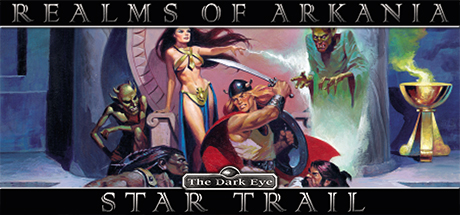
Realms of Arkania 2: Star Trail Classic, developed by Attic Entertainment Software and published by United Independent Entertainment, is a shining relic from an era when computer role-playing games valued depth and realism above accessibility. Originally released in 1994 and based on the German tabletop system “The Dark Eye,” Star Trail was designed to immerse players in a richly detailed world governed by rules, probabilities, and careful decision-making. The modern Steam release, subtitled “Classic,” preserves this experience in its raw, unfiltered form, offering a demanding but rewarding journey for anyone who longs for the intricate, unforgiving style of early ’90s CRPGs.
The game begins by dropping players into Aventuria, a sprawling fantasy land where tensions between elves and dwarves are rising amidst the threat of an impending orc invasion. Your mission—to recover the legendary Salamander Stone and help unite these ancient races—sounds straightforward, but Star Trail turns this premise into an expansive, systems-driven campaign. Rather than guiding a single hero, you manage a full party of adventurers, each with their own race, class, abilities, and backstory. Character creation is exhaustive, offering nearly endless combinations of stats and skills. Everything from strength and dexterity to culinary talent and herb lore is accounted for, and every choice has a tangible impact on how your party survives in the world. This level of granularity makes even the setup phase feel like a game in itself, setting the tone for what follows: a deep, methodical experience where preparation and knowledge are as important as bravery.
Once the adventure begins, Star Trail unfolds across multiple layers of gameplay. The overworld map captures the scale of Aventuria, allowing your party to travel between cities, forests, and mountains, while managing hunger, fatigue, and environmental hazards. Weather affects your progress, supplies can run out, and resting is a constant necessity. These survival mechanics give the game a sense of realism that was uncommon for its time, transforming what would otherwise be routine travel into a test of resource management. When exploring cities or dungeons, the game switches to a first-person perspective, offering labyrinthine corridors, hidden treasures, and the occasional deadly trap. Combat, on the other hand, takes place on a tactical, turn-based grid that demands forethought and strategic positioning. The variety of systems—exploration, travel, battle, and camp management—makes the game feel vast and unpredictable, with each new journey presenting both opportunity and danger.
The story is not told through cinematic sequences or long dialogue trees but through text-based descriptions and event prompts that evoke the feel of a tabletop campaign. Quests often have multiple outcomes determined by skill checks and party stats, meaning your characters’ expertise in negotiation, stealth, or wilderness survival can dramatically alter how events unfold. One failed roll can lead to an ambush, illness, or even starvation, while success rewards you with rare items, lore, or vital alliances. The result is a constant tension between control and chance, echoing the unpredictability of pen-and-paper adventures. Despite its age, this design gives Star Trail an emergent quality rarely seen in more scripted RPGs—every playthrough can tell a slightly different story, shaped by luck, planning, and the personalities of your party members.
Visually, the game shows its age but retains a certain nostalgic charm. The pixel art, static town screens, and minimal animations evoke the look of a time when imagination filled in the gaps that technology couldn’t. The first-person dungeon exploration can feel stiff by modern standards, yet it captures the claustrophobic tension of delving into ancient ruins with limited supplies. The interface, though cluttered, reflects the complexity of its systems, and mastering it becomes part of the learning curve. What initially seems archaic gradually becomes second nature as you learn how to navigate menus, manage inventory, and interpret the game’s sometimes cryptic feedback. The soundtrack, composed in the classic MIDI style, complements the atmosphere with haunting melodies that alternate between adventurous and foreboding, further anchoring you in the game’s old-school fantasy world.
Star Trail’s biggest strength—and its greatest barrier to entry—is its uncompromising depth. Every mechanic ties into another: hunger affects stamina, stamina affects combat performance, and poor management of fatigue or equipment can spell disaster in prolonged expeditions. Unlike modern RPGs that prioritize convenience, this game expects you to plan for every eventuality. Healing injuries, treating diseases, or simply surviving a long journey requires foresight and a well-balanced team. This makes victory incredibly satisfying, as every success feels earned through diligence rather than luck or generous design. Yet for newcomers or those unfamiliar with pre-2000s RPG conventions, the difficulty curve can be daunting. The game provides little in the way of hand-holding, and trial and error are an inevitable part of the experience.
Despite its age, Realms of Arkania 2: Star Trail Classic holds up as a masterclass in complex role-playing design. It captures the essence of a bygone era when games were built to challenge the player’s intellect rather than to provide instant gratification. Its world feels alive not because of graphical realism but because every system, from weather to morale, interacts in believable ways. It rewards patience, strategic thinking, and a willingness to embrace imperfection and unpredictability. Those who persist through its archaic interface and steep learning curve will find one of the most detailed and immersive fantasy worlds ever committed to a computer screen.
Ultimately, Star Trail Classic is not just a game—it’s a time capsule from a period when RPGs were crafted as intricate simulations of adventure rather than cinematic experiences. It demands attention, respect, and commitment, but it rewards those qualities with depth and immersion that modern titles rarely match. For players seeking the purest form of computer role-playing, this classic remains a treasure—a challenging, methodical, and enduring journey into the heart of old-world fantasy gaming.
Rating: 7/10