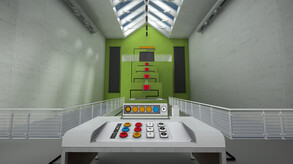
Re:Touring is a first-person puzzle game in which you'll explore the abandoned Luoni Energy Competence Center. Using a retro-style computer, you'll create color patterns to progress through the levels.
Modeled estimate, not a reported figure. How we estimate →
About
Stats
All-time low is the lowest price we've recorded for this game since we started tracking it.
Languages: English*, French*, German*, Spanish - Spain*, Italian*, Japanese*, Czech**languages with full audio support
Engagement
Hours played at review time, across 37 reviews with recorded playtime.
Reviews
Very nice little puzzle game. As the title suggests, you're essentially programming a small Turing machine. Well, to be exact it is more like a finite-state machine which you set up through Turing machine semantics. The programming itself is done with buttons on terminal, which in a neatly way remove the necessity of any type of editor or table based user interface. In some puzzles you have to create a specific pattern inside the "memory" to open doors or move things in the real world, while in other puzzles a single write operation itself produces a specific movement of an object depending on the written value. And when I speak of value, in this game that means color. The logic of each puzzle room was always easy to deduce, also thanks to clearly visible and easy to follow cables which connect individual parts and glow when they're active. The game never got too complicated. It started very easy and increased the difficulty with every level in moderate steps. New mechanics were always nicely introduced before they got actually used. And if you're looking for a small extra challenge: some achievements are forcing you to use less transition rules than the puzzle actually provides, which can get a little tricky sometimes. On the other hand, If you're looking for a smaller challenge: there is a hint system, but I didn't use that. So, I can't tell anything about it. It took me 2.5 hrs to complete the game and all its achievements in a single run. That seems a bit short, to be honest. But I had a pretty good time. The presentation is okay. Nothing special to expect here. The game should run fine on any even remotely modern hardware. Oh, and I praise the game for not using screenspace reflections :D The last thing, I'd like to mention is that the game is really well polished. I had no problems whatsoever and it was a smooth experience from the beginning to the end.
[quote]For more puzzle game reviews, news and everything puzzle-related, follow [url=https://store.steampowered.com/curator/25928931-Puzzle-Lovers/]Puzzle Lovers[/url] and check out our [url=http://steamcommunity.com/groups/puzzlelovers]Steam group[/url].[/quote] Re:Touring is a first person puzzler set in an abandoned testing facility. Complete with your usual array of cubes, buttons, and platforms. And yet, the developer still managed to put together a pleasing art style that doesn’t immediately draw comparisons to Portal. That alone is commendable these days. The game certainly wastes no time in getting started. 2-3 minutes of walking around in the intro area, with some very basic story, and you’re immediately onto the first puzzle. I particularly liked the tutorial: In that there effectively wasn’t one! [b]No dialogue, no irritating full-screen tip windows, just a few well crafted starting levels designed to explain the game’s mechanics as you solve them[/b]. Including a section with coloured buttons that don’t appear anywhere else in the game, so players can experiment and understand what they need to do to solve a puzzle, before the Console is added and increases complexity. From there, additional puzzle elements are added fairly quickly afterward. With only 4-5 levels being dedicated to each mechanic before introducing more. [b]It’s refreshing to play a puzzle game that doesn’t treat the player like an idiot, and gives them the freedom to figure things out by themselves from the very beginning.[/b] That said, these starting levels are also designed to be simple enough that they aren’t extremely challenging and slow the pace down either. It’s a good balance. The first puzzles you face revolve entirely around the Console mechanism, reading and writing colours to recreate patterns. The amount of rules you can set is always highly limiting, forcing you to think carefully about how you can utilize the colours already printed on the output as triggers. The Console does gain a few extra options over time, but these starting stages are still surprisingly challenging. Of all the puzzles in the game, one of the patterns in the 8th level actually had me stuck for the longest time! As said, further mechanics are added in the levels following, and the level design becomes more interesting to aid them. A fair few puzzles rely on timed elements, such as slowly discharging cubes or timed buttons. However, all of these puzzles are designed such that everything moves at a speed that makes it impossible to hurriedly sneak through with a close (but incorrect) solution, yet still provide plenty of leeway once you have the correct one. No puzzle requires quick reactions or a fast sprint between elements: If you’re barely unable to make it through a door or button in time, then your solution is just wrong. It’s really nice to have this level of certainty, [b]puzzles rely entirely on your cognitive ability, never mechanical skill[/b]. I’d imagine this makes the game quite accessible to physically impaired players, or those who don’t usually play first person games. In the topic of accessibility, there’s a multitude of Colour blind modes to pick from. Several colour-focused puzzle games have only added these long after release, it’s good to see them included here from the very beginning. Raised platforms often have guard rails, and there’s no way to fail a puzzle. Falling from a ledge would just put you back to the beginning of the room. There are water hazards in some levels, but these instantaneously respawn you back at their edge. [b]A feature I loved was the ability to click on colour panels on the walls, which would then add them directly to your UI, forgoing the need to constantly step away from the Console and check them in-world.[/b] It was extremely useful, after an update, this mechanic works on the Console itself too! Extremely useful. Almost all puzzle elements show a reminder of their function when you hover over them, and if you’re truly stuck: [b]Every individual puzzle (Even multiple within the same level) includes a Hint system that provides three increasingly explanatory hints[/b]. Some will even solve the puzzle for you entirely. It says on the store page that Accessibility is one of the main traits, and it absolutely shows. Yet there’s no compromise on difficulty or mechanics at all regardless. Admirable effort from the developer here. In terms of difficulty, things are a little varied. As said, I got stuck on one of the early Console-only puzzles for longer than any other in the game. Later puzzles mix these Consoles with physical mechanics, such as lasers and cubes to move around, but the Console is almost always the main focus. [b]In the mid-late levels, these elements can feel a little tacked on at times.[/b] In level 21 especially, the puzzle is effectively just one Console pattern to solve, everything else in the room just needs to be moved into specific places. I really enjoyed the final set of puzzles though, in which the colours you wrote would control machines in the room. No longer are you just trying to recreate the patterns shown to you, now you’d have to work out what patterns you’d need in the first place, and often transition between several! This felt like a proper evolution of the main mechanic, and I’d love to see a DLC or expansion in future with more of these! With Logic Gates and more machines to interact with, the possibilities would be endless. Options are passable, with full key rebinding and volume controls. Adjusting refresh rate didn’t seem to do anything, so VSync was a must for me. But input lag really doesn’t matter in a game like this. The deadzone for controllers seems extremely small, and I found that my DS4 was causing issues by constantly snatching input. [b]If movement feels buggy and your mouse keeps disappearing, I recommend unplugging your controller[/b]. There’s autosaving at the start of every level, but no mid-level saving, which was a disappointing surprise. None of the puzzles are extremely long though, so you don’t stand to lose a lot of progress at least. Achievements are available for beating the game without using any hints, and a few optional challenges in some levels. Some of these were surprisingly difficult! And a nice extra addition. In all, [b]it took me 3 hours to beat all 26 levels and reach 100% achievements[/b]. It’s short, but it doesn’t outstay its welcome either. It’s a very well crafted experience and I enjoyed my time with it. Highly recommended.

《Re:Touring》是一款思路还挺新鲜的小品解谜游戏。 本作是一个第一人称的解谜游戏,除了一些按钮、箱子、压力开关这种经典要素外,本作解谜的真正核心是,按照商店页原文所说,一些“可以生成颜色模式的复古计算机”。字面上看很难理解,起初并没有引起我的兴趣,还是看了其它评测才知道本作到底探索了什么样的核心机制。 简单来说,本作的核心机制受到了[b]图灵机[/b]概念的启发。没错,本作的标题就是一个相关的谐音梗(Touring和Turing)。 图灵机是一种抽象的假想机器,由一条无限长、被分成许多方格的纸条,一个读写头,一套控制规则,和一个状态寄存器组成。读写头在任意时刻都指向纸条上的一个方格,而图灵机可以通过读写头在纸条上读写各种各样的记号。图灵机在每个时间周期,都会在控制规则中通过“当前状态寄存器存储的内部状态”以及“当前读写头所指的方格上的记号”这两个元素组成的“键”进行查表,所查到的“值”将会指示图灵机在这个时间周期要进行什么操作,可以是以下几种操作的任意组合:1. 在纸条上写记号;2. 移动读写头; 3. 修改内部状态(状态跳转)。 虽然图灵机的运行逻辑很简单,但它和包括现代计算机在内的许多系统在可计算理论的意义下都是同构的(也就是说,理论上可以用图灵机模拟这些系统,也可以用这些系统模拟图灵机,两者“可计算”的场景没有区别),我们把这种同构性称为“图灵完备”。 咳咳,有点跑题到科普上了,回到本作。上面把图灵机的概念解释得比较“学术”,本作当然不是用我这样的文字方法来解释图灵机的概念,而是用谜题的方式让玩家直接上手。在本作中,机器的“纸条”只有5格长,可以使用的“记号”是红、黄、蓝三种颜色,读写头一次只能左右移动一格或不动,而“内部状态”则不超过3个,是一个超级简化版的图灵机。 但在我看来,如果只是直接借用图灵机的概念让玩家编程,并不能说是有创意,即使这个概念本身可能确实有意思,尤其是对于完全没见过的玩家而言,但毕竟这是一个相对出名的概念,将这种概念直接全盘搬进一个“游戏”当中,不得不说是一种很讨巧的行为,体现不出设计师本身的价值,充其量也就是技术上开发了一个可视化软件而已。 而本作的新意主要在于[b]将编程问题包装成了第一人称解谜的形式[/b]。玩家首先面对的是一个有具体场景的谜题,而玩家需要通过图灵机来控制谜题中的一些物体,从而完成解谜。图灵机会以多种形式产生激活信号,以影响其它物体的状态(比如开门或移动平台),其中最简单的一种形式是“当纸条上的颜色排列与指示的排列一致时,就能产生激活信号”,后续也会有别的激活方式。 这些激活方式虽然简单,但设计师可以通过构造谜题来构造出更复杂的需求,具体地,可以不只是要求一次性的激活,而是要求做到各种各样的“时序”操作,比如要先激活这个,过一段时间后再激活那个,或者干脆需要循环往复地产生特定的激活信号。反映到作为控制逻辑的图灵机中,玩家就需要思考,如何编写图灵机的规则,以让它按照特定的顺序和方式来修改纸条上的颜色排列,不管是循环还是停机,都有自己的作用。虽然核心还是给图灵机“编程”,但不得不说,用这种方式表现出来确实比较新颖。 总的来说,我认为本作虽然体量不大,谜题也比较简单,但设计上确实有一些新意,即使这个新意体现在表现形式上,而不是机制本身有创意。还是值得一玩的。 结论:[b]推荐[/b],不建议全价购买。 [quote]普通玩家一枚,不玩主流网游,少玩3A大作,关注独立精品。不是为了特立独行,只是为了追求自我。 喜欢我的评测?可以关注我的鉴赏家:[url=https://store.steampowered.com/curator/44752532-%25E8%2580%2581%25E8%2588%25B9%25E9%2595%25BFOldCaptain/]老船长OldCaptain[/url],推荐一些我个人觉得有特点的游戏。[/quote]
A well polished first-person puzzle with nicely ramping difficulty. The core mechanics and the Turing machine concept are introduced well and clearly explained, but some of the later levels took me an embarrassing amount of head bashing before it finally clicked. Some levels involve timing, but if you have the correct solution the timers are generous enough not to become a skill barrier. Although there are a few hints in the environment to get an idea of the backstory, don't expect much in the way of story or dialog. Overall if you enjoyed the pure puzzle mechanics aspect of a game like Portal, very much recommend this one. Also works pretty well on the Steam Deck btw :)
Je joue sur Linux. Version Linux : de rares crashs. [h1]Le jeu[/h1] Un jeu de réflexion qui n'est pas sans rappeler Portal ou Superliminal : il s'agit de résoudre des casse-têtes dans des salles de test, pour progresser vers la suivante. La principale mécanique repose sur un ordinateur avec un automate fini qui analyse des règles simples basées sur des couleurs. Le but étant, à partir d'un pattern existant, de reproduire d'autres patterns, ce qui peut activer des ascenseurs, des portes, et autres mécanismes divers. La progression est correcte, les salles devenant de plus en plus complexes au fur et à mesure. Il y a quelques niveaux avec un peu de timing, mais c'est large. Une ou deux fois j'ai trouvé le timing un peu tendu, en refaisant le niveau il s'est plutôt avéré que j'avais une solution un peu bancale :). A noter qu'il y a des indices possibles, ne les ayant pas du tout utilisés je ne sais pas à quel point ça peut aider. Graphiquement c'est simple mais fonctionnel, la musique d'ambiance et les bruitages sont passables, rien à redire. Le jeu est un peu court par contre, on en voudrait encore en arrivant au bout. [h1]Rejouabilité, achievements[/h1] Quelques achievements pour terminer le jeu sans aucun indice, tenter les rares interactions avec l'environnement (les portes, les distributeurs, ...), et quelques uns pour terminer quelques uns de niveaux en utilisant un nombre réduit de règles. J'ai mis une éternité à faire le nombre réduit de règles du niveau 15 alors que c'est le plus facile du lot. J'avais la bonne solution depuis le début, MAIS il faut griser les règles non utilisées... à bon entendeur :) [h1]En bref[/h1] Excellent jeu de réflexion, bien qu'un peu court. Recommandé. [h1]GNU/Linux[/h1] Le version native fonctionne globalement bien. J'ai toutefois eu quelques crashs aléatoires, notamment en tentant de refaire les niveaux pour les achievements. Je ne rappelle pas que le jeu ai crash lors de mon premier run. OS: Linux Mint 21, MATE edition. Hardware : 5950x, AMD RX 6900XT, 64GB ram. Screens : Dualscreen, 1x 4K & 1x 1920x1200, un seul screen X.
世界一わかりやすくチューリングマシンの動作が学べる、一人称視点のプログラミングパズルゲーム。2~3時間程度で終わる小粒な作品ですが、新ギミックが次々に出てくるので飽きずに最後まで楽しめます。続編希望。 椅子に腰かけたときに表示される、ちょっと洒落たヒントシステムがありますが、「ヒントを使わない」という実績要素が存在するため、実績コレクターはそこだけ注意。 https://www.youtube.com/watch?v=LPvX8_qO3FQ
I had a wonderful play through with this game! The puzzle difficulty progressed exceptionally well, it had a very enjoyable puzzle gimmick with programming the computers to get your outcome, the goals where clear with a difficult puzzle to accomplish them which was the perfect blend. If you like games like Portal I'm sure you'll love this game! Wasn't too long, the whole play through was about 4-5 hours (with a few distractions from Twitch Chat!). This game would be very exciting to have a level creator... just saying! ;)
It’s a fun game essentially about programming small finite state machines. Set in a first person environment with trivial platforming, but the platforms/doors are controlled by the state machines. The finite state machines (the "classic computer" referred to in the description) have the same structure and programmability throughout the main part (i.e. not in what I would consider tutorial levels) of the game. Some of programmable aspects (which I fully describe in the spoilery section below) are hidden in the earlier levels so you can learn the basics by trial and error, and are gradually introduced in the later levels where you at first learn about each of them by simple trial and error tutorials. There are no explicit explanations - you learn these programmable aspects just by playing around in the levels that introduce them. I will describe the state machines structure and programmability in some computer sciency speak. This can be considered a bit of a spoiler so skip to the end of this review if you want to discover everything for yourself, which I recommend. [spoiler] You have 5 major states arranged in a horizontal row. Each major state additionally has a color (minor state) associated with it, and the initial color of each major state is set by the puzzle. You have a set of one to three (depending on the puzzle) instructions that you can apply to any and all major states (a bit more on that shortly). The instructions can be programmed with up to 2 predicates each that dictate if the respective branch of that instruction should be executed. The predicate works by comparing the current color of the current major state. If the color matches, you can program in 3 things (these can be different for the two predicates) about the next state: (A) Whether to stay on the same current major state, or go to the one on the left or to go to the one on the right. (B) update the color of the current major state (C) select which one of the (up to three) instructions to execute next. The machine will halt if you tell it to move left when you are already in the left-most major state or to move right when you are already in the right-most major state. It will also halt if neither of your predicates match.[/spoiler] Finally we get to what these state machines can control in the world, to allow you to reach the exit. Some puzzles need the color of all 5 states to be a certain pattern to open a door, power a platform (or a switch you have to walk to that controls something else), etc. Sometimes a door/platform/etc can be powered simply by just one particular major state being a certain color. However, later on you need to generate sequences of controls being activated by the same state machine running to allow you to reach the exit. TLDR: the meat of the game is to program these machines so the correct final state, or sequence of states is generated. Usually it's very easy to know the final state or sequence you need to generate, but the tricky part is actually programming the machine to produce this sequence. That's the real puzzling aspect, and it's quite bit of fun. It’s not a very long game. There are about 6 chapters, each introducing some new mechanic. Each chapter is 4 or 5 levels. Each level is one or two state machines that need be “programmed” and run to allow you to reach the exit. It took me to 5.5 hours to get through all the puzzles without any hints. Oh yes, I forgot to mention there is a hint system but I never used it. I missed a few achievements that you get if you can solve certain levels in fewer instructions that instruction slots provided. I may go back to get them. In summary this is a very fun finite state machine programming game that will especially appeal to someone who might be interested in this aspect of computer science. I really like the fact that the end results of the correct programming unlocks a path to the exit that you get to via walking in first person, rather than simply a checkmark that you solved the programing puzzle and moving you to the next programming challenge immediately.
A quite novel puzzle game that challenges you to learn new puzzle mechanics seen nowhere else, and which are a joy to learn and put to use. It is, however, presented in a fairly threadbare way that screams I want to be like portal, but without the humor, storytelling, or effective worldbuilding of that game. So this game is really for the puzzle-fiend who thirsts for something new under the sun (e.g., please god, not another Sokoban ;-) and who doesn't need anything more than a good puzzle to motivate them. This game is all about using rewrite rules (eg red blocks become blue) and a moving painting head to make patterns that open doors. Sometimes timing matters, sometimes you are just challenged to figure out a way to transform the pattern no matter how long it takes. It takes its name from Turing Machines, but that's more like a fun fact than anything important to know or understand going into it. I've never played another game like it, and if they do exist, it's an unusual niche which was fun to learn about. The puzzles are well paced, explained by example rather than heavy handed text instructions, and always fair (if sometimes requiring a rage quit to enable a new perspective when returning the next day). All required some thought, and none blind experimentation. A+! Because of the fact that timing matters in about 20% of puzzles, this game, while mostly cerebral, does at times require good reflexes, which can be a little frustrating to a disabled gamer such as myself who has had to swear off a lot of fast-paced games because of injury. It's nothing more extreme than portal, though, so if you found that easy enough you'll have no problems here. At times I wondered why this game is in 3D - the puzzles only occasionally make use of the 3D world they are situated in. And interacting with the "Turing console" that you use to specify the rewrite rules is more cumbersome in 3d than if it were a 2D mouse or tablet game. At the least the dev could have programmed the D-pad to jump your cursor between adjacent buttons. It seems, however, that the gamepad support was an afterthought and it's not even possible to adjust the turnspeed or remap buttons. Luckily, the Unity defaults are all sensible and the game plays fine from a gamepad. All in all this seems like an early effort from a potentially quite talented puzzle developer. I'm looking forward to seeing what else he comes up with. Finally, a bit of advice directly to the developer: while the gameplay is very solid, injecting a stronger narrative, or at the least decent music, would help a lot. I realize there is a story, but it's so limply told and unimaginative that it really adds very little to the game. A little humor or creative story telling adds a ton to games like portal, chroma gun, etc. I think a game like this could have a much larger audience if you put a bit more effort into that side of things. But if that's too much work, a high quality soundtrack would be nice and could be purchased cheaply enough, unlike a decent story which is hard to farm out. Walking around nearly dead-silent hallways for 4 hours straight did get old.
Great first person puzzle game. Concepts are introduced nicely, and later levels are challenging, but not too difficult or unfair. Only in one level the timing seemed a bit unforgiving to me, but I still managed to succeed after a few attempts. I agree that the later puzzles are more interesting and I would wish for more of these - I would not hesitate to buy a DLC or a follow-up game with the same or similar mechanics.
Related
Related
Trends
Modeled estimate over time, reconstructed from Steam's monthly review histogram.
Momentum
Pace estimated from the game's recent review growth (our daily snapshots) at its own sales-per-review ratio — a momentum signal, not booked sales.
Audience
Estimated from the language of this game's reviews — a proxy for where players are, not official Steam demographics.
Related
| Monster Truck Destruction | $5.7K | 181 | 62% | $0.99 |
| Horror Globes | $5.8K | 95 | 92% | $4.79 |
| The Great Gatsby: Secret Treasure | $5.8K | 57 | 72% | $5.99 |
| Cyborg Invasion Shooter | $5.8K | 57 | 44% | $4.99 |
| Home Security | $5.8K | 76 | 51% | $4.99 |
| 三国虎将传VR-Sanguo Warriors VR | $5.8K | 57 | 68% | $4.99 |
Related
| Euro Truck Simulator 2 | $421.6M | 932.1K | 97% | $19.99 |
| Human Fall Flat | $109.3M | 225.6K | 95% | $19.99 |
| American Truck Simulator | $103.7M | 194.1K | 97% | $19.99 |
| DAVE THE DIVER | $90.8M | 139.6K | 97% | $19.99 |
| Slime Rancher | $73.8M | 155.4K | 98% | $19.99 |
| House Flipper | $65.8M | 110.8K | 94% | $24.99 |