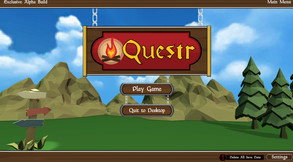
Manage a party of personalities on epic (and goofy) quests. Swipe right on who you like. Swipe left on who you don't. Watch out for liars and be careful how you spend your gold! Of course there's plenty of exciting encounters along the way. Can you keep everyone happy while turning a nice profit?
Modeled estimate, not a reported figure. How we estimate →
Media

About
Stats
All-time low is the lowest price we've recorded for this game since we started tracking it.
Languages: English**languages with full audio support
Engagement
Hours played at review time, across 37 reviews with recorded playtime.
Reviews
Wacky but FUN send up of the choice matter genre IMHO and some just don't get it? It's a lot of reading and making choices sometimes with the right option perhaps not available? There is no 2D/3D button mashing fighting here. Party MORALE is all that matters? I made it over 100% (an achievement) and there is a wheel spin involved to end the round even when it is certain to end the current run.
Cute casual RNG game. I play it with my kids and we have fun choosing the characters and the choices.
Technically competent, and kinda amusing, but there's just not much thing to do. Get it discounted if you want some simple thing to amuse yourself without too much thinking.
Not exactly a polished game or pretty one, but it does have its charm. Funny gameplay and interactions, with nice mechanics.
파티구해 퀘스트하러가자 퀘스트를 받고 모험을 떠날 준비를 합니다. 파티원을 골라서 받을 수 있으며 그들의 래벨과 직업, 종족 등과 선호/비선호에 맞춰서 예비 파티원들을 구성할 수 있죠. 예비 파티 구성이 완료되면 이벤트가 발생하여 그들의 레벨이 오르거나 안하겠다고 떠나는 경우가 있으며 해당 이벤트가 종료되면 모험을 떠날 파티원을 완성해야 합니다. 파티원의 고용에는 당연히 돈이 들며 보유금액을 넘겨서 쓸 수도 있죠. 파티를 완성하면 모험을 떠나면서 이벤트들이 발생하고 파티원들이 반응을 보이죠. 이벤트에서 긍정/부정 항목들이 존재하며 클리어할 수 있는 파티원을 선택해야 합니다. 선택에 따라서 이벤트가 성공할수도 실패할 수도 있는대 만약에 성공하면 사기가 상승하고 실패하면 사기가 하락하게 되죠. 이동 중에 파티원의 선호/비선호에 따른 반응도 발생하여 사기에 영향을 주며 마지막 지점에 도달하게 되면 요구레벨/파티레벨총합과 사기에 따라서 스핀에 성공/실패의 색이 나뉘게 되며 이를 돌려서 결과를 확인할 수 있죠. 성공하면 보상을 받은 뒤 다음 지역으로 이동할 수 있게 되고 실패하면 아무것도 얻지 못한 상태로 다시 시작해야하는대 만약 돈이 없다면 그대로 게임 오버! 참고로, 스핀에서 성공 수치가 높으면 진한 초록색으로 덮히는 영역도 생겨나며 여기에 스핀이 멈추면 추가 보상을 획득할 수도 있죠. 외에도 뭔가 특성 같은 것을 올리는 경우도 있고 모험을 완료한 뒤 원하는 파티원은 유지할 수도 있고(확률이지만) 이것저것 이벤트를 경험할 수 있는대... 영어라 모르것다... 아쉬운 점 -캐릭터 정보 확인이 조금 오묘함 -영어라 내용 이해가 조금 난해할 수 있음
At first I thought the game made no sense and that it was almost entirely luck based, but it's surprisingly well made. The only luck required would be at the end of finishing a quest. Every Quester has three aspects about them, the first two which are race and house increase or decrease morale which improves the chance of completing quests. The third one is their personality, this also can affect morale, but more importantly is required to complete the missions needed to pass the quests. Every personality has likes and dislikes which can be checked in the bottom right corner called Personalidex. Completing the main story quest gives a reward that's only cosmetic and can be found by clicking on collection, as well as experience that's required to unlock more personalities. Overall, I enjoyed the game and the price is well worth it.
[i]Questr[/i] is an RPG parody of dating apps similar to Tinder. In a similar fashion, you swipe left and right to build the perfect RPG team. Every potential party member has likes and dislikes, levels, costs to hire, and personality traits as well as their own class, guild, and ancestry. Personality traits determine the outcome of encounters throughout each quest. Beating an encounter raises morale, while failing lowers it. Party members also interact with one another between encounters, further raising or lowering morale depending on how well personality types get along and whether or not you paid attention to likes and dislikes. At the end of a quest, the morale level determines if you successfully complete it, giving you a reward and the possibility of having party members continue to quest with you. Unfortunately, most of the game is RNG. Sure, you can do your best to set up a well-balanced party, but there is the possibility that multiple members can catfish you by lying about a variety of things, meaning you can end up with an almost all gnome rogue party with the same personality trait save for a human that dislikes gnomes and rogues. Each encounter has a chance to show up more than once, so if you keep getting one that you absolutely cannot beat with any of your party members, your morale is going to plummet. Interactions between encounters also suffer a similar fate, where you have a party member bring up the fact that she hates House Lion over and over. Whether or not a quest is completed is determined by a giant spinwheel, which can lead to failing because it landed on a tiny failure sliver. Even when you do complete a quest, there is a chance that a party member will betray you by taking the reward, and you have the option to go after them. I once was betrayed after catching someone who betrayed me after catching someone who betrayed me. No, I did not accidentally copy and paste that; I was betrayed three times in a row. It was funny, though. Anyway, the game is cheap and unique, so despite its shortcomings. I recommend it.
Interesting gimmick for 5 minutes, the amount of randomness makes it uninteresting. I only paid a dollar for it, but I still don't think it was worth it.
Questr is an unconventional role-playing experiment that deliberately abandons many traditional RPG pillars in favor of personality-driven chaos, social friction, and emergent storytelling shaped as much by luck as by player choice. Developed and published by Mutant Entertainment Studios, the game feels less like a heroic fantasy epic and more like a procedural comedy generator, where assembling a party is not about optimizing stats but about gambling on whether a group of strangers can tolerate one another long enough to finish a quest. The most immediately distinctive feature is the party recruitment system, which replaces standard character selection with a swipe-based interface reminiscent of dating apps. Potential party members appear one at a time, each presenting a short description of their background, alignment, and personality traits. Some of this information may be misleading, exaggerated, or outright false, and deciding who to trust becomes a core part of the experience. This system injects humor and uncertainty into party building, turning recruitment into a social gamble rather than a tactical decision. The result is a group that often feels volatile, unpredictable, and deeply flawed by design. Once a party is assembled, players choose from a selection of quest paths, each representing a different narrative scenario rather than a physical overworld. Quests unfold as a series of text-driven encounters where party members propose solutions, argue among themselves, or undermine each other’s confidence. The player typically selects whose advice to follow, not knowing whether that choice will improve morale or push the group closer to collapse. Instead of combat mechanics or skill checks, outcomes are heavily influenced by the collective morale of the party, which acts as the game’s primary resource and risk indicator. Morale functions as both a thematic and mechanical backbone. Party members react emotionally to decisions, betrayals, and perceived injustices, and these reactions directly affect the likelihood of success. As morale rises or falls, the final resolution of a quest becomes more or less favorable, often determined by a randomized outcome weighted by your current standing. This approach reinforces the idea that Questr is not about mastery or optimization, but about managing relationships and accepting that some outcomes are beyond your control. The game’s reliance on randomness is central to its identity and also its most divisive element. For some players, the unpredictability creates memorable moments where carefully curated parties implode spectacularly or unlikely heroes save the day through sheer chance. For others, the lack of consistent cause-and-effect can feel frustrating, especially when thoughtful decisions still lead to failure due to unfavorable rolls. Strategy exists, but it is soft and probabilistic, more about damage control than precise planning. Visually, Questr is extremely minimal. Presentation consists largely of static images, basic UI elements, and limited animation, giving it a lightweight, almost prototype-like feel. There is little in the way of spectacle or atmosphere, and environments are implied rather than shown. Audio design follows suit, with simple background music and no voice acting. This stripped-down approach keeps focus on text and choices but also reinforces the impression that the game’s strength lies entirely in concept rather than production value. Writing tone leans toward dry humor and absurdity, often poking fun at RPG conventions, unreliable heroes, and the idea of destiny-driven adventuring. Characters can be selfish, cowardly, manipulative, or delusional, and the game frequently invites the player to laugh at the inevitability of things going wrong. While individual lines and scenarios can be amusing, repetition becomes noticeable over longer play sessions, and narrative variety depends heavily on tolerance for randomness rather than depth of authored content. Progression in Questr is limited and deliberately restrained. There is little sense of long-term growth, power accumulation, or evolving systems beyond unlocking additional quest scenarios. This reinforces the idea that each run is a self-contained story rather than part of a grand arc, but it can also make the game feel shallow for players accustomed to RPG progression loops. Replay value comes from curiosity about alternate party dynamics rather than mechanical evolution. Community reception reflects this niche appeal. Players who enjoy experimental, humor-driven games often appreciate Questr for its originality and willingness to embrace failure as part of the experience. Criticism tends to focus on the heavy dependence on luck, minimal presentation, and the feeling that promising ideas are not fully developed. The game is frequently described as interesting rather than satisfying, entertaining in bursts but difficult to recommend as a deep or enduring RPG. Ultimately, Questr is best understood as a playful thought experiment rather than a traditional role-playing game. It explores what happens when personality clashes, misinformation, and emotional instability replace combat stats and character builds. For players willing to approach it as an interactive narrative toy—one that values surprise and humor over control and mastery—it offers moments of genuine amusement and novelty. For those seeking structure, strategy, or a sense of heroic progression, it is likely to feel frustrating and insubstantial. Rating: 6/10
is good , do buy
Related
Related
Trends
Concurrent players on Steam, sampled daily since tracking started.
Audience
Estimated from the language of this game's reviews — a proxy for where players are, not official Steam demographics.
Related
| Eye, caramba! | $2.2K | 59 | 95% | $3.00 |
| The guard of dungeon | $2.2K | 201 | 59% | $1.99 |
| Shadows on the Vatican - Act II: Wrath | $2.2K | 134 | 82% | $1.04 |
| Bayou Island - Point and Click Adventure | $2.2K | 74 | 50% | $1.99 |
| Time of Fury | $2.2K | 98 | 58% | $0.71 |
| Viking's drakkars | $2.2K | 117 | 39% | $0.99 |
Related
| Stardew Valley | $258.9M | 881.6K | 99% | $14.99 |
| Slay the Spire | $80.1M | 216.5K | 97% | $24.99 |
| DAVE THE DIVER | $67.1M | 158.8K | 97% | $19.99 |
| The Scroll of Taiwu : Beyond The Dome | $62.3M | 69.6K | 66% | $29.99 |
| Tabletop Simulator | $42.2M | 73.8K | 96% | $19.99 |
| Castle Crashers® | $41.4M | 139.7K | 96% | $14.99 |