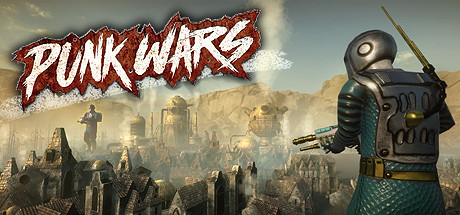
Punk Wars, developed by Strategy Forge S.A. and published by Jujubee S.A. in collaboration with Strategy Forge itself, is a post-apocalyptic strategy game that blends turn-based tactics with 4X-style empire management in a world where industrial ideologies have replaced nations. Set after civilization’s collapse, four rival factions—Steampunk, Dieselpunk, Atompunk, and Steelpunk—emerge from the ashes, each representing a different vision of technological survival and progress. Their war for dominance unfolds across desolate cityscapes filled with crumbling ruins, toxic wastelands, and scarce resources, all of which must be controlled and exploited to ensure survival. At first glance, Punk Wars captures attention with its ambitious mix of mechanics and its unique aesthetic premise, but beneath that creativity lies a game that, while conceptually strong, struggles to balance its systems and sustain momentum over time.
The premise of Punk Wars is simple yet compelling. Each faction embodies a distinct ideology and approach to rebuilding society, not just in visual design but also in gameplay structure. The Steampunk faction relies on mechanical ingenuity and mobility, fielding airships and advanced engineering to outmaneuver opponents. The Dieselpunk faction thrives on industrial production and raw military power, dominating through resource extraction and heavy weaponry. The Atompunk faction uses scientific precision and radiation-based technologies to achieve efficiency and superior range in combat, while the Steelpunk faction emphasizes sheer resilience and fortification, turning defense into its greatest weapon. These differences are more than cosmetic; they define how players expand, fight, and develop, creating a strong sense of identity for each side. This asymmetry gives the early game a spark of excitement, as discovering how each faction’s units and technologies interact provides genuine variety in strategy.
Punk Wars unfolds on a hex-based map where players must explore their surroundings, expand territory, exploit resources, and exterminate their rivals—the traditional “4X” formula—but it places far greater emphasis on the extermination part of that equation. Unlike other grand strategy games where diplomacy and trade play major roles, Punk Wars strips these systems down to their barest forms. There are no treaties, alliances, or negotiations; war is the only real form of communication. The lack of diplomatic nuance simplifies the game but also narrows its strategic depth. Every campaign becomes an inevitable march toward conflict, with expansion and resource management serving primarily as preparation for the next battle. While this focus on warfare gives Punk Wars a clear direction, it also limits player expression, leaving little room for alternative playstyles or emergent storytelling.
The tactical combat itself is played directly on the world map, making positioning and movement crucial to success. Units have limited mobility, which forces deliberate decision-making about where to deploy forces, when to attack, and how to defend critical resource nodes. Terrain matters, as cover and choke points can determine the outcome of engagements. Every move must balance aggression with caution, since healing units is slow and costly, and losing an experienced squad can have lasting consequences. There’s a constant tension between pushing forward to seize resources and consolidating to protect your holdings. The game’s greatest satisfaction comes from mastering this balance, especially when a clever encirclement or well-timed offensive turns the tide of war. However, the AI often fails to challenge the player’s tactical ingenuity, relying on predictable patterns or static defenses that can make later battles feel repetitive once optimal strategies are found.
The technology and production systems offer another layer of decision-making. Each faction has its own research tree divided into industrial and military branches, with many upgrades being mutually exclusive. This structure forces meaningful trade-offs: do you focus on improving your army’s firepower, or invest in infrastructure to support long-term expansion? These choices give the player agency in shaping the growth of their civilization, and the differences between factions ensure that each tech tree feels distinct. Yet, progression can also feel uneven. Research and production are tied tightly to resource availability, and because each faction relies on a unique type of resource that cannot be easily replicated, map control becomes the defining factor in victory. Losing access to a crucial resource can cripple progress, creating moments of real tension but also frustration, especially when luck of the map placement determines long-term success.
The visual design of Punk Wars is one of its most striking qualities. The bleak, industrial setting captures the atmosphere of a world teetering between rebirth and ruin. The factions’ aesthetics are clearly differentiated: the Steampunk’s brass machinery contrasts with the Dieselpunk’s smoky factories, the Atompunk’s neon glow, and the Steelpunk’s harsh, iron fortresses. The art direction effectively communicates the ideological divide at the heart of the game, and the UI, though utilitarian, maintains a consistent style that complements the theme. The soundtrack and ambient effects enhance the mood further, with a grim industrial tone that reinforces the sense of desolation. Unfortunately, the visual appeal is undermined somewhat by performance issues and repetitive map design. The landscapes, while well-rendered, tend to blend together after a few hours, and the lack of biome diversity weakens immersion in the long term.
While Punk Wars succeeds in creating a tense, resource-driven struggle, it suffers from pacing issues that prevent it from maintaining engagement throughout. The early game is challenging and full of potential as you establish your base, scout your surroundings, and clash with rival explorers. However, the mid-to-late game often stagnates once a player gains a decisive advantage. With few tools for diplomacy or alternative victory conditions, the final stages devolve into a grind for dominance rather than an evolving test of strategy. The absence of dynamic events or meaningful randomization also means that every campaign follows a familiar trajectory, reducing replay value over time.
In terms of balance and interface, Punk Wars remains uneven. The user interface, while functional, can be unintuitive, burying important information in layers of menus. Managing multiple fronts and production queues can become cumbersome, especially as the empire grows. The game’s AI and performance occasionally struggle during larger conflicts, leading to long turn times and occasional stutters. Some of these issues are common in indie strategy titles, but they do hinder the flow of play, especially when combined with the already deliberate pacing of turn-based systems.
Ultimately, Punk Wars is a flawed but fascinating experiment. It doesn’t redefine the 4X genre, but it successfully establishes an atmosphere and identity all its own. For players who enjoy careful resource management, territorial strategy, and methodical expansion, it offers a gritty and engaging playground. For those seeking diplomatic nuance, narrative complexity, or highly polished mechanics, its rough edges will be harder to overlook. In the end, Punk Wars stands as an earnest, imaginative project—one that captures the spirit of conflict and survival in a world rebuilt from the ruins of progress, even if it occasionally falters under the weight of its own ambition.
Rating: 5/10