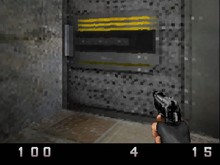
Psi Project: Legacy is a grim, retro-styled descent into madness that attempts to merge the chaotic immediacy of old-school shooters with the unnerving atmosphere of psychological horror. Developed by Vyacheslav Shilikhin and published by Conglomerate 5, the game places you in a deteriorating industrial complex filled with twisted experiments, nightmarish visions, and hostile abominations, all while the boundaries of reality seem to unravel around the protagonist. From the very beginning, the game establishes a sense of decay and claustrophobia: tight corridors, flickering lights, and crude, menacing creature designs evoke a world drowning in its own corruption. This oppressive setting becomes the backbone of the gameplay, constantly reminding the player that the journey ahead is as much a struggle against external monstrosities as it is against the psychological collapse of the character.
The game consciously leans into a retro aesthetic reminiscent of early 1990s corridor shooters, with sprite-based enemies, limited animation frames, and tight, maze-like environments. There is an undeniable charm in this stylistic choice — at its best, it captures the frantic energy of classic run-and-gun action. The player scours narrow rooms for weapons and ammunition, relying on quick reflexes rather than strategic depth. The simplicity of the movement and shooting mechanics intends to amplify the fast-paced nature of the experience. Unfortunately, this nostalgia-driven approach is also where many of the game’s limitations become evident. Weapon feedback lacks weight and punch, enemy behaviors often feel repetitive, and encounters can devolve into straightforward exchanges rather than tense or inventive firefights. Even in quiet moments, performance drops and stutters interrupt the flow, detracting from the immersion the game attempts to build.
Horror plays an important thematic role, though its integration varies in effectiveness. The narrative promises a descent into a nightmare where hallucinations and reality blend, suggesting a psychological edge to the chaos that surrounds the protagonist. There are hints of this throughout the environments — distorted imagery, surreal transitions, and unsettling sound cues that seem to emerge from nowhere. These elements are intended to unsettle the player and deepen the mystery of the complex. However, the execution feels uneven. The horror rarely escalates into compelling set pieces or meaningful story beats, leaving the impression that the psychological framework exists more as window dressing than as a driving force. The atmosphere succeeds in generating discomfort, but it lacks the narrative and mechanical support needed to transform that discomfort into sustained dread.
Community impressions of Psi Project: Legacy reflect this mixture of ambition and shortcomings. While some players appreciate the raw, unpolished retro energy, many express disappointment in the game’s technical instability, uneven pacing, and lack of mechanical refinement. Frame rate issues, simplistic combat, and limited variety in enemy encounters emerge as common complaints. The game feels most appealing to players who specifically enjoy retro oddities — titles that prioritize aesthetic experimentation and fast, disposable action over polish or depth. For others seeking a more substantial shooter-horror hybrid, the experience may feel too thin, too janky, or too inconsistent to satisfy.
Yet, despite its flaws, Psi Project: Legacy carries a certain rough-edged intrigue. There is a sincerity to its design — a sense that the developer was more interested in crafting a distinctive, unsettling atmosphere than in following modern genre expectations. When its elements line up, the game can deliver brief flashes of intense, chaotic fun. Its short length, low price, and unapologetic devotion to a retro style make it easy to dip into for a quick hit of grim, low-fi action. Even so, these strengths don’t quite elevate it beyond its limitations; rather, they define the experience as something that may appeal only to a niche audience willing to overlook its shortcomings.
In the end, Psi Project: Legacy is best understood as an experimental indie project that strives to channel the spirit of early shooters while adding a layer of psychological disorientation. It’s a glimpse into a warped underground world, filled with monsters and madness, carried by a retro aesthetic that is both its defining charm and its greatest constraint. For players who appreciate unsettling atmosphere and don’t mind rough edges, it offers a brief but provocative journey. For those seeking a polished, mechanically rich horror shooter, it remains more of a curiosity than a standout entry in the genre.
Rating: 4/10