
This is a puzzle game like a mathematical book, based on logic and deduction. In this game, you don't need to beat the level, but need to prove it is beatable. Your goal is not to win, but to prove you can win.
Modeled estimate, not a reported figure. How we estimate →
Media

About
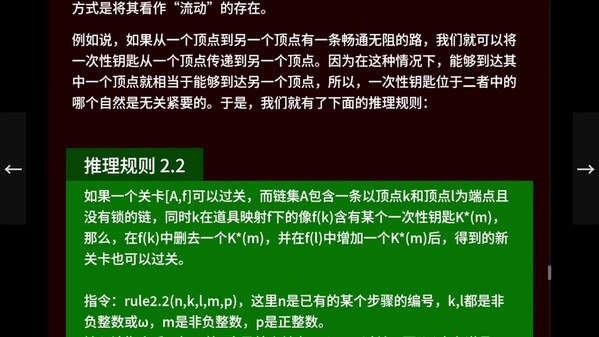
This is a puzzle game based on logic and deduction. In this game, you can learn and understand a brand new deduction system, and then take the axioms and rules of deduction as tools, to prove the propositions by entering the code.
Features:
Understand the axioms and rules of deduction (just like when you are reading a mathematical book)
Enter the code and prove the proposition (just like when you are solving a math problem)
"Q.E.D.", "Eureka!", and get into the next loop
Elements which might be frustrating:
No good artwork. (That's less important than the other three)
Amounts of text to read, and it requires a little comprehension of math. (Playing this game is virtually like reading a math book)
The only way to create a new proof step is entering the right code, which is not the core of the game essentially. (It's due to my limited programming ability)
No custom-corollary function. Only the axioms and rules of deduction are available. (Welcome to the CLASSIC deduction system)
If all of them are okay for you, then this game may be suitable for you.
FAQs:
Q: Which players are the game mainly for?
A: If you have some experience of reading math books and you are interested in logic, this game may be the one you like.
Q: Is it a hard game?
A: At the first, the difficulty of this game are mainly about the understanding the rules, and it's easy to work out the puzzle. But the problem will become very hard if you keep playing. Anyway, reading and comprehending themselves will form a part of difficulty.
Q: Are you inspired by something when designing this game?
A: This game is inspired by mathematical logic, mainly about natural deduction of statement calculus and first-order predicate calculus.
Q: How long does it take to beat the game?
A: About 20~40 hours.
Q: Is there any difference between this game and a mathematical exercise book?
A: Nothing. And I just let it be. If some players mind that, it's fine by me to use "the executable file" or "the exercise book" while talking with them, instead of "this game".
Genres
Stats
All-time low is the lowest price we've recorded for this game since we started tracking it.
Languages: Simplified Chinese, English
Engagement
Hours played at review time, across 40 reviews with recorded playtime.
Reviews
Themes across 40 recent reviews and how positive each mention is. A keyword signal, not full sentiment analysis.
positive critical· bar length = how often the theme comes up
Reviews
还是非常推荐的,劝退点在demo中已经很明显了,但是如果你喜欢你就会觉得物所超值。 /这些题目的难度真是不当人,甚至连例题都没有,不看攻略一道题就能卡几小时。/
非常好玩,题目难度较高而不至于一头雾水,黑底的讲解非常详细,然后后来又发现了一些问题特意回去验证,让人回味无穷 建议是设置如果明显一点,然后放在一起会更好;括号匹配的高亮也可以更加明显一点
非常好习题集,使我的脑子旋转
刚到第五章写代码写的头疼且卡关想给差评,熟悉了思路一路打完456章还是很爽的。 论证中的一些重复操作敲起来是真麻烦啊
比较看人,游戏本身很有想法,感兴趣的可以试一试,现在也逐渐在更新游戏解决交互上的一些问题
好玩。编码体验太差了,而且从第四章第五章开始就完全变成了逻辑学作业那一套,更何况axiom4太强大了,智能识别重言式,难点全在把前几章的破旧四轮车焊接到强大axiom4飞机引擎上,感觉比起爽快更多的是憋屈。这游戏特色是图论,感觉最理想的是在一二三章的基础上增加一些特色机制,平台跳跃解谜游戏的谜题机制应该远不止一个锁,并且开放一些自定义引理之类的QoL功能解决这些更复杂的谜题。不过瑕不掩瑜,不至于打差评。
可以,题目做起来很爽,我专门写了个python程序来输出我那些小工具,这导致我的步骤有时候有点繁琐。
创意很好,但是各个方面都很稚嫩。就像一个刚学编程的大一新生,不去使用好用的库,强行从零开始搓出一个游戏的感觉。评论里有很多很好的建议,但我认为帮助不大。因为如果我的猜测不错,那么这些建议大概率意味着代码要重做了。与其重写一个屎山代码,不如直接借鉴一些好的案例。 我的建议是,直接参考github上natural number game的框架。lean的交互已经做得很好了,可以直接向steam上其他编程类游戏一样,做一个virtual lean,完全没必要自己重新设计。 公理系统也是一样的问题。现在这个公理系统非常乱,似乎是想到哪个命题加哪个,看哪个命题能删就删哪个,充分显示了一个不好的公理系统能给证明带来多大的阻碍。不如直接在现有成熟的公理系统之上,适当添加特色的内容。
好玩的,有意思。(注:对于纯文字游戏、数学、数理逻辑、代码这几项过敏者,慎入此游戏) 只在开放题4.14上卡住了,卡住的原因是:将r44中的k,k'两点误认为了端点,结果这题卡了我好久好久,当时满脑子都是这个,想了半天,觉得应该是不可证的吧,查了查别人的通关视频,害,白折腾。 在通关后花了很多时间优化步数,目前进度: 第一章:1+3+4+9=17 第二章:6+4+6+8+10+8+12+7=61 第三章:1+1+5+6+7+7+15+17+9+0=68 第四章前九题:1+1+5+12+(2)+8+6+22+5=62 第四章后八题:21+15+5+14+27+72+18+80=252 第五章前11题:1+1+1+3+3+5+9+11+11+11+12=68 第五章后11题:24+26+3+2+21+18+9+5+9+8+10=135 第六章:5+9+26+15+11+9+12+11+11+9+5+1+10+16=150 合计:17+61+68+314+203+150=813步,基本达到我个人的极限了。
x(1)이 {1, 2, 3, 4}에 속하고 x(1)이 {3, 4, 5, 6}에 속할 때, x(1)이 {3, 4}에 속함을 증명하자. ================================================================================ x(1)이 {3, 4}에 속하지 않는다고 가정하자. 그러면 규칙 4.2에 의해 x(1)은 {1, 2}에 속하며 {5, 6}에 속한다. x(1)이 {1}에 속한다고 가정하자. 그러면 규칙 4.3에 의해 1은 {5, 6}에 속한다. 하지만 이는 공리 3에 의해 모순이므로 x(1)은 {1}에 속하지 않는다. 따라서 규칙 4.2에 의해 x(1)은 {2}에 속한다. 그러면 규칙 4.3에 의해 2는 {5, 6}에 속하는데, 이는 공리 3에 의해 모순이다. ================================================================================ 따라서, x(1)은 {3,4}에 속한다. 이런거 하는 게임입니다.
Related
Related
Trends
Concurrent players on Steam, sampled daily since tracking started.
Momentum
Pace estimated from the game's recent review growth (our daily snapshots) at its own sales-per-review ratio — a momentum signal, not booked sales.
Audience
Estimated from the language of this game's reviews — a proxy for where players are, not official Steam demographics.
Related
| SIGNAL: Uncharted Lands | $4.3K | 54 | 98% | $4.99 |
| Drop Doll | $4.3K | 114 | 78% | $1.99 |
| Backmooms | $4.3K | 144 | 83% | $1.33 |
| Whisker Waters | $4.3K | 70 | 46% | $2.99 |
| 溢爱~fragile love | $4.3K | 124 | 88% | $1.99 |
| Mussoumano: Ataque dos Haters | $4.3K | 62 | 65% | $4.99 |