
This is a puzzle game like a mathematical book, based on logic and deduction. In this game, you don't need to beat the level, but need to prove it is beatable. Your goal is not to win, but to prove you can win.
Modeled estimate, not a reported figure. How we estimate →
Media

About
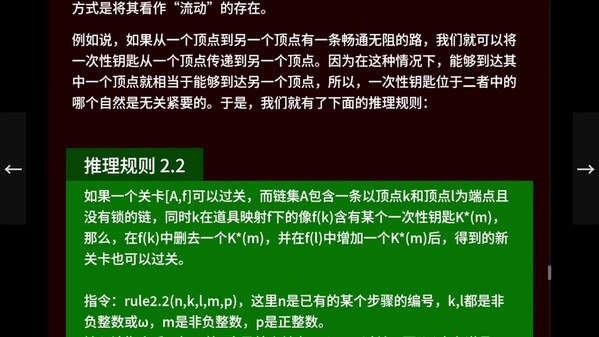
This is a puzzle game based on logic and deduction. In this game, you can learn and understand a brand new deduction system, and then take the axioms and rules of deduction as tools, to prove the propositions by entering the code.
Features:
Understand the axioms and rules of deduction (just like when you are reading a mathematical book)
Enter the code and prove the proposition (just like when you are solving a math problem)
"Q.E.D.", "Eureka!", and get into the next loop
Elements which might be frustrating:
No good artwork. (That's less important than the other three)
Amounts of text to read, and it requires a little comprehension of math. (Playing this game is virtually like reading a math book)
The only way to create a new proof step is entering the right code, which is not the core of the game essentially. (It's due to my limited programming ability)
No custom-corollary function. Only the axioms and rules of deduction are available. (Welcome to the CLASSIC deduction system)
If all of them are okay for you, then this game may be suitable for you.
FAQs:
Q: Which players are the game mainly for?
A: If you have some experience of reading math books and you are interested in logic, this game may be the one you like.
Q: Is it a hard game?
A: At the first, the difficulty of this game are mainly about the understanding the rules, and it's easy to work out the puzzle. But the problem will become very hard if you keep playing. Anyway, reading and comprehending themselves will form a part of difficulty.
Q: Are you inspired by something when designing this game?
A: This game is inspired by mathematical logic, mainly about natural deduction of statement calculus and first-order predicate calculus.
Q: How long does it take to beat the game?
A: About 20~40 hours.
Q: Is there any difference between this game and a mathematical exercise book?
A: Nothing. And I just let it be. If some players mind that, it's fine by me to use "the executable file" or "the exercise book" while talking with them, instead of "this game".
Genres
Stats
All-time low is the lowest price we've recorded for this game since we started tracking it.
Languages: Simplified Chinese, English
Engagement
Hours played at review time, across 40 reviews with recorded playtime.
Reviews
Themes across 40 recent reviews and how positive each mention is. A keyword signal, not full sentiment analysis.
positive critical· bar length = how often the theme comes up
Reviews
充分体现了公理体系不合理的时候会带来的巨大困难
作为写过很多lean代码的人,肯定得过来感受一下这个游戏。Prove You Can Win以游戏的形式呈现了proof assistant(机器形式化证明),其实基本和proof assistant没有区别,游戏过程就是写代码。游戏里的命题以沿着路线过关为主题,甚至加入了锁钥机制使得更像那种传统的2D游戏,有点图论的感觉,但其实并没有涉及到任何图论知识。整个游戏基本覆盖了本科数理逻辑课程中的基础部分,比如逻辑联结词、量词等。如果没学过数理逻辑,其实可以玩这个游戏来入门,这样就不用上课了(bushi)。 这个游戏大部分命题其实挺trivial的,但也有几个命题有些亮点。例如当初我看成就,发现有一个成就叫"证明错误的命题"。我还在想怎么会证明出错误的命题,到了第五章发现居然能证明空关卡可以通关(空关卡本来是不能通关的)。其实本质上是rule5.4随便加全程量词太强了,我当时看rule5.4描述的时候我就感觉到这个是不是有点过于强了有可能会不对,到后面看到那个证明错误的命题的时候果然印证了我的想法。还有有些别的命题证明过程比较精彩,例如我全成就前最后证明的是不利用rule1.1(就是加链条的规则)的最后那个命题,我第一眼看上去还以为证明不了,后来想到了可以加锁加钥匙,还是有点意思的。 尽管这个游戏有上述的精彩之处,但必须的说明的是,作为游戏而言,prove you can win其实相当失败。倒不是没有图形化的问题。我是可以接受纯写代码的,但关键在于写代码的体验相当糟糕。最糟糕的一点是,证明过的命题无法引用,导致很多时候我都在写重复的东西。除此之外,第四章有些命题涉及到大量分类讨论,再加上刚才说过的无法引用的问题,导致我命题4.15和4.17(如果我没记错序号的话)都各自写了上百行。当然我的证明肯定不是最优的,但本质上其实就是分类讨论,思路是很顺畅的,但分类讨论落在它这个游戏里就是海量的代码。这是游戏制作者亟需改进的一点。所以对于新人而言,其实更值得推荐的还是lean的natural number game. 写lean的体验比玩这个游戏好了大约10^10^10倍。 关于成就:只要证明了所有能证明的命题就能全成就。对于游戏里命题证明的思路与技巧,我将会写一篇指南。
a1(👍)
[h1]《证你能赢》审稿意见[/h1] [h3]Overall merit: weak accept[/h3] [h3]Reviewer expertise: Expert[/h3] [list] [*]计算机博士在读 [*]16小时完美通关,总行数1081 [/list] [h3]Paper summary:[/h3] 类Jupiter Notebook交互式数理逻辑习题集。从简单的连通性模型开始,逐渐转向经典的逻辑规则,循序渐进地建构一套弱化版的逻辑体系。 [h3]Pros:[/h3] [olist] [*]引导细致顺畅,难题往往有充足的铺垫提示。 [*]难度适中且有梯度。相比真正的数理逻辑习题集十分容易,适合毕业多年忘记学习过程中的痛苦的理科生回味解题的乐趣,或者尚未学习相关课程但感兴趣的高中生体验解题的乐趣。 [*]由于公理系统太弱,有些题必须想到特定技巧才可以做(比如[spoiler]¬P⇒(P⇒Q)[/spoiler])。这些题往往设计成开放题,使读者起初认为不可做,之后想到了再回来补星。也有的使用强提示引导(比如4.12,5.24)。以上设计成功塑造了Eurika的体验。 [/olist] [h3]Cons:[/h3] [olist] [*]由于公理系统太弱,少量题目必须穷举,使得操作十分繁琐。 [*]编辑器功能太少,使得操作十分繁琐。当然,这也起到了鼓励使用巧妙的解法而非穷举的效果。 [*]内容过于硬核,目标用户比较小众。 [/olist] [h3]Comments:[/h3] 我希望可以提供以下功能: [olist] [*]移动一段证明的位置并且不改变所有语句的依赖关系,即自动修改行号。这可以让我省下很多在内层写下的重复公理。 [*]对语句加标记,并用标记取代行号。这可以避免隔着一百行来回找行号。 [/olist] 我推测作者出于手写证明的坚持,不希望提供方便的复制功能(我知道有导出,但需要改行号)也不允许引用已经证明的定理。所以,上面提出的功能只是方便操作,并没有加强写证明的能力。
20h把能证的都证完一遍了(没有卷行数),来评测一下: 体系和一些题目设计比较有意思,单纯看机制的话是不错的游戏,第四章之后会有很多有意思的关卡。 主要缺点是操作体验比较差。其实我还算能接受不能自己定义定理这一点,大不了把证明复制粘贴一遍呗,但主要不能接受的是只能用编号指代每一行,导致复用代码变得极其困难(每次粘贴来相同的证明都需要更改一遍行号,而且根本分不清一大串代码里面哪些是需要修改的行号而哪些又是其他参数,一眼扫过去都是数)。如果能自己给每一行定义编号的话相信体验会好很多。 另外如果自定义定理在技术上难以实现,也可以在证出来某些命题之后给一个可以直接调用对应结论的命令啊……后期一些关至少要近百行,一条一条打真是挺折磨的……
I bought it [i]because[/i] of a negative review saying "you may use more meaningful names to introduce arguments in a function". That basically told me that this game was created by a mathematician. Even though English is a little bit clumsy and it's hard to get into first, once you get the hang of it, it becomes a fun logic puzzle game. It's impressive how pathfinding turned into a set of axiom schemes. This would have been much greater if it was possible to enter proofs via interactive graphic system, though. For example, I would like to apply rule 1.2 via "drag one path to another to remove it", and rule 1.3 via clicking on a path. Enabling this would have made this game much more accessible.
I tried this as an introduction to interactive theorem proving. This game formalizes a maze game, but instead of finding a path, you prove that a path exists using a small set of axioms. The biggest downside is the UI/UX: compared to actual interactive theorem provers, it feels noticeably less smooth and less capable. Also, many interactive theorem provers are free, and there are plenty of free beginner-friendly materials for Lean 4 and Coq that can be just as fun (and more flexible). If you've never touched this kind of thing, the game does provide a very basic "onboarding" experience, so I can see some value there. If you're comfortable setting up tools, I'd recommend trying Lean 4 (Theorem Proving In Lean, Mathematics In Lean) / Coq (Software Foundations series) tutorials instead.
给我一个证明和构造简单引理的机会吧,瓦塔西什么都会做的😭。 回来吧同理可得, 我最骄傲的信仰, 历历在目的易证, QED莫名在流淌。
几天下来拿到了全成就 评价评价一下哈哈 感觉对于一个数学爱好者+解谜游戏爱好者(我这种人),这款游戏会是一种享受,特别是喜欢逻辑推理的玩家. 前三章(甚至第四章)感觉都是比较基础的操作,第五章开始逐渐趣味(喜欢imp和rule5.1),推矛盾时候会有一种解压感. 关于界面&代码的问题,因为个人习惯了无自动补全的写码,其实还行?但感觉自动补全/提示会是一个极大优化(特别是写出定理之后自动提示(如悬浮窗)所需的输入数量和分别对应(如visual studio那样)如果技术允许估计会对大众体验提升不少哈哈 写在最后:建议大家写行数的时候用负标号 免得复制粘贴时候一行一行改//
身为intp还蛮喜欢这种在规则限制下带着镣铐跳舞的感觉的,找到解题方法后的豁然开朗感觉像回到了写计算理论作业的时候,不过就是操作有点坐牢
Related
Related
Trends
Concurrent players on Steam, sampled daily since tracking started.
Momentum
Pace estimated from the game's recent review growth (our daily snapshots) at its own sales-per-review ratio — a momentum signal, not booked sales.
Audience
Estimated from the language of this game's reviews — a proxy for where players are, not official Steam demographics.
Related
| Crayon Chronicles | $4.6K | 54 | 70% | $3.99 |
| FIND ALL 8: The road to the Maya | $4.6K | 144 | 99% | $1.99 |
| 后室重生Backrooms Rebirth | $4.6K | 71 | 61% | $2.22 |
| The Auto Sort Is Broken | $4.6K | 89 | 80% | $2.99 |
| The Subject | $4.6K | 61 | 69% | $4.99 |
| Detective Holmes: Trap for the Hunter. Hidden objects. 探し物 | $4.6K | 61 | 79% | $4.99 |