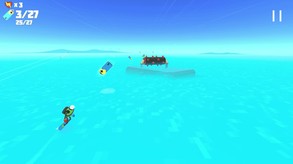
Power Hover is an atmospheric arcade-style action game developed and published by the indie studio ODDROK. Built around the simple yet satisfying concept of riding a hoverboard through futuristic landscapes, the game combines elements of endless runners, obstacle courses, and light narrative exploration into a smooth and visually striking experience. Rather than relying on complex mechanics or deep progression systems, the game focuses on fluid movement, timing, and stylish presentation. Players control a small robot traveling across a mysterious world in pursuit of stolen energy cores that once powered its home village. While the premise is straightforward, it provides a gentle narrative thread that carries players through the game’s various environments and challenges.
The story unfolds in a minimalist way, relying more on atmosphere and visual cues than on dialogue or lengthy exposition. The player’s robot protagonist sets out after a mysterious figure who has taken the village’s energy source, leaving the once lively mechanical settlement powerless. As the journey progresses, players traverse a world filled with abandoned technology, industrial ruins, and desolate landscapes that hint at a larger history behind the robotic civilization. Short cinematic moments occasionally appear between levels to reinforce the sense of pursuit, but the storytelling remains subtle and unobtrusive. This understated narrative style fits the game’s tone well, allowing the environment and music to carry much of the emotional weight.
Gameplay in Power Hover revolves around guiding the hoverboard-riding robot through carefully designed obstacle courses. The character automatically moves forward, while the player primarily controls lateral movement and positioning. Although this control scheme is simple on the surface, the levels are designed to demand quick reactions and precise timing. Players must weave between hazards such as spinning blades, falling structures, bombs, and laser barriers while maintaining momentum across narrow platforms and winding pathways. The hoverboard glides with a smooth sense of inertia that makes the act of steering feel natural and satisfying, creating the sensation of surfing through the air as obstacles rush toward the player.
The level design plays a crucial role in keeping the experience engaging. Each stage introduces new environmental hazards or variations on familiar mechanics, ensuring that players constantly adapt their approach. Some sections require navigating tight corridors filled with traps, while others emphasize speed and rhythm as players race along wide open tracks lined with collectible energy batteries. Certain stages even play with perspective and gravity, allowing the hoverboard to ride along walls or curved surfaces while the camera dynamically shifts to maintain clarity. These moments add variety and visual flair, preventing the game from feeling repetitive despite its relatively simple control system.
Collectibles are another important part of the gameplay loop. Throughout each level, players can gather scattered energy batteries that were dropped by the thief being pursued. Collecting every battery in a stage rewards careful movement and exploration, encouraging players to replay levels in order to perfect their runs. Achieving full completion often requires learning the safest routes through complex obstacle arrangements and mastering the hoverboard’s momentum. This collectible system adds a layer of challenge for completionists while remaining optional for players who simply want to experience the main journey.
Beyond the main campaign, the game includes additional challenges and score-based modes that expand its replayability. Some levels shift the focus toward survival gameplay, where players must endure increasingly difficult obstacle patterns while trying to reach the highest score possible. Leaderboards encourage friendly competition among players who want to test their reflexes and push their performance further. While the story mode can be completed in a relatively short amount of time, these additional challenges help extend the game’s lifespan for those who enjoy refining their skills.
One of Power Hover’s most memorable aspects is its artistic presentation. The game features a colorful low-poly visual style that blends minimalist geometry with bright lighting and expansive environments. The futuristic landscapes feel both serene and slightly melancholic, depicting a robotic world that seems quiet and abandoned yet still vibrant with color. From dusty deserts filled with towering mechanical structures to glowing industrial complexes and endless highways, the environments provide a sense of scale and movement that complements the hoverboard gameplay. The simplicity of the art style also allows the game to run smoothly on a wide range of hardware, making it accessible without sacrificing visual charm.
The soundtrack further elevates the experience. Electronic and ambient music tracks accompany the gameplay, perfectly matching the sensation of gliding across futuristic terrain. The music builds a rhythmic flow that encourages players to move confidently through obstacles, almost turning each level into a musical ride. Combined with the clean visual presentation and responsive controls, the audio design helps create a relaxing yet energetic atmosphere that makes the game enjoyable even during repeated attempts at difficult sections.
Despite its many strengths, Power Hover is not entirely without shortcomings. The simplicity of the gameplay mechanics means that the experience may feel somewhat limited for players who prefer deeper systems or extensive customization. Because most of the character’s actions are automated, the sense of control is more about positioning than performing varied moves. Additionally, the campaign’s relatively short length means that players can complete the main story fairly quickly. While replaying levels to collect all batteries and chase high scores adds longevity, those looking for a longer adventure might wish for additional stages or expanded mechanics.
Even with these limitations, Power Hover succeeds remarkably well at delivering a focused and polished arcade experience. Its smooth hoverboard movement, stylish visuals, and relaxing electronic soundtrack combine to create a game that feels both calming and exciting at the same time. The simplicity of its controls makes it easy to jump into, while the cleverly designed levels ensure that mastering the game still requires skill and precision. For players who appreciate artistic indie titles or enjoy reflex-based arcade challenges, Power Hover offers a memorable journey through a quiet robotic world filled with motion, color, and rhythm.
Overall, Power Hover stands out as a charming and well-crafted indie experience that demonstrates how strong visual direction and thoughtful level design can elevate even the simplest gameplay concepts. It may not be the longest or most complex title available on Steam, but its polished mechanics and atmospheric presentation make it a worthwhile ride for anyone looking for a stylish, relaxing, and engaging arcade adventure.
Rating: 8/10