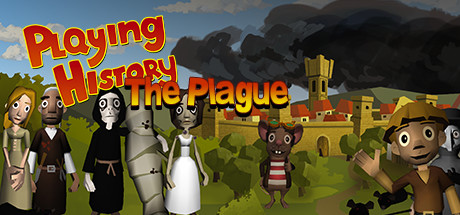
Playing History: The Plague is an educational historical adventure developed by Serious Games Interactive and published by My Way Games that transforms the devastating events of the Black Death into an interactive narrative experience. Set in Florence during the 14th century, the game places players directly inside one of history’s deadliest pandemics, allowing them to experience the fear, confusion, and social collapse caused by the plague through exploration and story-driven gameplay. Rather than teaching history through static information alone, the game attempts to make the historical setting feel personal and emotionally engaging by focusing on the lives of ordinary people struggling to survive.
The story follows a young protagonist searching for a way to help their sick mother while the plague spreads rapidly throughout the city. As fear consumes the population, Florence slowly changes from a lively medieval center into a place dominated by panic, superstition, and death. This transformation gives the game much of its emotional power because players witness the collapse of daily life firsthand rather than simply hearing about it through historical narration. The personal nature of the story helps the historical setting feel more immediate and relatable, especially for younger players unfamiliar with the realities of medieval Europe.
One of the game’s greatest strengths is how naturally it incorporates educational content into the adventure itself. Instead of presenting long lectures or forcing players to read excessive historical text, information is delivered through dialogue, environmental storytelling, and interaction with the people living inside the city. Players encounter merchants, priests, healers, and frightened citizens who each reveal different perspectives on the plague and medieval society. Through these interactions, the game quietly teaches players about medicine, religion, superstition, and social conditions during the Black Death without interrupting the flow of the story.
Exploration is a major part of the experience. Florence is presented as a detailed medieval city filled with narrow streets, marketplaces, homes, and historical landmarks that players gradually investigate while searching for clues and solutions. The atmosphere changes noticeably as the disease spreads, with once-active areas becoming quieter, darker, and increasingly desperate. This gradual deterioration creates a convincing sense of tension and helps players understand the scale of the disaster on a more emotional level.
Gameplay remains fairly simple and accessible throughout the adventure. Players solve basic puzzles, interact with characters, gather information, and complete story-related objectives tied to the historical setting. The mechanics are designed primarily to support the educational experience rather than provide deep strategic or action-focused gameplay. While experienced adventure game players may find the systems relatively straightforward, the simplicity makes the game approachable for students and casual audiences interested in historical storytelling.
Visually, the game uses a stylized art direction that balances accessibility with historical atmosphere. Character models and environments are not especially advanced compared to modern narrative games, but the medieval city still feels believable thanks to its architecture, costumes, and environmental details. The visual design successfully communicates the contrast between Florence before and during the plague, helping the world feel alive even within the limitations of the presentation.
The soundtrack quietly strengthens the atmosphere with medieval-inspired music and subtle ambient sound design. Softer tracks accompany exploration and dialogue, while darker and more melancholic themes emerge as the plague worsens. The audio never becomes overly dramatic, instead maintaining a restrained tone that fits the educational nature of the experience. Environmental sounds and background conversations also help make the city feel inhabited despite the growing fear spreading through its population.
One particularly effective aspect of the game is how it emphasizes the human side of history rather than focusing entirely on statistics or historical facts. The plague is presented not simply as an event, but as a tragedy experienced by ordinary people struggling to understand what was happening around them. Fear, grief, superstition, and uncertainty become central themes throughout the narrative, giving players a stronger emotional connection to the historical setting.
At the same time, the game’s educational focus naturally limits the depth of its mechanics. Players expecting complex gameplay systems, difficult puzzles, or highly interactive combat will likely find the experience too simple. The pacing can occasionally feel slow during dialogue-heavy sections, and some objectives are fairly linear. Certain mechanics and animations also feel dated compared to more modern adventure games, reflecting the game’s modest production scale.
Despite these limitations, Playing History: The Plague succeeds because it understands its purpose clearly. It is designed not as a hardcore adventure game, but as an immersive educational experience that encourages players to learn history through emotional involvement and exploration. By focusing on atmosphere, personal storytelling, and historical authenticity, the game manages to make one of history’s darkest periods feel accessible without losing the seriousness of its subject matter.
Playing History: The Plague stands out as a thoughtful historical adventure that demonstrates how video games can be used to teach complex historical events in an engaging and emotionally meaningful way. Its combination of accessible gameplay, immersive medieval atmosphere, and educational storytelling creates an experience that remains both informative and surprisingly moving for players interested in historical narratives.
Rating: 7/10