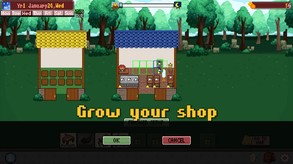
Be a Pixel Shopkeeper! Collect items using inventory management puzzle mechanics. Sell your wares, decorate your shop, craft new products, and expand! Train to beat tougher dungeons, unlock new classes and decor, and furnish your shop smartly to maximize profits!
Modeled estimate, not a reported figure. How we estimate →
Media

About


(Please Read ^^)Genres
Stats
All-time low is the lowest price we've recorded for this game since we started tracking it.
Languages: English
Engagement
Hours played at review time, across 48 reviews with recorded playtime.
Reviews
Themes across 48 recent reviews and how positive each mention is. A keyword signal, not full sentiment analysis.
positive critical· bar length = how often the theme comes up
Reviews
https://youtu.be/HHEJJqI6n5s A neat idea that can get a bit grindy. It's super casual. Takes a lot of clicking. I liked placing items in to the bag and because there are different shaped bags it can be tricky. Appreciate that it's in the game though. The ideas are here and they're interesting. PIxel Shopkeeper runs out of steam though after a few hours. Which is fine. I'm excited for Pixel Prototype's next game though. Light recommendation.
I can't recommend this game. It looked really promising with the graphics and theme of the game but after playing it a while it is very simple and repetitive. I'm not sure if they will update it later but it looks like it was lacking some elements before it launched.
Cool little Game for around 6$. If you look for a Game like ShopAKeep (but much better), Kingdoms Item Shop or love Business Simulations you can have some Hours of Fun (with Replay Potential) with this Game
[h1]Cute RPG Shop Sim[/h1] [i]Pixel Shopkeeper[/i] is a cute shop sim in an RPG world. Customers of various classic RPG classes come to your shop to buy the equipment and consumable items they need. The basic cycle is to alternate dungeon diving with shop days. There are several different battle areas around the islands of the game, and each area has increasing levels of difficulty. The first dungeon level in an area is free; the others take a small fee that increases with level. Whatever the dark dungeons and monsters your customers fight, you will only fight on the surface world and bash a few cute animals. The "dungeon" fights always consist of four regular opponents and a boss. The battle music here resembles something from early Final Fantasy. Your character automatically fights through the area. This frees you for an inventory puzzle. Each animal drops some items. Your job as player is to arrange the items you choose into a gridded shape representing your bag. Items can be rotated to better fit into the bag. Later, you can buy other bags with larger shapes and useful grid tiles. If you fail an area, you drop all gathered items for that run. The boss guards a chest. A few fights in, you have your choice of one of three chests. Some chests guarantee equipment and others guarantee crafting ingredients. All dungeon areas save for the first one have effects on your bag. One has a quicksand or gravity effect that can make items sink from where you attempt to place them. The coldest area will freeze placed items so you can't adjust them during that run. Once you have items to sell, you return to your shop for a setup phase. Here, you can buy and set display tables and decor, all of which have useful buffs for prices or customer behavior. Furniture can often be upgraded for better buffs. You will also need to set up the items for sale. Only one individual item goes in a sales slot. This does make daily shop setup a bit tedious, especially after some shop expansions. You can, however, right-click on the tables for a menu to automatically place categories of items. However, you'll often prefer the tedious route because each class has preferred items and you gain benefits for reaching milestones with each class. All classes have both male and female packages, distinguished by hairstyle or headdress and not obvious anatomy. The only difference between genders as far as item preference goes is that the ladies love jewelry. (Here, it's normal jewlery, not enchanted rings or amulets.) Eventually, a travelling merchant offers you always-open access to certain useful items, mostly crafting recipes. Every recipe takes one plain-ish item and one or more of a particular ingredient. You will, of course, have to buy the recipe, but you will also have to spend money per crafted item item, about 30-60% of the base sell price. A garden in which you can plant seeds will open next door. These seeds produce either certain crafting ingredients or heals. While in the setup phase, you can also train up to finish higher-level dungeons. This takes an increasing amount of gold, of course, and is a random roll. You will always score a bit more HP and at least one or two increases in a statistic somewhere. You can also equip any weapon you make or craft and a single piece of armor. You can switch between shop setup and perusing the world map as much as you like, but once you end shop setup and trigger a shop day, you cannot set out items or furniture. The merchant also gives you decor items to decorate the outside of your store, such as roof tiles and wallpaper and bushes. These go into a rating score for store decoration contests. These are marked on the calendar, but you need to be starting that day in order to trigger the contest by clicking on the calendar. Hilariously, customers do not actually enter your shop. Rather, they walk from one end of the screen to the other. If they are considering a purchase, they will pause and deliberate a bit. Bought items disappear with the happy clink of gold coins. If you click on a customer before they reach your store, you can poke them into considering buying something. Some decor speeds up the decision or expands what items a customer is interested in. This walk past also allows customers to offer you ingredients for crafting. Offered ingredients will appear above their heads, and you need to click on it to collect. Later, someone will build a restaurant next door. It offers powerups (in the form of food) for dungeons, as well as crafting ingredients and garden seeds randomly during the day. Eventually, customers will also have requests. They require either a specific item, or an item with certain minimum stats. Some are crafted items. In return, they will either give you items right away or go off on a short quest and share spoils with you. [b]Difficult Difficulties[/b] The game offers you three difficulties: Challenge, Chill, and Sandbox. I tried Chill and found it wasn't quite as "chill" and easy as I expected. In that mode, a guy named "Some NPC" tells you that your student loans totaling 50,000 gold are due in 16 weeks, and you must pay up -- or DIE!!! (The game is not so gruesome as that suggests and just gives you Game Over on failure here.) I tried this mode twice and failed around the 10th week both times. The problem here starts with you having barely any money, just enough to buy the shop and a few cheap early furnishings. Payments are due quite reasonably at the end of the week, defined as the end of the day on Saturdays. These payments start at an easy 50 gold and ramp up exponentially. The thing is, nearly [i]everything[/i] costs money, and it is easy to feel like you are falling behind as the payments escalate. There are far easier debt repayment scenarios out there in game land. Plus, item drops are a random roll, if clearly restricted to certain dungeons. A run can end without getting any of the one item that you most wanted out of the three or four in that dungeon. One small saving grace here is that the boss chests can contain any item already found and can often include a couple dozen various items in the higher dungeons. [b]Sandbox[/b] Sandbox mode eliminates the loan shark, allowing you greater freedom to explore the game. In Challenge or Chill, the loan repayment is labeled as Chapter 1. A few game weeks into Sandbox, the probable Chapter 2 goals are revealed as some white-haired noble congratulates you for paying off your debts and offers high-priced land for a second shop. This shop must be built up and stocked just the same as the first one. You'll also need to hire a manager from one of the customer classes, but they'll only offer themselves if they have a certain minimum affinity for you. Affinity is earned through cutely awkward interactions in a nearby park on the weekends. Each class brings in extra items of one sort or another, such as armor or weapons, or gold. Sandbox also reveals that the shop(s) have a high number of expansion, each just a couple more spaces to the side, and the gold amounts ramp up quickly. I lost count after five upgrades. [b]Unfinished Business[/b] No updates have been listed since mid-2018. The core game is perfectly playable, but there are hints of planned features that have never been fully implemented, or at least I haven't been able to trigger. There are two islands that could be sites for other stores. One of the potential sites is the location for a hidden starter store that you can enter into the store decoration contests, but I have not been able to buy and use. One of the late-game crafting ingredients has no recipes that I can find. Still, the game balance issues regarding very pricey upgrades and the lack of clear deeper game goals do not deter my recommending at least a look at this game. It's worth maybe 15-20 hours of your time.
This game is good. I want to get that out of the way right now: it's definitely fun to play, and I enjoy it. The gameplay is enjoyable, it's very cute, I like the dialog, the NPCs make me giggle sometimes. The game is very small, but a lot of what it does, it does well. If you like the style of "be a shopkeeper, repay a debt, go through dungeons, tetris your bags", you will like this game! Definitely, definitely buy it. However -- because everything has a however -- while I do like the game, it does have some pretty noteable flaws to it, and a couple of them which tend to make some aspects not very fun. I don't think they make the game not worth buying, but the game would sure be a lot more fun without them. > BAGS The bags feel useless. I tried most of them whenever they came up, but honestly, none of them were really worth using to me beyond the default one. They're neat, don't get me wrong, but I never found one that was actually easier and more enjoyable to use than the default. They just felt gimmicky and annoying, and their high price tag made it feel like a waste of money to buy any of them. > DUNGEON TIMER The dungeon will actually time out once the boss is killed, meaning that even if you're still trying to shuffle items, you've lost those. This is incredibly unfun and extremely annoying, ESPECIALLY when it comes to the dungeons you pay to enter, because the shapes of the items are so ridiculous that you're scrambling to try to fix it up... and then you just spontaniously lose things halfway through. Considering the dungeons move extremely fast, this is just a pretty awful-feeling mechanic overall, and I'd personally have made it so that the items have to either be discarded, time out, or all in your bag before the dungeon ends. (The actual speed of the dungeon is just fine) > DAY TIMER The day ends when the timer hits the moon. This sounds reasonable, until you realize that the game doesn't stop DOING things before the timer hits the moon. People will still walk up to your store and browse, and I've had multiple frustrating instances where they were finally about to buy something I've been trying to sell for days, and... the day ended and it didn't sell. The day shouldn't end until whoever's browsing your store is done. > TOO MUCH CLICKING This is, perhaps, I think the worst sin this game makes. You have to constantly and repeatedly click things, and it's just outright irritating. You have to click to clean your tables. You have to click NPCs to increase their chances of buying. You have to spam click items to "polish" them. You have to click birds and tumbleweeds to get money. It's not fun, it's just irritating, and I feel like I'm playing a crappy mobile clicker game half the time. There's stuff you can buy to lower how often you have to do it, but it doesn't really help. There honestly should be some kind of option to toggle off the overly prominent clicking, because that sometimes makes me dread going into shop mode because I just wanna sell stuff and watch the NPCs. If I wanted to play Cookie Clicker, I'd go play that! > THE PRICES DON'T STAY SET Hey! Do you want to sell your items for 110%, try to make a profit? I hope you like setting that every single time, every single day. Props to the game, it does let you set that price for all items currently out on display, but it doesn't *save* the price you set things as. So every time you restock, you have to set the percentage. It gets old, fast.
neden kimse böyle bi oyun olduğunu hala fark etmedi merak ediyorum. belki de basit oynanışa ve grafiklere sahip olduğunu düşünüyorlardır. fakat yaratıcı ve basit olmayan bir oynanış söz konusu oyunda. tavsiye ediyorum, belirli aralıklarla oynuyor olsam bile zevk alarak oynadığım bir oyundur.
Pixel Shopkeeper is a good small game to play in-between longer stories. Its main elements of gameplay are dungeoneering for loot, then stocking a shop to sell your items. These two elements never feel boring, though, due to some interesting mechanics. In the dungeoneering phase, all loot must be fit into bags with limited slots so that the player must tetris them in before they disappear on the ground. Further along in the game you can buy different bags with varying power-ups, including multipliers and slots for instantaneous sale. Different terrain also yields different challenges, such as dust motes getting in your bag that you have to click to remove, or items freezing in place in the snow biome. Even if you take a sale day to sell your items, there are more features to the map. Your shop can be upgraded, new furniture bought, you can plant and harvest materials. The customers that come by might have quests or free ingredients for your crafting recipes. Birds and tumbleweeds that come by can be clicked for extra money (who knows where they were keeping it?). The game feels like it stalls midway through, when all you've been doing is selling and dungeoneering. Thankfully there are overarching quests that can lead you to the endgame. In the beginning of the game you will meet a King who needs four crystals that lie in a dungeon for you to beat. The same with a Princess later on whose journey home will require ten crystals that can be gained through sometimes hard weekly quests that involve your sales or dungeoneering skills. When you've completed these quests, the game is over rather abruptly, which was to be expected considering its current stage of development. But then, if you've beat all but the last impossible dungeon and are rolling in money, there wasn't much more to work toward, and it's all the satisfaction you need to see that Princess return home safely. Would recommend for min-maxers looking to take a break from AA-titles :)
Buy dis
The game has been completely abandoned by the dev, I played the entire game in 12 hours, took a few years off, came back and saw there were no updates on the game for 5 years other than adding 1 achievement...... thanks bud.
Simple but fun once you get past the weekly goal.
Related
Related
Trends
Modeled estimate over time, reconstructed from Steam's monthly review histogram.
Momentum
Pace estimated from the game's recent review growth (our daily snapshots) at its own sales-per-review ratio — a momentum signal, not booked sales.
Audience
Estimated from the language of this game's reviews — a proxy for where players are, not official Steam demographics.
Related
| Hostile Waters: Antaeus Rising | $37.7K | 475 | 77% | $2.99 |
| Pro Show Jumping | $37.7K | 59 | 85% | $19.99 |
| Agricultural Simulator 2013 - Steam Edition | $37.7K | 667 | 23% | $1.49 |
| Legends of Heropolis DX | $37.7K | 97 | 65% | $10.99 |
| Cross Racing Championship Extreme | $37.7K | 112 | 88% | $9.99 |
| The Cyclist: Tactics | $37.7K | 102 | 96% | $17.99 |
Related
| 7 Days to Die | $425.3M | 403.6K | 87% | $44.99 |
| Mount & Blade II: Bannerlord | $309.8M | 294K | 88% | $49.99 |
| Don't Starve Together | $164.7M | 539.6K | 95% | $14.99 |
| Satisfactory | $164.4M | 275.9K | 97% | $27.99 |
| Kerbal Space Program | $154.7M | 144.8K | 96% | $39.99 |
| Raft | $144M | 375.8K | 93% | $19.99 |