Prepare to be enchanted by a world where the choices you make and the paths you choose shape your destiny. Obsidian Entertainment, the developer of Fallout: New Vegas™ and South Park: The Stick of Truth™, together with Paradox Interactive is proud to present Pillars of Eternity.
Modeled estimate, not a reported figure. How we estimate →
Media

About
Prepare to be enchanted by a world where the choices you make and the paths you choose shape your destiny. Obsidian Entertainment, the developer of Fallout: New Vegas™ and South Park: The Stick of Truth™, together with Paradox Interactive is proud to present Pillars of Eternity.
Recapture the deep sense of exploration, the joy of a pulsating adventure, and the thrill of leading your own band of companions across a new fantasy realm and into the depths of monster-infested dungeons in search of lost treasures and ancient mysteries.
So gather your party, venture forth, and embrace adventure as you delve into a realm of wonder, nostalgia, and the excitement of classic RPGs with Obsidian’s Pillars of Eternity!
Human, Aumaua, Dwarf, Elf, Godlike and Orlan.
Stealth, Athletics, Lore, Mechanics and Survival.
Build a character as one of eleven classes such as Barbarian, Chanter, Cipher, Druid, Fighter, Monk, Paladin, Priest, Ranger, Rogue and Wizard.
Side with various factions using a reputation system, where your actions and choices have far-reaching consequences.
Beautiful pre-rendered environments laced with an engaging story and characters bring the world to life.
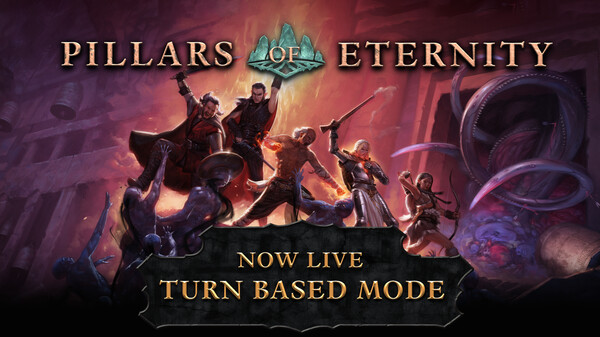
Choose to play with either real-time with pause or turn based mode. You can swap between the two freely during your adventure, giving you full control over every encounter.
Genres
Stats
All-time low is the lowest price we've recorded for this game since we started tracking it.
Languages: English*, French, Italian, German, Spanish - Spain, Russian, Polish*languages with full audio support
Updates
Build ids and update times come straight from Steam's PICS — the same source SteamDB reads. Patch history grows as we record new builds.
Engagement
Hours played at review time, across 613 reviews with recorded playtime.
Reviews
Themes across 606 recent reviews and how positive each mention is. A keyword signal, not full sentiment analysis.
positive critical· bar length = how often the theme comes up
Reviews
好
нравится
Peak
A meticulously hand-crafted CRPG piece that will be eternalized in the history of the genre. It stands out for all its strengths: deep lore, plot progression with many twists, a solid combat and RPG system, excellent quests based on a choice-driven narrative, and great level design. Rating: 5/5 Adra statues.
Eora is solidly in my top 3 fantasy settings now, right behind Rivellon (Divinity) and The Old Kingdom (Garth Nix books). I love the characters, the history, the things you uncover about the world through this game - it's all really well thought out and designed. I especially enjoyed the Endless Paths of Od Nua and the White March DLC. As an Aumauan monk I could've done without the fantasy racism but that seems to be baked in to the genre sadly. There are too many spells in my opinion, I tried my best to read through the cleric and druid spell lists but in the end I really only regularly cast about 1/8th of the spells I had access to. The other 7/8ths basically never got used at all. Visually this is very much a Unity game from a long time ago. It is frankly incredible that they pulled this off within the engine. I really appreciate this from a technical level, even if some of it doesn't hold up well in the modern era. The environments look really nice though, and I like the visual effects from the spells and loot. At the very least, from the perspective you usually play at, the mid-polygon models don't really affect anything. The music is nice, but overall sound design is a bit lacking. There are maybe one or two spellcast shouts, which you hear ALL THE TIME from different characters. I started my playthrough before the turn-based mode was added, and I figured I'd finish how I started on real-time with pause. I highly advise other players *not* to repeat this unless they explicitly enjoy RTWP. It made combat into an uncontrollable mess, as I'm really not the best at extreme micromanaging. I also set additional auto-pauses, like character damaged and attack ineffective. While I was often able to respond to heavy damage because of this, there were many more instances of an auto-pause firing, I set a response, unpause, auto-pause fires again, so I hit space twice to unpause the presumed auto-pause only to end up pausing my own unpause. Not the best. Turn based might be slower, but it is the more reasonable way to play.
finally getting around to this, big fun time enjoying it a lot
I still find the combat a bit too chaotic for my tastes but on normal difficulty it's not too bad. Great atmosphere, writing and world-building, and so far a really compelling story.
Pillars of Eternity I is built like a classical isometric RPG with a severe expression. It is obsessed with souls, memory, metaphysics, and inherited catastrophe. The Dyrwood feels wounded from the first hour. The Hollowborn crisis is not just a plot hook; it is social rot made visible. Babies are being born without souls, animancy is feared and politicized, and the whole region feels as though it is walking around with an untreated head wound. That atmosphere is one of the game’s great achievements. It has the old Infinity Engine DNA, but it is not merely nostalgic cosplay. It tries to build a whole metaphysical order and then ask what politics, religion, guilt, and identity would look like inside it. And Eora is a hell of a setting. Not because it is “epic fantasy” in the default sense, but because it is designed around a few unusually robust ideas. Souls are real. Reincarnation is real. The gods are real in their effects, but not simple in their origins. Animancy is both miracle and scandal. Once the game gets its hooks into those ideas, it can do things a lot of fantasy cannot. It can make theology investigable. It can make identity unstable. It can turn memory into evidence and curse alike. If you like your fantasy with philosophical teeth, this game will be like catnip to you. Its central narrative is also more coherent than Deadfire’s. You are chasing Thaos, but really you are chasing the architecture of deception itself. The revelation about the gods and the Engwithans is one of the great mic-drop moments in modern fantasy RPG writing, because it is not just a twist. It recontextualizes the moral shape of the world. The game earns that reveal by spending dozens of hours teaching you how much people need meaning, how badly power wants legitimacy, and how fragile truth becomes once it is embedded inside institutions. Obsidian was cooking with promethium there. The downside is that Pillars I can be hard to love at first. It front-loads lore like an overeager grad student who has trapped you in a hallway. There is a lot of terminology, a lot of soul-science, a lot of proper nouns, and the game occasionally mistakes density for seduction. Some players bounce off because the opening hours feel like being handed a textbook while someone whispers, “No no, keep going, it gets devastating.” They are not wrong. It does get devastating. But the onboarding is rough. Its combat, too, is good but not glorious. Real-time with pause works, and the underlying systems are thoughtful. One of Pillars’ best design ideas is making every attribute useful to every class in some way, which pushes back against the old dump-stat nonsense. But Pillars I can feel stiff. Builds are less expressive than in II. Some classes sing more than others. Encounter readability is not always ideal. It is a game you can respect before you fully enjoy. Where Pillars I really wins, besides atmosphere and plot cohesion, is moral seriousness. Not “grimdark,” not juvenile cruelty wearing a skull ring, but real seriousness. It keeps asking what people do when belief fails, when institutions rot, when the truth would destroy order, when suffering is inherited rather than chosen. The best companions are wrapped up in those questions. Durance is probably the standout not because he is likable, but because he is incandescently written. He is spite, faith, shame, and rationalization ground together until sparks come out. Aloth, Eder, Grieving Mother, and the others all fit into the game’s concern with fractured selves and uneasy memory. Even when the companion roster is uneven, it is thematically aligned.
fun
★ ★ ★ ★ ★
Related
Related
Trends
Modeled estimate over time, reconstructed from Steam's monthly review histogram.
Engagement
DAU/MAU are modeled from peak concurrent players (≈×8 and ×28) — Steam publishes no active-user counts, so treat these as rough estimates, not reported figures.
Audience
Audience
Estimated from the language of this game's reviews — a proxy for where players are, not official Steam demographics.
Games most often reviewed by the same players — an audience-affinity signal from our review sample, not full ownership data.
Related
| Starship Troopers: Extermination | $20.2M | 33.2K | 80% | $29.99 |
| The Outlast Trials | $20.3M | 108.6K | 93% | $39.99 |
| For The King | $20.1M | 43.6K | 88% | $19.99 |
| DYNASTY WARRIORS 8: Xtreme Legends Complete Edition | $20M | 14K | 84% | $49.99 |
| Sifu | $20.4M | 28K | 92% | $9.99 |
| Shadow Warrior 2 | $20M | 28.1K | 87% | $29.99 |