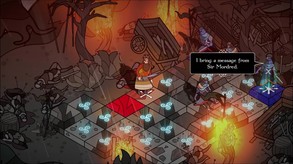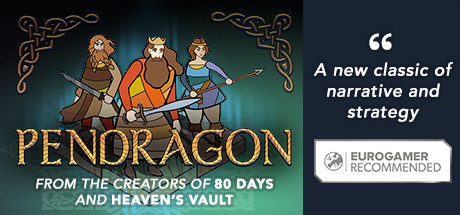
AD 673. Camelot has fallen. The Round Table must rally to save King Arthur. Narrative strategy game from the creators of 80 DAYS, with elegant tactics and a unique, dynamic story every time you replay.
Modeled estimate, not a reported figure. How we estimate →
Media

About


Stats
All-time low is the lowest price we've recorded for this game since we started tracking it.
Languages: English**languages with full audio support
Engagement
Hours played at review time, across 40 reviews with recorded playtime.
Reviews
Themes across 40 recent reviews and how positive each mention is. A keyword signal, not full sentiment analysis.
positive critical· bar length = how often the theme comes up
Reviews
Alright, so, if you like emergent narrative you're going to have a good time. If you like game mechanics, you are going to have a BAD TIME. Pendragon is very, very simple. Not simple but deep. Just simple. You move one square at a time, and you are able to spend an action to change directions between cardinal and diagonal. If an enemy is next to you and you can move into them, you kill them. And if there is an enemy next to them that can move into you, you die. Abilities do things like letting you move an additional square sometimes, and that's about it. They're almost all bad. You just have to twiddle back and forth waiting for the cpu to make a mistake. This runs out your real hp gauge, the morale bar, and if you get the wrong random encounters you're SOL. On the flipside, almost every encounter has some kind of narrative to it, and you can intuitively send it in different directions by making different movements based on cues in the narrative. That's cool. And there's a lot of stuff you can solve through dialog, and the writing throughout is sparse but uncommonly good. There isn't a TON of story variety, which makes sense because of how intricate and bug free everything is, but there's a bunch of unlockable characters and they all have different and interesting tragic flavors. I think if you look at Pendragon as sort of like the tactics version of a walking sim, you'll be in the right mindset for it. If you want roguelike arthurian tactics with a decent game length and solid mechanical depth, this is 10000% not that, and you will have an awful and frustrating time if you play it in that mindstate like I did. Ultimately, I think Pendragon is cool even if it drove me up a tree. The emergent narrative would probably be stronger in a single player experience (like Banner Saga), but I don't think the roguelike elements are *wrong*, or the core design is broken or anything. It could stand to be a little clearer that it's a story experience for story people only, and that if you have ever so much as enjoyed a mechanic you will hate it, but within that niche it's really solid and the art, writing, and moody horn music do make it a lovely experience.
I have always liked Inkle games for their story telling ( Socery and 80 days) and I expected a well told turn based story with this game, and if this is what you are expecting your going to be disapointed. I can't put my finger on what is off about this game, but if I was to try to identify what the most serious flaw is, it would be the story feels undeveloped, the fighting parts feel confusing with visual clues missing ( e.g some characters can attack diagonal and some can't, which ones can and can't are pure guess work) and the ending is just so dissapointing. It looks nice but feel more of an empty experience, did i dislike it , not really but did I like it , no not really , this game could of been much more but in the end it's just so average and unfinished.
There is not much game in this narrative adventure game. The combat consists of chess-like moves, you move into the square of an enemy, the enemy is defeated and vice versa. If so, I can read Thomas Malory instead. The redeeming features are the atmosphere and the style of the artwork.
Short, Should have Point n' Click or Visual Novel tag instead of Strategy. If You're looking for a turn based battling game this is not the game.
EUROGAMER Recommended, must be the same ones that voted for Brexit 3/10 tossed into the game with no idea how to play or what to do tutorials dont tell you much oops i miss clicked on a friendly guy and killed him, game didn't think it should ask me if i'm sure i want to do that like it does randomly +music I have the high ground and still lose I cant attack i can attack… i dont get this game at all… Game runs are really short Game wont let me click on anything anymore How do i get more food? Finished the game twice and i have no idea How long is a day?? Sometimes people 1 hit you for all your health, other times they dont… how i finished the game https://steamcommunity.com/sharedfiles/filedetails/?id=2909602030
It's a great game with an interesting concept. I do think it did not execute the concept very well. The game overall needs improvement. The morale system is unintuitive. It's a combat game but if you spend too long in combat you lose. Except sometimes there's way too many stalemates going back-and-forth with nothing happening. Sacrificing characters is encouraged by the developers in order to break stalemates, but there is nothing in the game that intuitively encourages that. You will always want to win the battle and not die. The concept of dialogue based on how you move the character is intriguing. But again, it's not very intuitive. I see Pendragon as a really good proof-of-concept. And I do have a lot of fun playing it. But don't expect a supreme masterpiece. If you are interested in hidden gems, then this is for you.
This is a creative storytelling device with some chess-like encounters. I enjoyed it as something different, but it's clearly not worth the $20 price tag by any stretch. A playthrough is completed in about 45 minutes and while there are separate paths that you can select, playing as different characters doesn't change much beyond the nature of the insults hurled about and unlocking new characters happens very frequently even without intending to do so. It's unique, but there isn't much meat here.
Pendragon, developed and published by inkle Ltd., is a strategy game that quietly reshapes expectations of what the genre can be, blending tactical decision-making with a deeply reactive narrative structure. Set during the final, fractured days of Arthurian legend, it doesn’t retell the familiar myth in a straightforward way. Instead, it fragments the story into multiple perspectives, placing the player in the role of different characters whose journeys intersect as they move toward the inevitable confrontation at Camlann. The result is a game that feels less like a single campaign and more like a tapestry of overlapping stories, each shaped by the player’s actions. The tactical layer is built on a grid-based system, but it deliberately avoids complexity in favor of clarity and immediacy. Units move in fixed patterns—some along straight lines, others diagonally—and combat is resolved quickly, often in a single decisive exchange. This gives encounters a sharp, almost board game-like quality where positioning matters more than micromanagement. There is very little room for error, and even a small miscalculation can result in the loss of a character. However, rather than punishing the player in a traditional sense, these outcomes feed directly into the narrative, turning defeat into a meaningful part of the story rather than a simple failure state. What makes Pendragon stand out is how seamlessly it merges these tactical decisions with storytelling. Every action on the battlefield—whether it’s sacrificing a unit to protect another, retreating from an unwinnable fight, or pressing forward at great risk—has narrative consequences. Characters react to events, relationships shift, and new paths open or close depending on what happens during play. Dialogue is woven into the experience in a way that feels natural rather than intrusive, often appearing between or even during encounters, reinforcing the idea that the story is unfolding in real time alongside the gameplay. The structure of the game follows a roguelike format, with each run representing a different attempt to reach the final battle. These runs are relatively short, encouraging experimentation and making it easy to explore different choices and outcomes. Progression comes not from grinding or accumulating resources, but from uncovering new storylines, characters, and abilities. Each playthrough adds context to the larger narrative, gradually building a broader understanding of the world and its inhabitants. This approach makes repetition feel purposeful, as even unsuccessful runs contribute to the overall experience. The writing is one of the game’s strongest elements, showcasing inkle’s expertise in interactive storytelling. Characters are distinct and often complex, with motivations and personalities that evolve based on player decisions. The game takes creative liberties with Arthurian mythology, reinterpreting familiar figures in ways that feel fresh while still grounded in the themes of loyalty, betrayal, and fate. Conversations are concise but impactful, and the branching nature of the narrative ensures that no two playthroughs feel exactly the same. Visually, Pendragon adopts a striking art style inspired by medieval stained glass, giving the game a unique and cohesive identity. Characters are stylized yet expressive, and the environments, though minimal, effectively support the tone of the story. The presentation emphasizes clarity, ensuring that important information is easy to read during combat, while still maintaining a strong aesthetic presence. The audio design is understated, providing atmosphere without overshadowing the dialogue and gameplay. Despite its strengths, the game’s simplicity can also be a limitation. The tactical system, while elegant, may feel too light for players seeking deeper mechanical complexity. Its focus on narrative means that combat serves more as a vehicle for storytelling than as a fully developed system in its own right. Additionally, the game does not always clearly explain how certain mechanics or narrative triggers work, which can lead to moments of confusion, particularly for players trying to understand the consequences of their choices. The variability inherent in its roguelike structure also leads to some inconsistency. Not every run carries the same emotional weight, and some storylines are more engaging than others. The randomness of events can occasionally result in pacing that feels uneven, with certain playthroughs offering richer experiences than others. However, this unpredictability is also part of the game’s appeal, reinforcing the idea that each journey is unique. Ultimately, Pendragon succeeds by committing fully to its vision. It does not try to compete with traditional strategy games on complexity, nor does it rely solely on narrative to carry the experience. Instead, it finds a balance between the two, creating a system where gameplay and story are inseparable. It turns tactical decisions into narrative moments and treats every outcome as part of a larger, evolving tale. In the end, Pendragon stands as a thoughtful and innovative interpretation of both the strategy and roguelike genres. It offers a distinctive experience that prioritizes character, choice, and consequence, delivering a game that feels as much like an interactive storybook as it does a tactical challenge. For players willing to embrace its approach, it provides a memorable and rewarding journey through a reimagined legend. Rating: 7/10
I really love this game. It's difficult enough to feel challenging, but I feel like the story and particularly the characters, are the main part of the game. So many characters stories are told and character interaction is really well done. It really forces you to slow down and can be really relaxing to play. The fireside stories can be hilarious and add depth to the characters and story. It's replayable. The quest is the same each time but many things change between playthroughs which makes for an interesting experience. Choice of characters changes. Skills you are offered varies with the story choices and people you meet. Maps change so you don't get the same character interaction or challenges over and over. The difficulty can be increased with successive playthroughs making it perfect for people with varying skill at turn based strategy. The whole thing is crafted in a really interesting and immersive way.
As much as I would love to recommend the game, I cannot. I remember playing it at the lowest difficulty. The story ws nice, the presentation engaging... And then it was over. I came to rescue Arthur, barely a scratch to my name, and- Wow, Mordred is dead already. What a dunce. Then the difficulty is increased for unlocking purposes, and suddenly the enemies always put themselves perfectly to counter your classic strategies. You barely scramble by with your okay abilities you got given by the game, and suddenly Mordred, on the third easiest difficulty, is a complete menace, avoiding you with all his might and gaining power like he spends a month in a gym between each turn. Your cool ability is unable to surpass him and you die. And now you have to trod through the less and less engaging interactions yet a-pecking-gain. That was when I dropped the game. It hooked me in, but provided little sustenance.
Related
Related
Trends
Modeled estimate over time, reconstructed from Steam's monthly review histogram.
Momentum
Pace estimated from the game's recent review growth (our daily snapshots) at its own sales-per-review ratio — a momentum signal, not booked sales.
Audience
Estimated from the language of this game's reviews — a proxy for where players are, not official Steam demographics.
Related
| Feed the Reactor | $47.8K | 565 | 82% | $2.44 |
| FREE DUROV | $47.8K | 385 | 90% | $3.99 |
| Rocket Bot Royale | $47.8K | 781 | 86% | $2.99 |
| Survivor Girls Sanctuary | $47.8K | 186 | 65% | $9.99 |
| Don't Sink | $47.8K | 213 | 73% | $9.99 |
| DAMON and BABY | $47.8K | 93 | 89% | $19.99 |